

Recommended Blogs

Blog
Data Mesh vs Data Fabric: Which Architecture Fits Your Enterprise Data Strategy?

 Last Updated: June 8th, 2026
 Read Time: 5 minutes
Table of Content
- Why Enterprise Data Architecture Needs a Clearer Decision Model
- Data Mesh vs Data Fabric: What Each Architecture Actually Solves
- When to Use Data Mesh vs Data Fabric in Enterprise Strategy
- The Enterprise Trade-Offs: Governance, Ownership, Cost, Scale, and AI Readiness
- How TxMinds Helps Enterprises Build Trusted, AI-Ready Data Architectures
Share On


Enterprise data architecture is no longer a quiet platform decision. It now shapes how quickly leaders trust reports, scale AI, govern risk, and respond to business change.
That is why the debate around data mesh vs data fabric enterprise architecture deserves sharper thinking. Both promise better data access, but they solve different problems. One changes ownership. The other strengthens integration and metadata intelligence.
For CIOs, CDOs, and data leaders, the question is not which model sounds more modern. The question is which architecture fits your enterprise reality today.
This blog gives you a practical decision lens. You will see where data mesh fits, where data fabric fits, and when a hybrid model becomes the stronger path.
Key Takeaways
- Data mesh solves ownership and accountability challenges by moving data responsibility closer to business domains.
- Data fabric solves integration and governance challenges through metadata automation and unified access.
- Many enterprises need a hybrid model, not a pure data mesh or pure data fabric approach.
- The right architecture depends on data maturity, operating model readiness, governance needs, and AI goals.
Why Enterprise Data Architecture Needs a Clearer Decision Model
Many enterprises already have data warehouses, data lakes, lakehouses, catalogs, pipelines, and governance tools. Yet business teams still struggle to find trusted data quickly. The issue is rarely storage alone. It is ownership, context, governance, integration, and accountability across distributed systems.
The old model creates familiar friction
Centralized data teams helped enterprises create control and reporting consistency. Over time, that same model often created delays. Business domains waited for central teams to interpret local data. Data engineers became translators, pipeline owners, quality reviewers, and support teams.
That operating model becomes harder when data is spread across cloud, SaaS, legacy platforms, and partner ecosystems.
AI raises the cost of weak architecture
AI initiatives expose every weakness in enterprise data strategy. Poor lineage, unclear definitions, duplicated records, and missing metadata all reduce trust.
IBM notes that data silos can weaken data sharing, data quality, and AI initiatives. This is why enterprise data strategy decentralized architecture is gaining attention. Leaders want speed and ownership, but they cannot lose governance.
Data Mesh vs Data Fabric: What Each Architecture Actually Solves
Data mesh and data fabric are modern responses to enterprise data bottlenecks, but they solve different problems. Data mesh is an organizational and cultural shift that improves scale through decentralized ownership. Data fabric is a technology-centric architecture that improves integration, access, and governance through automation.
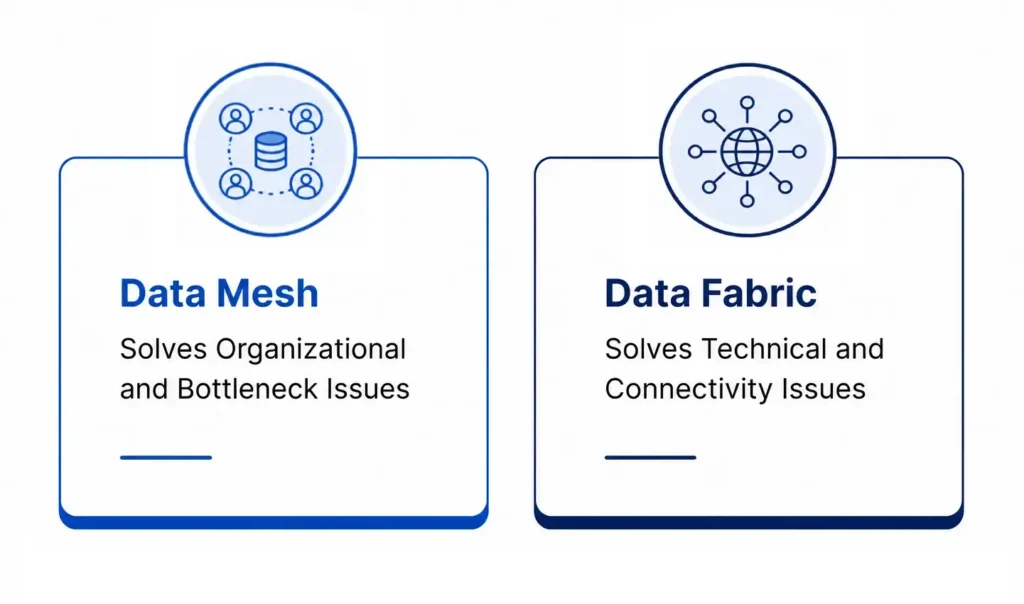
Data Mesh: Solves Organizational and Bottleneck Issues
A data mesh decentralizes responsibility by moving data ownership closer to business domains.
- The core problem solved: Central data engineering teams often become bottlenecks in large enterprises. They lack the domain context that business units hold. A data mesh solves this by allowing individual domains, such as finance, sales, claims, or operations, to own, manage, and publish their data assets.
- How it works: Business domains package and serve their data as products. These data products should be discoverable, secure, documented, reusable, and useful for other teams across the company.
- Best used when: Your organization faces scaling hurdles, cross-team silos, or constant delays because one central data team must serve every request.
Data Fabric: Solves Technical and Connectivity Issues
A data fabric unifies fragmented systems and automates data management, governance, and access.
- The core problem solved: In multi-cloud and hybrid environments, data is scattered across platforms and governed inconsistently. A data fabric solves this by using metadata, AI, knowledge graphs, and automation to create a unified orchestration layer.
- How it works: Instead of physically moving all enterprise data into one place, a data fabric acts as connective tissue. It automates discovery, integration, access control, and security across distributed sources in near real time.
- Best used when: Your primary challenge is linking fragmented data, enforcing compliance across multiple environments, and enabling fast, reliable access across tools and teams.
Data Mesh vs. Data Fabric
| Feature | Data Mesh | Data Fabric |
|---|---|---|
| Primary focus | People and organizational processes | Technology and automated connectivity |
| Ownership | Decentralized, with business domains owning their data | Centralized or unified through an automated layer managing data access |
| Problem it fixes | Central team bottlenecks and lack of domain context | Data silos, poor connectivity, and inconsistent governance |
| Key approach | Data as a product | Metadata-driven automation |
Although often framed as competitors, these two approaches are frequently complementary. Many modern enterprises use a hybrid model where data mesh gives domain teams autonomy over data products, while data fabric provides the technical backbone required to discover, govern, and harmonize data across the enterprise.
When to Use Data Mesh vs Data Fabric in Enterprise Strategy
Data mesh and data fabric are often complementary. In enterprise strategy, choose data mesh to solve organizational bottlenecks by decentralizing ownership to business units. Choose data fabric to solve technical integration challenges by automating data pipelining, governance, and unified access across distributed systems.
When to Use Data Mesh
Data mesh is fundamentally an organizational and cultural strategy. Use it when your primary challenges are scaling teams, breaking data silos, and driving business accountability.
- Decentralized operations: You have diverse business units, such as finance, claims, underwriting, sales, or supply chain, that hold specialized knowledge of their data.
- Business unit autonomy: Individual departments need freedom to build, manage, and share their own data products without waiting on one central IT bottleneck.
- Product-minded governance: You want to treat data as a business asset that is discoverable, secure, documented, reusable, and useful to the rest of the organization.
- Target outcome: Higher team agility, clearer domain accountability, stronger data ownership, and faster business-led innovation.
When to Use Data Fabric
Data fabric is fundamentally a technological and integration strategy. Use it when your primary challenge involves complex technical environments, varied cloud and legacy storage, and the need for governed access.
- Siloed technology ecosystems: Your data is scattered across on-premises servers, multi-cloud environments, SaaS platforms, warehouses, and third-party applications.
- Unified governance and security: You need an automated way to track metadata, apply access rules, enforce compliance, and control data permissions across systems.
- Automation-driven operations: You need AI-augmented tools, metadata intelligence, and knowledge graphs to automate ingestion, preparation, integration, and governance workflows.
- Target outcome: Better interoperability, faster automation, stronger governance, and a unified virtual view of distributed enterprise data.
The Best of Both Worlds: The Hybrid Approach
Many enterprises do not choose only one strategy. They combine both because each one addresses a different side of the data operating model.
In a hybrid data mesh–data fabric architecture, data mesh represents the who and the why. It defines ownership, domain accountability, and business value. Data fabric represents the what and the how. It provides the automated platform used to connect, govern, manage, and share distributed data products.
The Enterprise Trade-Offs: Governance, Ownership, Cost, Scale, and AI Readiness
Architecture choices create operating consequences. Leaders should evaluate trade-offs before funding another platform program.

Governance and accountability
Data mesh needs a federated data governance model where central standards guide domain teams. It works only when domains accept real ownership. Data fabric strengthens governance through metadata automation, policy enforcement, lineage, and access control across distributed systems.
Ownership and adoption
Data mesh changes who owns data. That can improve trust, but it also requires strong data product management and enterprise discipline. Data fabric usually creates less organizational disruption. It improves access and control while existing teams keep familiar operating models.
Cost, scale, and AI readiness
Data mesh can reduce central bottlenecks, but it needs skills, tooling, and governance discipline across domains. Data fabric can reduce integration effort, but it depends on metadata maturity and strong platform design.
For data architecture modernization in multi-cloud enterprise environments, many leaders combine both. Data mesh adds business context, while data fabric improves discoverability, lineage, governance, and AI readiness.
How TxMinds Helps Enterprises Build Trusted, AI-Ready Data Architectures
At TxMinds, we help enterprises move from fragmented data ecosystems to trusted, governed, and AI-ready foundations. We do not begin with a tool preference. We begin by assessing data maturity, platform complexity, governance readiness, and business priorities. Our teams help leaders evaluate data mesh vs data fabric enterprise architecture through a practical enterprise lens, including ownership models, metadata maturity, integration needs, cloud strategy, AI readiness, and operating risk.
We support data platform modernization, governance design, data engineering, cloud integration, quality assurance, and scalable platform execution. We also help enterprises define whether data mesh, data fabric, or a hybrid architecture fits their next stage. For some organizations, the priority is domain ownership. For others, metadata automation and integration must come first. TxMinds helps enterprises build the roadmap, architecture, and delivery discipline needed to make that choice work.
VP and Global Head Data & AI Practice
Results-oriented Data Analytics & AI Specialist with 24+ years of experience in multiple roles, including Practice Leader with P&L ownership. Expert in building Data Analytics practices, defining market strategies, and leading large-scale transformation initiatives. Skilled in Business Intelligence, Data Engineering, Cloud platforms (Azure, AWS, GCP), AI/ML, and Data Governance, with a strong focus on customer-centric solutions and strategic alliances.
FAQs
What is the main difference between data mesh and data fabric?
The main difference is focus. Data mesh is an operating model based on domain-oriented data ownership, while data fabric is a metadata-driven data integration platform that connects and governs data across distributed systems.
When should an enterprise use data mesh vs data fabric?
Use data mesh when business domains are ready to own and manage data products. Use data fabric when the priority is metadata automation, unified access, lineage, and governance across hybrid or multi-cloud data environments.
Can data mesh and data fabric work together?
Yes. A hybrid data mesh data fabric architecture can combine domain ownership with automated integration. Data mesh defines who owns data products, while data fabric helps discover, connect, govern, and manage those products across the enterprise.
How does data mesh vs data fabric support enterprise data strategy?
Both support enterprise data strategy in different ways. Data mesh improves accountability and business context through decentralized architecture, while data fabric improves governance, metadata automation, and trusted access across complex enterprise systems.
Discover more