


Recommended Blogs

Blog
How MLOps Analytics Helps Enterprises Control AI Accuracy After Deployment
Table of Content
- How MLOps Analytics Helps Control Model Accuracy After Launch
- MLOps Analytics for Analytics Teams: From Model Launch to Model Reliability
- Building an Enterprise MLOps Pipeline for Continuous Model Control
- MLOps Analytics as a Strategic Capability for AI Trust and Scale
- How TxMinds Helps Enterprises Build Production-Ready MLOps Analytics
Share On


A machine learning model does not stay accurate just because it was deployed successfully. Business data changes. Customer behavior changes. Market conditions change. When that happens, model performance can slowly drop without teams noticing it early.
For C-level technology leaders, this creates a real problem. Decisions based on outdated or drifting models can affect pricing, forecasting, risk scoring, customer experience, and operational planning.
This is why MLOps analytics matters. It helps teams track model performance after deployment, detect issues early, and decide when a model needs review or retraining. With the right MLOps operating model, analytics teams can manage model monitoring, drift detection, workflow automation, and retraining in a more controlled way.
This blog explains how MLOps Analytics helps enterprises control AI accuracy after deployment by monitoring model behavior, detecting drift, triggering review workflows, and supporting evidence-based retraining decisions.
Key Takeaways
- AI accuracy can weaken after deployment as data, customer behavior, systems, and business rules change.
- McKinsey’s 2026 AI Trust Maturity Survey found that 74% of respondents identify inaccuracy as a highly relevant AI risk, making oversight a leadership priority.
- MLOps Analytics helps teams manage ML model monitoring, model drift detection, workflow automation, and retraining in one controlled lifecycle.
- Strong MLOps for analytics teams turns model deployment into ongoing reliability, with clearer ownership, better governance, and stronger control over AI accuracy after deployment.
How MLOps Analytics Helps Control Model Accuracy After Launch
A model can perform well in testing and still weaken in production. The reason is simple. Business conditions change faster than most models can adjust. McKinsey’s 2026 AI Trust Maturity Survey found that 74% of respondents identify inaccuracy as a highly relevant AI risk as adoption expands. That makes accuracy loss a leadership concern, not only an analytics issue.
This is where MLOps analytics becomes useful. It gives teams a controlled way to track performance, detect drift, and respond before decisions suffer. Without proper ML model monitoring, enterprises may keep using outdated predictions. With strong model drift detection, analytics teams can see when production data no longer matches the model’s original assumptions.
MLOps Analytics for Analytics Teams: From Model Launch to Model Reliability
MLOps Analytics helps analytics teams manage model accuracy after deployment. It connects model performance, data behavior, monitoring workflows, and business outcomes so teams can see when a model needs review, retraining, or replacement. For enterprise teams, this means model ownership does not end when the model goes live. It continues through ML model monitoring, model drift detection, review, retraining, and controlled updates.
For analytics teams, this operating model usually includes:
- Clear ownership for every production model
- Baseline performance tracking after deployment
- Data quality checks across active pipelines
- Continuous model drift detection
- Automated alerts through MLOps workflow automation
- Version control for data, code, and model changes
- A documented ML retraining strategy
- Controlled releases based on machine learning deployment best practices
This is why MLOps for analytics teams matters. It gives teams a repeatable way to keep models reliable after launch. With the right MLOps pipeline enterprise approach, leaders can reduce hidden accuracy risks and build more trust in AI-driven decisions.
Building an Enterprise MLOps Pipeline for Continuous Model Control
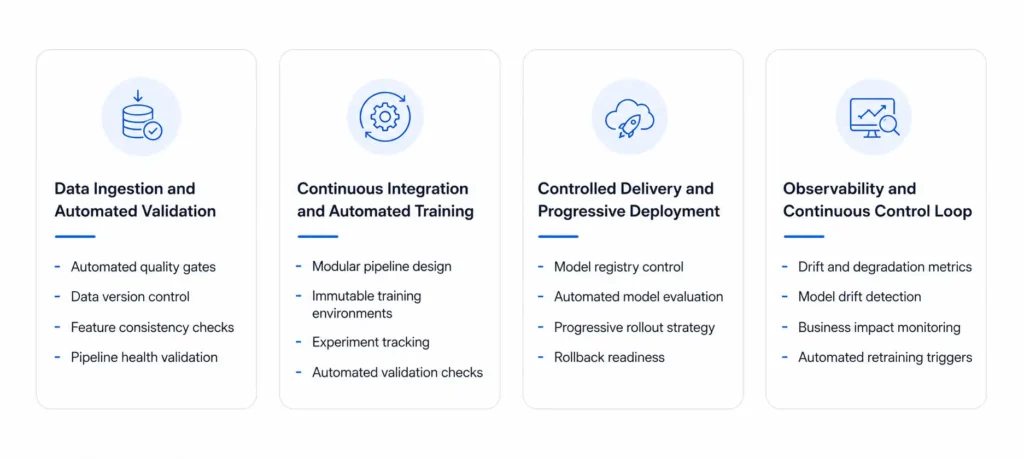
An enterprise MLOps pipeline should treat model accuracy as a managed lifecycle. The goal is not only to deploy models faster. It is to keep them accurate, traceable, and useful after deployment.
Strong MLOps Analytics connects data validation, training, release control, monitoring, and retraining into one operating model. This gives analytics teams a controlled way to manage models as they move through live business environments.
-
Data Ingestion and Automated Validation
Data changes are a leading cause of silent model failure. Analytics teams should validate data before it reaches production models.
- Automated quality gates
Check schema, missing values, formats, ranges, and duplicate records before model scoring begins. - Data version control
Track datasets used for training, validation, testing, and production comparison. - Feature consistency checks
Ensure offline training features match online inference features across active pipelines. - Pipeline health validation
Confirm source freshness, transformation logic, and delivery timing before predictions are generated.
- Automated quality gates
-
Continuous Integration and Automated Training
A strong MLOps workflow automation setup makes training repeatable across teams. It should reduce manual handoffs without removing human review.
- Modular pipeline design
Convert notebooks and experiments into reusable components for production-grade execution. - Immutable training environments
Package dependencies, configuration, and runtime settings for consistent model training. - Experiment tracking
Record parameters, metrics, datasets, code versions, and model outputs for review. - Automated validation checks
Test every candidate model against accuracy, stability, fairness, and business thresholds.
- Modular pipeline design
-
Controlled Delivery and Progressive Deployment
Never move a newly trained model directly into production. Controlled release is one of the core machine learning deployment best practices.
- Model registry control
Treat the registry as the approval layer for staging, testing, and production releases. - Automated model evaluation
Compare candidate models against the current production model before any release. - Progressive rollout strategy
Release models gradually to limited users, regions, segments, or workloads first. - Rollback readiness
Keep approved previous versions available when production behavior becomes unstable.
- Model registry control
-
Observability and Continuous Control Loop
Traditional system monitoring does not show when a model is becoming less accurate. ML model monitoring must track technical signals and business signals together.
- Drift and degradation metrics
Monitor input changes, prediction shifts, confidence movement, and outcome decay. - Model drift detection
Detect when production data no longer reflects the model’s training assumptions. - Business impact monitoring
Connect model performance to KPIs such as conversion, risk, cost, and forecast quality. - Automated retraining triggers
Start review or retraining workflows when drift crosses approved thresholds.
- Drift and degradation metrics
Not every drift signal should trigger automatic retraining. Some signals require investigation, threshold adjustment, data correction, or business review before a model is changed. Retraining should follow evidence from drift, business impact, and validation results. This is how model drift detection deployment becomes useful in daily operations. It helps analytics teams act before weak model performance becomes a business problem.
MLOps Analytics as a Strategic Capability for AI Trust and Scale
MLOps Analytics gives enterprises a structured way to keep machine learning reliable after deployment. It helps analytics teams track model behavior, detect performance gaps, and connect technical signals with business outcomes. For C-level leaders, this creates better control over AI systems that influence decisions across pricing, forecasting, risk, operations, and customer experience.
Key Pillars of MLOps Analytics
- Model observability and drift detection: Continuous ML model monitoring helps teams track how models perform against live data. Strong model drift detection shows when predictions begin moving away from expected behavior.
- Operational efficiency and system control: A mature MLOps pipeline enterprise model reduces manual checks, repeated reviews, and delayed responses. This helps analytics teams manage larger model portfolios without increasing operational friction.
- Governance and audit readiness: Production models need traceability across data, code, versions, decisions, and approvals. This supports accountability when AI outputs affect regulated or business-critical workflows.
- Explainability and business metrics: Leaders need to understand whether a model is still supporting business goals. MLOps connects accuracy, confidence, drift, and outcome metrics in a way non-technical stakeholders can use.
Driving Trust and Scale
- Trust through continuous evaluation: MLOps for analytics teams creates a repeatable process for reviewing model performance. This helps teams catch weak signals before they become decision failures.
- Scale through workflow automation: MLOps workflow automation supports testing, release checks, monitoring alerts, and retraining workflows. This makes scaling more manageable as enterprise AI adoption grows.
- Control through retraining strategy: A strong ML retraining strategy defines when models need review, retraining, or replacement. It should follow evidence from drift, performance decay, and business impact.
- Reliability through deployment discipline: Machine learning deployment best practices help teams release models with validation, approval, monitoring, and rollback controls. This reduces risk when models move into production.
For enterprise leaders, the value of MLOps Analytics is practical. It gives analytics teams a way to manage AI accuracy, trust, and scale after deployment. With model drift detection deployment built into daily operations, models become easier to monitor, govern, and improve over time.
How TxMinds Helps Enterprises Build Production-Ready MLOps Analytics
At TxMinds, we build AI and ML solutions around enterprise outcomes, not isolated experiments. Our AI development approach covers advisory, model development, AI model testing, Quality Engineering, and MLOps lifecycle management.
We help enterprises keep AI models compliant, accurate, and production-ready through scalable pipelines, integration practices, monitoring controls, and retraining workflows. This supports stronger model oversight and more reliable AI decision-making after deployment.
We also bring a broader delivery view across data maturity assessment, use-case planning, responsible AI, and end-to-end ownership. For leaders building an enterprise MLOps pipeline, TxMinds helps connect accuracy, governance, automation, and business value into a controlled AI operating framework.

Rajiv Diwan
VP and Global Head Data & AI Practice
Results-oriented Data Analytics & AI Specialist with 24+ years of experience in multiple roles, including Practice Leader with P&L ownership. Expert in building Data Analytics practices, defining market strategies, and leading large-scale transformation initiatives. Skilled in Business Intelligence, Data Engineering, Cloud platforms (Azure, AWS, GCP), AI/ML, and Data Governance, with a strong focus on customer-centric solutions and strategic alliances.
FAQs
Why is MLOps for analytics teams important?
MLOps for analytics teams is important because model work does not end after deployment. Analytics teams need a clear process for ML model monitoring, model ownership, drift detection, performance review, and controlled model updates.
How does model drift detection help after deployment?
Model drift detection helps teams identify when production data no longer matches the data used to train the model. With proper model drift detection deployment, teams can catch accuracy issues early and take action before business decisions are affected.
What should an enterprise MLOps pipeline include?
An MLOps pipeline enterprise setup should include data validation, version control, automated testing, model registry, deployment approvals, MLOps workflow automation, monitoring, and a clear ML retraining strategy based on performance and drift signals.
Discover more