

Recommended Blogs

Blog
The Executive Guide to Evaluating Data Architecture for 2026 Growth and Operational Resilience

 Last Updated: June 9th, 2026
 Read Time: 5 minutes
Table of Content
- Turning Enterprise Data Architecture into a Strategic Growth Enabler
- Identifying Red Flags in Your Current Data Architecture
- Five Pillars to Evaluate for Scalable, Trusted, and AI-Ready Data Architecture
- Executive Frameworks for Rapid, Practical, and Boardroom-Ready Data Architecture Assessment
- How TxMinds Enables Scalable, Trusted, and AI-Ready Data Architecture for Growth
Share On


Most 2026 growth plans assume that data will be available, reliable, and ready when the business needs it. That assumption often breaks under pressure.
Many enterprises still run on data architectures built for reporting, not for faster decisions, AI use cases, operational visibility, or business expansion. The issue is not only technology. It affects how quickly leaders can trust information, act on market changes, and scale without creating new risk.
This guide explains how C-level technology leaders can evaluate enterprise data architecture against 2026 growth goals. It focuses on scalability, data quality, AI readiness, governance, and resilience. The aim is to help leaders identify where the current architecture supports growth, where it creates drag, and where modernization should be prioritized.
Key Takeaways
- Data architecture is a strategic enabler for growth, influencing speed, trust, and operational resilience.
- Red flags such as fragmented governance, manual processes, and bottlenecks signal risks to scaling and analytics.
- Evaluating architecture across scalability, data quality, AI readiness, governance, and resilience provides a clear picture of readiness.
- A practical, executive-focused assessment framework allows leaders to prioritize investments and align architecture with 2026 growth goals.
Turning Enterprise Data Architecture into a Strategic Growth Enabler
Enterprise data architecture is not an IT artifact. It’s the foundation for analytics, automation, and AI‑infused processes that create competitive differentiation. In practice, it shapes how quickly business units can consume data, how reliably decisions can be made, and how effectively new revenue streams can be developed.
From our engagements, teams with modular, scalable data architecture unlock value faster. They avoid brittle pipelines that collapse when new use cases emerge. They enable analytics teams to experiment without breaking production systems. And they reduce friction between operations, engineering, and business stakeholders.
A robust architecture accelerates time to value and gives you the confidence to invest boldly. When leaders think of data architecture as a strategic enabler rather than a technical cost center, they create an environment where growth isn’t constrained by legacy debt.
Identifying Red Flags in Your Current Data Architecture
Weak data architecture rarely fails all at once. It usually shows up as slower delivery, inconsistent reporting, rising support effort, and growing dependence on a few key people. These signals matter because they reveal where your data foundation may struggle under 2026 growth demands.
Architecture and Integration Bottlenecks
A growth-ready data architecture should support speed without creating instability. When every data request needs manual intervention, the architecture is already limiting the business.
- Shadow reporting outside governed systems: Business teams export data into spreadsheets or local tools because official pipelines are too slow.
- Slow-release cycles for data changes: New dashboards, pipelines, or reports take weeks because systems are tightly coupled.
- Limited ability to scale workloads: Data platforms slow down during peak reporting, analytics, or operational demand.
- High dependency on specific individuals: Only a few engineers understand critical pipelines, models, or data flows.
Data Quality and Trust Gaps
Growth depends on trusted data. When leaders cannot rely on consistent numbers, decision speed drops and confidence weakens.
- Multiple versions of the same metric: Sales, finance, and operations report different numbers for the same business measure.
- Manual reconciliation becomes routine: Teams spend more time validating data than using it for decisions.
- Unclear data ownership: No single team is accountable for definitions, quality, lineage, or issue resolution.
- Data is stored without business context: Large volumes of information exist, but teams cannot explain its purpose or reliability.
People and Process Friction
Architecture problems often appear as people problems first. Slow onboarding, repeated rework, and fragile processes usually point to deeper structural issues.
- New team members take too long to contribute: Documentation is weak, data models are unclear, and system knowledge is scattered.
- Testing depends on manual checks: Teams rely on human review because automated validation is limited or unreliable.
- Business attributes disappear in reporting: Key CRM, ERP, or operational fields fail to flow into analytics correctly.
- Support teams handle repeated data issues: The same defects return because root causes are not addressed in the architecture.
When these patterns become normal, scalable data systems become difficult to sustain. The enterprise may still operate, but growth becomes harder, slower, and riskier.
Five Pillars to Evaluate for Scalable, Trusted, and AI-Ready Data Architecture
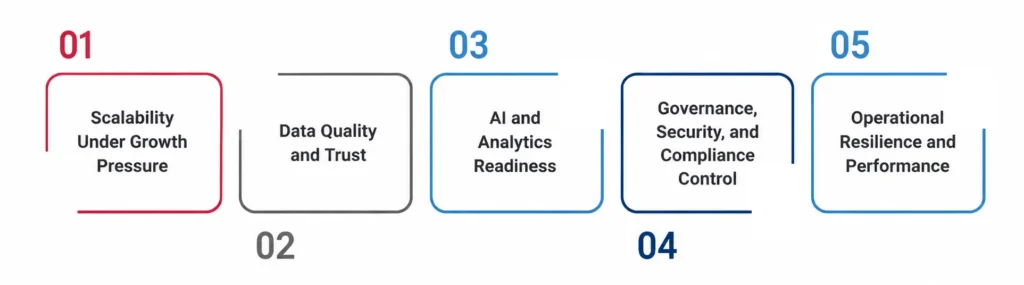
A data architecture assessment should move beyond a platform review. Leaders need to understand whether the architecture can support growth, protect trust, enable AI, and maintain performance under pressure. For 2026 planning, five areas deserve focused evaluation.
-
Scalability Under Growth Pressure
- Scale compute and storage independently when workloads increase.
- Support high-concurrency access across reporting, analytics, and operational teams.
- Handle structured and unstructured data without forcing major redesign.
- Absorb new data sources quickly as products, regions, and business units expand.
A scalable data system should grow with business demand. It should not require major rework every time the enterprise adds a new market, product, or analytics use case.
-
Data Quality and Trust
- Accuracy and consistency across business units, dashboards, and source systems.
- Data freshness so teams know whether insights reflect current conditions.
- Schema and pipeline changes before they disrupt downstream reporting.
- Lineage and traceability from source systems to business-facing reports.
Strong data quality creates confidence. It also reduces reconciliation work, reporting disputes, and delays in executive decision-making.
-
AI and Analytics Readiness
- Real-time and near-real-time data movement where the business requires faster action.
- Clean and well-labeled data assets for analytics and AI models.
- Integration with model pipelines for development, testing, deployment, and monitoring.
- Flexible access to governed data for data science, analytics, and business teams.
AI readiness is not about adding a model on top of weak data. It requires an architecture that delivers usable, trusted, and contextual data at the right time.
-
Governance, Security, and Compliance Control
- Role-based and attribute-based access controls across users and systems.
- Encryption for data at rest and in motion across the full data lifecycle.
- Clear ownership for critical data domains such as customer, finance, product, and risk.
- Metadata management so teams can find, understand, and use data responsibly.
- Regulatory alignment for privacy, retention, auditability, and regional compliance needs.
Good governance protects speed and control at the same time. It gives business users access without allowing unmanaged data exposure.
-
Operational Resilience and Performance
- Low-latency performance for business-critical reporting and analytics.
- Cost visibility across storage, compute, queries, and data movement.
- Reliable integration patterns between source systems, data platforms, and applications.
- Recovery and continuity controls for failures, outages, and data pipeline disruptions.
- Monitoring and alerting for performance degradation before users are affected.
A resilient architecture does not only recover from failure. It gives teams early warning, predictable performance, and enough control to protect business continuity.
Executive Frameworks for Rapid, Practical, and Boardroom-Ready Data Architecture Assessment
A strong data architecture assessment should give leaders a clear view of risk, readiness, and investment priority. It should not become a technical inventory that only engineering teams can interpret.
-
Phase 1: Assess the Current State
Begin by evaluating the current data ecosystem to understand pipeline reliability, governance coverage, and operational performance. Focus on how data moves, who manages it, and where bottlenecks occur. This phase helps executives see which parts of the architecture are stable, which create friction, and where immediate attention is required.
-
Phase 2: Define Boardroom-Ready Metrics
Translate technical performance into metrics that matter to business leaders. Measure data trust, time to deliver insights, system reliability, and operational risk. By presenting metrics in a business context, executives can quickly prioritize investments, monitor progress, and connect architecture decisions to measurable outcomes.
-
Phase 3: Map Capability Gaps and Business Risk
Compare current capabilities against growth and operational goals for 2026. Identify gaps that could affect revenue, compliance, AI readiness, or scalability. This phase produces a risk map that highlights high-impact issues versus minor technical debt, enabling focused planning and resource allocation.
-
Phase 4: Build a Prioritized Modernization Roadmap
Create a phased plan that balances quick wins with long-term improvements. Address urgent data quality and access issues first, then strengthen governance, observability, and AI readiness. Longer-term initiatives optimize platforms and pipelines to ensure the architecture scales reliably with business growth.
How TxMinds Enables Scalable, Trusted, and AI-Ready Data Architecture for Growth
At TxMinds, we treat data architecture as a business enabler rather than just a technical task. We help organizations gain a clear picture of their data estate, identify risks, and prioritize improvements that align with growth and operational goals.
Our expertise combines domain knowledge with engineering rigor. We build scalable platforms with embedded governance, quality controls, and AI readiness, ensuring data is reliable and actionable across hybrid and enterprise environments.
The result is an architecture that delivers faster insights, consistent data trust, and flexibility to support evolving business needs. Leaders gain confidence in their data foundation and can scale analytics, AI, and operations with measurable impact.
VP and Global Head Data & AI Practice
Results-oriented Data Analytics & AI Specialist with 24+ years of experience in multiple roles, including Practice Leader with P&L ownership. Expert in building Data Analytics practices, defining market strategies, and leading large-scale transformation initiatives. Skilled in Business Intelligence, Data Engineering, Cloud platforms (Azure, AWS, GCP), AI/ML, and Data Governance, with a strong focus on customer-centric solutions and strategic alliances.
FAQs
What is enterprise data architecture assessment, and why is it critical for 2026 growth?
Enterprise data architecture assessment evaluates how well your data systems support scalability, analytics, AI, and operational goals. It ensures data pipelines, governance, and infrastructure can handle projected workloads and decision-making needs.
How can I identify if my current data architecture is holding back business growth?
Look for signs such as fragmented governance, slow data pipelines, inconsistent reporting, manual reconciliation, and bottlenecks in scalability. These indicate that the architecture may not support future growth or AI-readiness.
Which key pillars should leaders focus on when evaluating data architecture?
Executives should assess five core areas: scalability, data quality and trust, AI readiness, governance, and operational resilience. Evaluating these pillars provides a clear view of risk and readiness.
What practical frameworks exist for making boardroom-ready decisions on data architecture?
A structured framework includes reviewing current systems, defining metrics in business terms, mapping capability gaps to growth objectives, and prioritizing modernization actions to reduce risk and improve scalability.
Discover more