


Recommended Blogs

Blog
Why Cloud Strategy Needs More Than a Migration Roadmap
Table of Content
- Why a Cloud Strategy Roadmap Starts with Enterprise Priorities
- What a Business-Aligned Cloud Strategy Roadmap Should Include
- Building a Cloud Transformation Plan That Scales with Control
- Aligning Cloud Decisions with Cost, Risk, Performance, and Growth
- How TxMinds Helps Enterprises Build Cloud Strategies Beyond Migration
Share On


Cloud programs usually begin with confidence, because the platform decision feels like progress. Migration waves are drafted, budgets are assigned, and teams start moving workloads. Then the harder questions surface inside leadership meetings.
Which applications will improve business performance after migration? Who owns rising consumption when usage patterns change? Which systems deserve modernization, and which should be contained or retired?
A migration roadmap can sequence workloads. It cannot, by itself, decide how cloud investment, operating ownership, modernization priorities, risk, and cost control should work together.
For C-level leaders, these questions decide whether the cloud becomes an advantage or another layer of complexity. A migration roadmap can help migrate workloads, but a cloud strategy provides leadership with a disciplined way to connect technology decisions with growth, resilience, cost control, security, and speed. It turns cloud from an infrastructure project into an enterprise scaling model.
This blog provides business leaders with a practical path to making cloud decisions that hold up at scale. You will see what a cloud adoption roadmap should include, how a cloud transformation plan should be structured, and how a cloud migration services company helps stay aligned with measurable business outcomes.
Key Takeaways
- A cloud strategy roadmap should begin with business priorities, not platform preference, so cloud investment supports measurable enterprise outcomes.
- Cloud spending is becoming harder to ignore, with IDC forecasting global public cloud spending to surpass $1 trillion in 2026.
- The right cloud strategy enables businesses to connect spending, architecture, security, and modernization decisions.
- A strong cloud adoption roadmap should connect migration, modernization, governance, security, cost control, and operating accountability into one scalable execution model.
Why a Cloud Strategy Roadmap Starts with Enterprise Priorities
Cloud strategy should begin with business direction, not platform preference. A migration roadmap answers how workloads may move. Cloud strategy answers which enterprise outcomes deserve investment, which systems need modernization first, and what operating controls must be in place as cloud adoption expands.
The scale of cloud spending makes that discipline harder to ignore. IDC forecasts global public cloud spending will surpass $1 trillion in 2026, driven by PaaS adoption, AI platforms, and enterprise cloud migration.
A cloud strategy roadmap gives leaders a way to connect spending, architecture, security, and modernization decisions to measurable outcomes. These may include faster releases, better resilience, stronger compliance, improved customer experience, or AI readiness. Before execution begins, leaders should define three anchors.
- Business outcomes cloud must improve.
- Guardrails for cost, risk, security, and compliance.
- Decision rights across business, finance, operations, and technology.
A business-aligned cloud strategy prevents the cloud from becoming another infrastructure expansion. A reliable cloud modernization services provider helps keep every decision tied to enterprise value.
What a Business-Aligned Cloud Strategy Roadmap Should Include
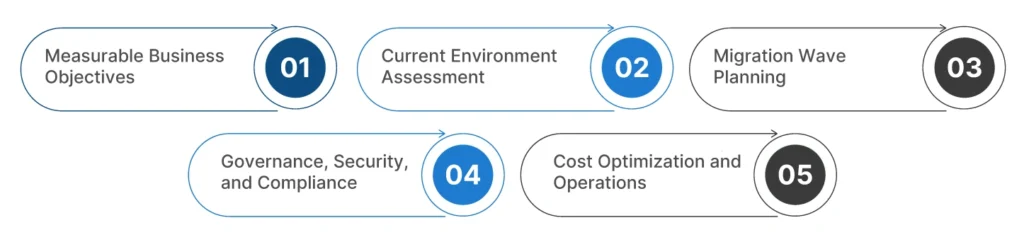
A business-aligned cloud strategy roadmap turns cloud adoption into measurable enterprise progress. It connects strategy, architecture, migration, governance, and operating discipline into one execution path.
Key components to include in the roadmap:
-
Measurable Business Objectives
- Define the outcomes the cloud must support, such as faster market response, cost control, resilience, or AI readiness.
- Set baseline KPIs across uptime, release speed, cost per workload, scalability, and customer experience.
- Link every cloud initiative to a business priority, not only a technical milestone.
-
Current Environment Assessment
- Review the full application, infrastructure, data, and integration landscape.
- Identify performance bottlenecks, security gaps, compliance exposure, and technical debt.
- Classify workloads by readiness, business criticality, modernization need, and migration complexity.
-
Migration Wave Planning
- Prioritize workloads based on value, risk, dependency, and operational sensitivity.
- Start with lower-risk systems to validate migration patterns, controls, and operating readiness before moving more business-critical workloads. Move business-critical platforms only after architecture, security, and recovery controls are tested.
-
Governance, Security, and Compliance
- Define access controls, identity policies, encryption standards, and data protection rules.
- Establish approval gates for architecture, security, compliance, and cost decisions.
- Build auditability, recovery planning, and regulatory alignment into the cloud transformation plan.
-
Cost Optimization and Operations
- Create clear ownership for cloud usage, budgeting, forecasting, and spend accountability.
- Monitor workload performance, consumption patterns, and resource utilization continuously.
- Use optimization practices to reduce waste without weakening performance or resilience.
Building a Cloud Transformation Plan That Scales with Control
A cloud transformation plan should create speed without weakening enterprise control. The aim is not to move everything quickly. It is to move the right workloads with the right architecture, governance, and operating discipline.
A scalable plan depends on several core components.
-
Embed Policy and Automation Guardrails
Manual, ticket-based approvals alone cannot keep pace with enterprise cloud adoption. Policy-as-code and automated guardrails should handle standard controls, while higher-risk exceptions retain formal review. Leaders need built-in controls that guide teams while reducing operational friction.
- Architecture standards: Define approved patterns for compute, storage, networking, identity, and data access.
- Automated controls: Use policy-driven checks to detect configuration drift, access risks, and non-compliant deployments.
- Provisioning discipline: Standardize environment creation so teams can move faster without creating shadow complexity.
-
Establish a Unified Control Model
As cloud environments expand, disconnected tools and ownership gaps create hidden risk. A unified control model gives leaders clearer visibility across platforms, teams, and workloads.
- Operational visibility: Track workload health, access, performance, availability, and compliance from one governance view.
- Centralized standards: Apply consistent rules across architecture, security, cost, monitoring, and service reliability.
- Clear accountability: Define who owns each workload, each cost center, and each operational decision.
-
Build a Cloud Center of Excellence
A cloud centre of excellence gives transformation a practical operating backbone. It should not become a bottleneck. Its role is to set standards, guide teams, and improve delivery maturity.
- Governance with flexibility: Create guardrails that protect the enterprise without slowing every delivery team.
- Shared knowledge: Provide reusable patterns, migration playbooks, reference architectures, and cost practices.
- Skills enablement: Support teams in cloud architecture, security, automation, reliability, and financial accountability.
-
Optimize Cost and Performance Continuously
Cloud cost control requires active governance, not occasional budget reviews. Leaders need visibility into how workloads consume resources and where value is being created.
- Resource ownership: Tag workloads by product, business unit, environment, and accountable owner.
- Performance tuning: Review capacity, availability, latency, and usage patterns against business requirements.
- Continuous optimization: Reduce waste through rightsizing, scheduling, workload balancing, and demand-based scaling.
-
Sequence Migration with Modernization Priorities
A strong cloud transformation plan does not treat every workload the same. Some systems can migrate quickly. Others may need to be retained, replat formed, refactored, rearchitected, replaced, retired, or rebuilt based on business value, dependency complexity, and technical constraints.
- Portfolio assessment: Classify applications by business value, risk, technical debt, and dependency complexity.
- Wave planning: Move lower-risk workloads first to validate patterns, controls, and operating readiness.
- Modernization focus: Prioritize high-impact systems where cloud can improve resilience, scalability, or business agility.
This is where cloud transformation becomes a scaling discipline. The plan should let teams move faster, but only within clear boundaries. When standards, automation, accountability, and modernization priorities work together, cloud growth becomes easier to govern and harder to derail.
Aligning Cloud Decisions with Cost, Risk, Performance, and Growth
A business-aligned cloud strategy should make every cloud decision answer a business question. Cost, risk, performance, and growth should shape the roadmap before migration begins.
A cloud strategy roadmap works best when leaders define what success means for each workload. Some systems need faster releases. Others need stronger resilience, better security, or lower operating cost. To keep cloud decisions aligned with business outcomes, leaders should track:
- Cost ownership by product, workload, or business unit.
- Performance against user, customer, and operational expectations.
- Security controls, compliance readiness, and risk exposure.
- Release speed for priority applications and digital products.
- Data availability for analytics, AI, and decision intelligence.
This approach keeps the cloud adoption roadmap grounded in enterprise value. It also prevents the cloud transformation plan from becoming a technical exercise. The real test is whether the roadmap makes trade-offs visible: where speed matters most, where risk must be reduced first, and where modernization is needed before migration creates more complexity.
How TxMinds Helps Enterprises Build Cloud Strategies Beyond Migration
TxMinds shapes cloud strategy around modernization, AI readiness, data trust, and scalable engineering control. That means we do not treat cloud as a lift-and-shift exercise. We connect architecture, migration planning, governance, FinOps discipline, and delivery execution into one practical roadmap.
Our teams support leaders across cloud readiness, application modernization, platform engineering, data integration, quality engineering, and managed operations. We pinpoint which workloads should move, which systems need redesign, and which controls must be embedded first.
For enterprises building a cloud strategy roadmap, we bring an outcome-led approach. We focus on clarity, resilience, accountability, and scale, so cloud investments become stronger business decisions.

Vivek Gupta
VP, Delivery, Digital Engineering
Vivek Gupta is the Vice President of Delivery at Tx with over 25 years of experience driving digital transformation. At Tx, he has built the foundation for DevOps, Digital, and Cloud practices, shaping strategies that empower businesses. Before joining Tx, Vivek held leadership roles at Infosys and Tech Mahindra. His leadership fuels innovation, strengthens delivery excellence, and enhances Tx's global impact. Vivek's commitment to driving change ensures our clients stay ahead in an evolving digital landscape.
FAQs
How do you create a cloud strategy roadmap?
You create a cloud strategy roadmap by defining business goals first, then assessing applications, data, infrastructure, security, and operating readiness. After that, prioritize workloads by value, risk, and complexity before planning migration, modernization, governance, and optimization phases.
What should a cloud adoption strategy include?
A cloud adoption strategy should include business objectives, workload assessment, migration priorities, architecture decisions, security controls, compliance requirements, cost ownership, operating model changes, and success metrics. It should guide cloud adoption as a business program, not only a technical migration.
How do you align cloud strategy with business outcomes?
You align cloud strategy with business outcomes by linking every cloud decision to measurable value. This may include faster releases, lower operating cost, stronger resilience, improved customer experience, better data access, or AI readiness.
What is the difference between a cloud adoption roadmap and a cloud transformation plan?
A cloud adoption roadmap defines how the enterprise will move into cloud environments. A cloud transformation plan goes further by addressing modernization, governance, cost control, operating model changes, and long-term scalability.
Discover more