


Recommended Blogs

Blog
Cloud Readiness Assessment: Why Migration Speed Can Create More Risk Than Value
Table of Content
- The Enterprise Cloud Readiness Mandate: Why Speed Without Control Creates Risk
- What Cloud Readiness Must Reveal Before Migration
- A Practical Cloud Assessment Framework for C-Level Decision-Making
- Application Portfolio Assessment: Deciding What to Move, Modernize, Retire, or Retain
- How TxMinds Helps Enterprises Move from Cloud Readiness to Cloud Confidence
Share On


Cloud migration can fail long before the first workload moves. The plan may look ambitious, yet the enterprise may still lack application visibility, cost ownership, security discipline, or the operating readiness needed to manage cloud workloads at scale.
Moving quickly does not solve those gaps. It can make them more expensive.
That is why a cloud readiness assessment should come before migration speed. It gives technology leaders a clear view of what can move now, what needs modernization, what should remain in place, and where stronger governance is needed before migration creates avoidable risk.
For C-level leaders, the value is practical and immediate. A stronger readiness model can reduce migration risk, protect business continuity, control cloud costs, and align cloud decisions with enterprise outcomes. The right cloud consulting services can also turn assessment findings into a realistic adoption roadmap.
Key Takeaways
- Cloud migration must start with readiness, as only 14% of organizations are cloud-evolved despite growing enterprise cloud adoption.
- AI is increasing cloud urgency, with 99% of organizations saying AI is driving greater cloud investment.
- Security readiness needs executive attention, as 66% of cybersecurity experts lack confidence in real-time cloud threat detection and response.
- A strong cloud readiness assessment helps leaders decide what to move, modernize, retire, retain, or secure before migration speed creates risk.
The Enterprise Cloud Readiness Mandate: Why Speed Without Control Creates Risk
Cloud migration is now an enterprise operating-model decision, not only an infrastructure move. It shapes AI execution, modernization, data access, resilience, security, and cost discipline. NTT DATA’s 2026 global cloud study found that only 14% of organizations describe themselves as cloud-evolved. It also found 99% say AI is increasing their need for cloud investment.
Migration Speed Can Hide Weak Foundations
A fast move can reduce data center dependency while preserving legacy complexity. Common gaps include hidden application dependencies, weak access controls, unclear ownership, poor data governance, and limited cost accountability. These gaps usually surface after go-live as cost overruns, outages, tool duplication, or stalled modernization.
Cloud Readiness is a Business Control Point
A robust cloud-readiness assessment helps leaders decide what to move, modernize, secure, delay, or retire. It also provides cloud consulting services with a clearer execution basis, as priorities are tied to business risk. Readiness turns migration from a technical sprint into a controlled enterprise decision.
What Cloud Readiness Must Reveal Before Migration
A cloud-readiness assessment should determine whether the enterprise is prepared to operate, govern, secure, and scale in the cloud. It should not stop at infrastructure inventory or hosting costs. Microsoft’s Cloud Adoption Framework prioritizes readiness over migration, modernization, governance, security, and management, reinforcing a simple point: cloud readiness must come before cloud scale.
A strong cloud assessment framework should examine:
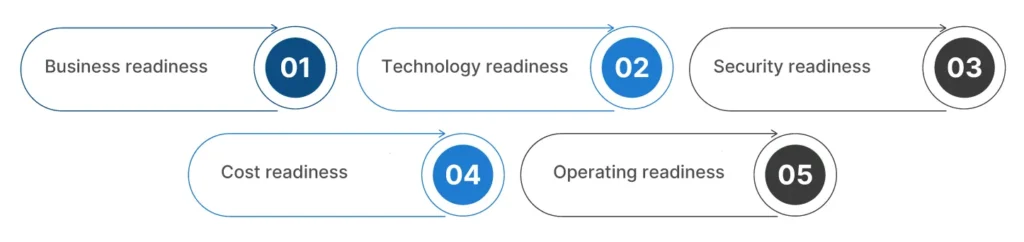
- Business readiness: Cloud goals, success measures, funding ownership, and business capabilities that need cloud support.
- Technology readiness: Applications, workloads, databases, integrations, performance needs, and migration complexity.
- Security readiness: Identity, access controls, encryption, logging, data classification, and compliance obligations.
- Cost readiness: Cloud budgeting, usage visibility, FinOps ownership, and cost control models.
- Operating readiness: Cloud skills, governance, DevOps discipline, observability, and support ownership.
Fortinet’s 2026 cloud security report found that 66% of surveyed organizations lack confidence in their ability to detect and respond to cloud threats in real time.
That is why cloud adoption readiness cannot be treated as a technical checklist. The right cloud consulting services help leaders turn readiness findings into clear migration priorities, risk controls, and modernization decisions before the first major workload moves.
A Practical Cloud Assessment Framework for C-Level Decision-Making
A practical cloud assessment framework helps leaders evaluate the value of migration, technical feasibility, organizational readiness, and enterprise risk before committing significant capital. For leaders asking how to assess cloud readiness, the answer starts with business intent and ends with execution control. The goal is not simply to move faster. It is to use a cloud-readiness assessment to determine what should move, what needs modernization, and where the enterprise needs stronger governance.
Financial and Value Modeling (The Why)
Before approving cloud migration, leaders should validate the economic case clearly. Cloud value must be measured against business outcomes, not infrastructure movement alone.
- Total cost visibility: Compare current infrastructure costs with projected cloud consumption, licensing, support, and modernization spend.
- Business value alignment: Link migration to speed, resilience, scalability, customer experience, and AI-readiness.
- Cost governance readiness: Define budgeting, chargeback, usage monitoring, and ownership before workloads scale.
- Investment sequencing: Prioritize workloads where cloud adoption readiness supports measurable enterprise value.
Technical Feasibility and Suitability (The What)
Technical readiness determines whether applications can run well in cloud environments. This is where application portfolio assessment becomes essential.
- Application rationalization: Classify applications to move, modernize, retire, replace, or retain.
- Dependency mapping: Identify databases, APIs, integrations, batch jobs, and downstream system dependencies.
- Architecture suitability: Assess performance, latency, availability, security, and scalability requirements.
- Data and integration readiness: Review data flows, governance, quality, and integration patterns before migration begins.
Organizational and People Readiness (The Who)
Cloud migration changes how teams build, operate, secure, and fund technology. Weak operating readiness can slow value after migration.
- Skills assessment: Evaluate cloud skills across architecture, engineering, security, operations, and data teams.
- Operating model readiness: Define roles across platform teams, DevOps, FinOps, governance, and support functions.
- Change adoption: Prepare teams for new workflows, release models, monitoring practices, and accountability structures.
- Partner support: Use cloud consulting services where internal teams need advisory, architecture, or execution support.
Risk, Governance, and Security (The Guardrails)
Cloud readiness must expose risk before migration expands the attack surface. Governance should guide decisions from planning to operations.
- Security posture: Assess identity, access controls, encryption, logging, network rules, and incident response.
- Compliance readiness: Map regulatory obligations, audit needs, data residency, and retention requirements.
- Governance model: Define policies for provisioning, access, cost, architecture standards, and workload approval.
- Resilience planning: Review backup, disaster recovery, availability, observability, and business continuity needs.
A robust cloud-readiness process provides leaders with a clearer answer to a single executive question. How do you know if your business is ready for the cloud? You know when value, applications, data, people, security, and governance can work together at scale.
Application Portfolio Assessment: Deciding What to Move, Modernize, Retire, or Retain
An application portfolio assessment helps leaders avoid one of the costliest cloud mistakes: moving every application without questioning its value. As part of a cloud-readiness assessment, it shows which systems are business-critical, which need modernization, which can move with minimal change, and which should stay out of the migration plan.
This is where cloud readiness becomes practical, because leaders can connect application decisions to cost, risk, performance, and business continuity. A focused cloud assessment framework should classify applications by:
- Business value: Is the application still essential to revenue, operations, customer experience, or compliance?
- Technical health: Does it carry outdated code, unsupported platforms, poor performance, or high maintenance effort?
- Dependency risk: Which databases, APIs, batch jobs, reports, and downstream systems depend on it?
- Cloud suitability: Can it run well in the cloud, or does it need replatforming or refactoring first?
- Security and data sensitivity: Does it handle regulated, confidential, or high-risk enterprise data?
- Migration path: Should the enterprise rehost, replatform, refactor, repurchase, retire, retain, or relocate it?
- Execution priority: Should it move early, later, after modernization, or not at all?
For C-level leaders asking how do you assess cloud readiness, application clarity is one of the strongest answers. Cloud adoption readiness is real when every workload has a reason, a risk profile, an owner, and a defined migration path. That is how cloud migration becomes controlled modernization, not infrastructure relocation.
How TxMinds Helps Enterprises Move from Cloud Readiness to Cloud Confidence
At TxMinds, our cloud consulting services help enterprises move from cloud readiness to cloud confidence. We assess the current technology landscape, application portfolio, data dependencies, security posture, and operating model before migration begins.
We work with leaders to identify which workloads should move, modernize, retire, or remain. We also help define a practical cloud assessment framework that connects strategy, architecture, governance, cost control, and delivery sequencing.
Our approach is grounded in enterprise realities. We help teams reduce avoidable migration risk, strengthen application modernization decisions, and prepare cloud foundations for scale, AI readiness, and operational reliability. We do not treat cloud migration as a race to move infrastructure. We help enterprises build the readiness needed for durable cloud value. If your organization is planning migration, modernization, or platform renewal, we can help assess where cloud confidence should begin.

Vivek Gupta
VP, Delivery, Digital Engineering
Vivek Gupta is the Vice President of Delivery at Tx with over 25 years of experience driving digital transformation. At Tx, he has built the foundation for DevOps, Digital, and Cloud practices, shaping strategies that empower businesses. Before joining Tx, Vivek held leadership roles at Infosys and Tech Mahindra. His leadership fuels innovation, strengthens delivery excellence, and enhances Tx's global impact. Vivek's commitment to driving change ensures our clients stay ahead in an evolving digital landscape.
FAQs
What is included in a cloud readiness assessment?
A cloud readiness assessment includes business goals, application dependencies, data readiness, security posture, cost models, operating skills, governance, and migration priorities. It helps leaders understand whether the enterprise is prepared to move, modernize, secure, and scale workloads in the cloud.
How do you assess cloud readiness across an enterprise?
You assess cloud readiness by using a structured cloud assessment framework. This includes financial value modeling, technical feasibility, application portfolio assessment, organizational readiness, security controls, compliance needs, and operating model maturity.
How do you know if your business is ready for the cloud?
Your business is ready for the cloud when every major workload has a clear owner, business case, risk profile, cost model, security control, and migration path. Strong cloud adoption readiness means cloud decisions are tied to business outcomes, not only infrastructure availability.
Why is application portfolio assessment important for cloud migration?
An application portfolio assessment helps leaders decide what to move, modernize, retire, retain, or replace. It prevents enterprises from migrating outdated, low-value, or high-risk applications without understanding cost, dependency, performance, and security impact.
Discover more