


Recommended Blogs

Blog
AI/ML in Security Operations That Protects Business Revenue and Trust
Table of Content
- AI/ML Integration in Applications: Why SecOps Needs to Adapt
- An Enterprise AI Security Framework That Fits the SecOps Lifecycle
- Securing AI-Powered Applications: What Changes in Detection and Response
- AI/ML Security for Enterprises: Guardrails for Data, Models, and Operations
- TxMinds Enables Secure AI ML Integration in Enterprise Applications
Share On


Security operations teams are under more pressure than ever. The volume of alerts, applications, and data sources has grown so large that traditional tools alone cannot keep pace. At the same time, adversaries are using automation and machine-learning techniques to probe defenses faster and with more sophistication.
The shift is already visible in how SOCs work today. A 2025 SOC survey found that 39.8% of respondents say AI and ML are a defined part of their SOC operations, while another 40% say they are using these tools even though they are not part of a defined workflow yet.
That gap matters. As AI/ML integration in applications accelerates, teams need an enterprise AI security framework for securing AI-powered applications and application security for AI models without slowing the business down.
This blog explores where AI and ML fit in SecOps, what changes in detection and response, and how enterprises can adopt them with the right guardrails.
Key Takeaways
- AI/ML in SecOps is now essential to keep pace with alert volume, attacker automation, and growing application complexity.
- Treat AI as part of an enterprise security framework mapped to the SecOps lifecycle, not as a bolt-on tool.
- AI-powered detection shifts SOCs from manual alert triage to risk-based decisions that protect revenue and customer trust.
- Guardrails for data, models, and operations (governance, access control, monitoring, explainability) are critical to avoid scaling bad signals.
- Securing AI-powered applications means protecting both business apps and the AI models behind them as high-value assets.
- With the right partner, enterprises can integrate AI/ML into applications and SecOps without slowing delivery or increasing operational risk.
AI/ML Integration in Applications: Why SecOps Needs to Adapt
Most security teams are used to applications that behave predictably. The logic stays the same, the data flows are familiar, and when something looks odd, it usually stands out. With AI/ML integration in applications, the picture changes. Models learn from data, outputs shift with context, and automation starts making decisions that used to sit with people.
Though that is a real advantage for productivity, but it also creates new blind spots if SecOps keeps relying on static rules and manual review.
There is a measurable business case for modernizing the approach. IBM’s research, based on its Cost of a Data Breach analysis, reports that enterprises with extensive security AI and automation identify and contain breaches 108 days faster on average than those without it, and save about USD 1.76 million in breach costs.
What this means for business leaders is that AI in security is not just a technology upgrade. It is an operating model upgrade. Instead of asking analysts to sift through everything, ML can learn patterns across network traffic, logs, and user behavior, then surface the few events that deserve attention and speed up response decisions.
An Enterprise AI Security Framework That Fits the SecOps Lifecycle
A useful way to avoid chaos is to treat AI as part of an enterprise AI security framework that is deliberately mapped to how SecOps already works, rather than bolted onto the side.
A recent report shows that about 65% of AI use cases in security operations are still focused on detection. About 88% of these approaches are not explainable, which makes trust and large-scale adoption difficult for many SOC teams.
In practice, the framework looks like this:
- Identify: Inventory AI assets such as models, datasets, and integrations, classify business criticality, and document where AI decisions affect security-relevant workflows.
- Protect: Control access to training data, model artifacts, and inference endpoints, and enforce configuration baselines for AI infrastructure.
- Detect: Apply ML-assisted analytics across identity, endpoint, network, cloud, and application telemetry, with a focus on behavioral baselining and anomaly detection.
- Respond: Connect AI insights to SOAR playbooks, escalation rules, and analyst workflows so actions stay consistent and auditable.
- Recover: Ensure incident learnings feed back into detections, model monitoring, and playbooks so the same pattern does not repeat.
This structure keeps AI/ML security for enterprises grounded. Governance comes first, operational wins show up in the middle, and the program keeps improving over time.
Securing AI-Powered Applications: What Changes in Detection and Response
When you start securing AI-powered applications, security operations move from sorting endless alerts to making faster, higher-quality decisions about business risk. AI can help teams cut through noise by interpreting activity across systems, ranking what matters, and summarizing why an alert deserves attention, so response time improves without adding headcount.
A practical set of SecOps improvements usually includes:
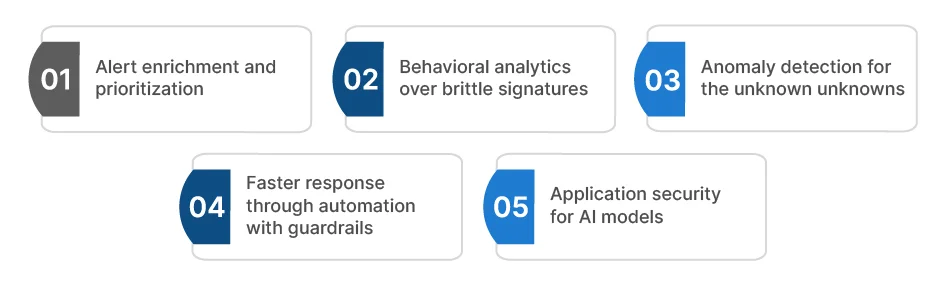
- Alert enrichment and prioritization: ML can fuse signals across identity, endpoint, network, cloud, and application telemetry, then assign risk so analysts start with what is most likely to matter instead of what arrived most recently. This is especially useful when business-critical systems generate high volumes of routine activity that can mask early warning signs.
- Behavioral analytics over brittle signatures: Instead of depending on fixed rules, ML learns what normal looks like and flags meaningful deviations. This is important when attackers reuse legitimate tools and credentials because those moves often look normal in isolation.
- Anomaly detection for the unknown unknowns: Unsupervised approaches can surface new or rare behaviors that do not match known patterns. That gives teams a way to catch emerging tactics earlier, before there is a reliable signature to key off.
- Faster response through automation with guardrails: Predictive signals can trigger playbooks for containment and investigation, but only when confidence thresholds and approval steps are clear. This keeps speed high while preserving accountability.
- Application security for AI models: This is the newer shift. Protect inference endpoints, watch for abuse patterns, and treat model access and data access as sensitive assets that deserve the same controls as core applications.
AI does not just generate more alerts. Used well, it changes which alerts get attention first and how quickly a team can reach a defensible decision.
AI/ML Security for Enterprises: Guardrails for Data, Models, and Operations
AI can strengthen security operations, but it can also introduce new risks if treated as a simple technology upgrade. In real enterprise environments, telemetry is inconsistent, identities are fragmented, and data quality varies across systems. When AI models are trained or operated on unreliable inputs, the outcome is not just inaccurate detection but inaccurate detection at scale.
That is why AI/ML security for enterprises begins with strong data governance, clear ownership, and end-to-end visibility before expanding automation.
Trust is the next critical factor. Many AI-driven detections operate as black boxes, which makes it difficult for security teams and executives to confidently stand behind decisions during incidents, board reviews, or regulatory scrutiny. If teams cannot clearly explain why an alert was prioritized or why an action was triggered, confidence erodes quickly. Effective programs ensure that explainability, audit trails, and decision transparency are built into the workflow from the start.
Finally, enterprises must assume adversaries will adapt. Attackers are already using automation and AI to scale reconnaissance and refine attack methods. This makes securing AI-powered applications and strengthening application security for AI models essential. Human oversight for high-impact actions, strict access controls for model and data assets, and continuous tuning based on operational feedback keep automation aligned with business risk.
TxMinds Enables Secure AI ML Integration in Enterprise Applications
We build security into the product from day one. That is how we approach AI/ML security for enterprises when teams are pushing AI/ML integration in applications into production and still need stability, speed, and control.
With our modern application development services, we lean on modern engineering fundamentals like cloud native architecture, strong testing practices, and secure integration patterns for intelligent features. By wiring continuous testing and security checks into delivery pipelines, we catch issues early and keep quality high as systems scale.
We also treat application security for AI models as part of everyday DevSecOps. That means we help teams secure data access, protect inference endpoints, and monitor runtime behavior with clear governance and logs that stand up in real operations. The result is a practical way to keep securing AI-powered applications aligned with enterprise risk while continuing to ship.


Vivek Gupta
VP, Delivery, Digital Engineering
Vivek Gupta is the Vice President of Delivery at Tx with over 25 years of experience driving digital transformation. At Tx, he has built the foundation for DevOps, Digital, and Cloud practices, shaping strategies that empower businesses. Before joining Tx, Vivek held leadership roles at Infosys and Tech Mahindra. His leadership fuels innovation, strengthens delivery excellence, and enhances Tx's global impact. Vivek's commitment to driving change ensures our clients stay ahead in an evolving digital landscape.
FAQs
How does AI/ML in security operations protect business revenue?
AI/ML reduces dwell time and speeds up detection and response, lowering the likelihood and impact of breaches that cause outages, lost transactions, and long-term customer churn.
Why do we need an enterprise AI security framework for SecOps?
A framework aligns AI use with the existing SecOps lifecycle (identify, protect, detect, respond, recover), so investments are governed, auditable, and tied to business risk rather than scattered experiments.
What changes in detection and response when we secure AI-powered applications?
Detection becomes more behavior-driven and risk-based, alerts are enriched and prioritized automatically, and response playbooks can be partially automated with clear confidence thresholds and approvals.
What are the main risks of adopting AI/ML in SecOps without proper guardrails?
Key risks include over-reliance on opaque models, scaling inaccurate detections, uncontrolled access to sensitive data and models, and decisions that cannot be explained to regulators, boards, or customers.
How should enterprises secure AI models and inference endpoints?
Enterprises should treat models as critical assets: enforce strict identity and access controls, protect training and inference data, monitor runtime behavior, and integrate model security checks into DevSecOps pipelines.
Discover more