


Recommended Blogs

Blog
AI-Native Applications: The Architecture Enterprises Need to Compete in the Next Decade
Table of Content
- Key Takeaways
- From Digital Transformation to AI-Native Transformation
- What Makes an Application Truly AI-Native?
- Why AI Application Development Services Will Define Enterprise Advantage
- The Architecture That Turns Intelligence into Enterprise Power
- How Leaders Can Build AI-First Applications Without Multiplying Risk
- TxMinds: Building the AI-Native Foundation for the Enterprise Decade
Share On


Enterprise advantage is moving from software that records work to software that thinks with work. Stanford’s 2026 AI Index reports that organizational AI adoption reached 88%, showing that enterprise AI has moved from selective experimentation to mainstream operating reality.
Yet adoption is not the same as advantage. Many enterprises now own AI tools, pilots, copilots, and proofs of concept. Far fewer have redesigned their applications, workflows, and data foundations around intelligence.
For business leaders, the question is whether the enterprise itself is built to learn, adapt, and decide faster. This blog gives leaders a practical lens for understanding AI-native applications, where architecture matters, and how AI application development services can turn ambition into durable enterprise capability.
Key Takeaways
- AI adoption is mainstream, with 88% organizational adoption reported in the blog.
- AI agents are becoming central, with 40% of enterprise applications expected to include task-specific agents.
- Adoption alone does not create an advantage. Strong AI architecture does.
- AI-first applications need clean data, clear accountability, and phased scaling.
From Digital Transformation to AI-Native Transformation
Digital transformation helped businesses automate workflows and connect fragmented business systems. Though it has created efficiency, it has rarely changed how the enterprise thinks.
Why Yesterday’s Enterprise Systems Can’t Carry Tomorrow’s Intelligence
Most enterprise applications still follow a familiar pattern. A user enters data, the system processes it, and reports appear later. Leaders then make decisions after the fact.
AI-native applications compress that distance. They sense context, recommend action, and improve through feedback. They do not simply support processes. They reshape them.
McKinsey’s 2025 Global Survey on AI found that 88% of respondents report regular AI use in at least one business function. Yet only about one-third say their companies have begun scaling AI programs.
That gap should command executive attention. The market is not short of AI activity. It is short of an AI architecture.
What Makes an Application Truly AI-Native?
An AI-native application is defined by how deeply intelligence shapes the system’s behavior. The application understands context, learns from outcomes, and participates in decisions. It can guide work instead of merely displaying information.
Core traits of AI-native applications:
AI-native systems usually share five architectural traits.
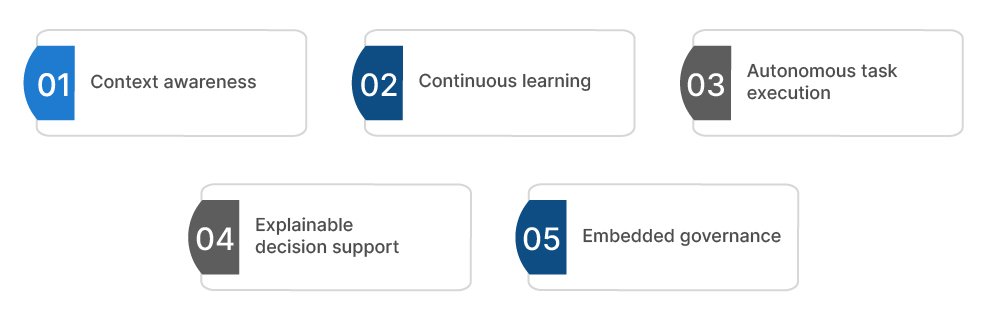
- Context awareness: The application understands users, roles, history, permissions, and business intent.
- Continuous learning: Feedback loops help improve recommendations, workflows, and model performance.
- Autonomous task execution: Agents can complete bounded tasks with guardrails and escalation paths.
- Explainable decision support: Users can understand why a recommendation appeared before acting on it.
- Embedded governance: Security, compliance, auditability, and human oversight are built into workflows.
These traits show whether AI-native application development is truly useful. They also help reduce wasted spending on tools that do not create value.
Why AI Application Development Services Will Define Enterprise Advantage
AI application development services are moving from optional experiments to core enterprise capabilities. They now shape how companies improve efficiency, serve customers, manage risk, and move faster.
Here is why AI application development services are becoming a serious driver of enterprise advantage.
1. Better Efficiency and Lower Operating Costs
- Intelligent automation: AI-powered applications can manage repetitive work across documents, tickets, reports, and customer requests. This helps employees focus on work that needs judgment.
- Predictive operations: AI applications can analyze system, asset, and workflow data. This helps teams detect problems earlier and reduce avoidable downtime.
- Smarter process planning: AI can connect demand, capacity, inventory, and workforce signals. This helps enterprises reduce waste and improve operational speed.
2. Faster Data-Driven Decisions
- Real-time insights: AI applications can process large volumes of structured and unstructured data. This gives leaders faster visibility than traditional dashboards alone.
- Better recommendations: AI-native systems can suggest next steps using business rules, historical patterns, and current conditions. This helps teams act with more confidence.
- Stronger strategic planning: Enterprises can use AI to identify risks, market shifts, and resource gaps. This supports better planning across functions and regions.
3. More Personal Customer and Employee Experiences
- Smarter engagement: AI-native applications can understand user intent, past behavior, and service context. This makes every interaction more relevant and less repetitive.
- Tailored services: Enterprises can deliver experiences that adjust to each customer, employee, or partner. This creates faster support and stronger satisfaction.
- Connected journeys: AI can link disconnected systems across channels and departments. Users get smoother experiences without repeating the same information.
4. Faster Innovation with Scalable Systems
- Custom AI solutions: Enterprises can build AI-first application experiences around their own workflows. This is more effective than forcing generic tools into complex operations.
- Scalable architecture: AI applications can support growing users, data volumes, and business processes. The system must scale without creating uncontrolled cost or complexity.
- Shorter release cycles: Reusable data pipelines, integrations, and model components help teams move faster. New intelligent features can reach users with less rework.
5. Stronger Security and Risk Management
- Proactive threat detection: AI applications can detect unusual activity across systems and workflows. This helps teams respond before small issues become larger problems.
- Compliance support: AI can help review documents, identify gaps, and support regulated processes. The system should assist compliance teams, not replace accountability.
- Built-in governance: Strong AI applications include access controls, audit trails, model monitoring, and human review. These controls protect trust as automation expands.
From AI Pilots to Enterprise-Wide Impact
Many enterprises have already tested AI in small pockets. The next step is connecting those efforts to core workflows. AI application development services help enterprises move beyond isolated pilots. They bring strategy, engineering, data, governance, and adoption into one execution path.
That is where AI becomes more than a tool. It becomes part of how the enterprise works, learns, and competes.
The Architecture That Turns Intelligence into Enterprise Power
AI-native applications need more than models and interfaces. They need an architecture that connects data, agents, workflows, and governance. This is where intelligence becomes useful. The application can understand context, take guided action, and improve work without losing control.
Core Components of Enterprise AI Architecture
Modern enterprise AI works as a layered system. Each layer has a clear role in turning AI from a pilot into a dependable business capability.
1. Agent layer: Specialized AI agents handle defined tasks across workflows. They work best when roles, permissions, and escalation rules are clear.
2. Data layer: Curated enterprise data gives AI the context it needs. This includes documents, records, customer data, transactions, and operational signals.
3. Orchestration layer: This layer connects agents, tools, models, and systems. It ensures the right action happens in the right workflow.
4. Governance layer: Controls, audit trails, monitoring, and human review sit inside the system. Governance should guide AI behavior from the start.
Key Principles for Making AI Architecture Work
1. Move from records to reasoning
Traditional systems store what happened. AI-native systems help explain what it means and what should happen next.
2. Design around business intent
Teams should define the outcome first. The architecture should then guide AI toward the safest and most useful path.
3. Keep the structure modular
Large enterprises need flexibility across functions, regions, and systems. A modular design helps teams scale without rebuilding everything.
4. Build governance into the workflow
AI should not operate outside enterprise rules. Security, compliance, and human oversight must be part of the architecture itself.
When these pieces work together, AI-native application development becomes easier to scale. The enterprise moves from isolated tools to systems that support real decisions and real work.
How Leaders Can Build AI-First Applications Without Multiplying Risk
Building an AI-first application is a leadership decision about where AI should act, who must remain accountable, and how risk should be managed. Leaders can reduce risk by focusing on a few practical moves.
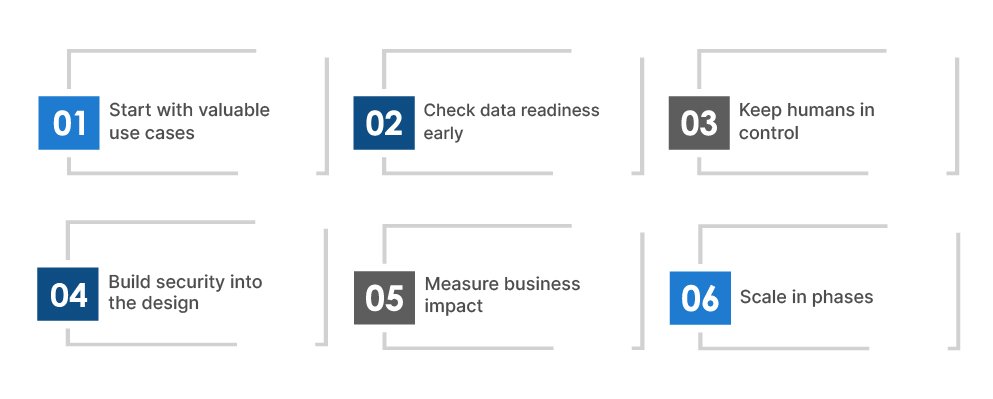
- Start with valuable use cases: Choose workflows where AI can improve speed, accuracy, or cost. Strong examples include customer service, procurement, compliance review, underwriting, and knowledge management.
- Check data readiness early: AI-first applications depend on clean, accessible, and well-governed data. Weak data foundations create weak recommendations and poor user trust.
- Keep humans in control: AI should support decisions, not hide accountability. Sensitive actions should include review, approval, escalation, and audit trails.
- Build security into the design: Access controls, monitoring, and compliance rules should be part of the application. They should not be added after deployment.
- Measure business impact: Track outcomes such as cycle time, cost reduction, customer satisfaction, risk reduction, and revenue impact. Model accuracy alone is not enough.
- Scale in phases: Start with a focused workflow, learn from real users, and then expand. This approach reduces risk while building internal confidence.
The goal is not to automate everything. It is to build intelligent systems that help the business act faster, safer, and with better judgment.
TxMinds: Building the AI-Native Foundation for the Enterprise Decade
At TxMinds, we help enterprises move from AI ambition to AI-native execution. We work with leaders who need secure, scalable applications built around business outcomes. We design applications where intelligence, data, workflows, and governance operate together from the start.
Our teams of expertise bring AI strategy, product engineering, cloud architecture, data integration, and automation expertise into one delivery motion. That helps enterprises reduce fragmentation and move with greater confidence.
We support modern enterprises that need AI application development services grounded in architecture and not just experimentation. We empower them to identify high-value use cases, modernize critical workflows, and build systems ready for enterprise realities.
AI will not separate winners from followers by adoption alone. The real advantage will belong to enterprises that build AI into the way they work, make decisions, and create value every day.

Amar Jamadhiar
VP, Delivery North America
Amar Jamadhiar is the Vice President of Delivery for TxMind's North America region, driving innovation and strategic partnerships. With over 30 years of experience, he has played a key role in forging alliances with UiPath, Tricentis, AccelQ, and others. His expertise helps Tx explore AI, ML, and data engineering advancements.
FAQs
What are AI application development services?
AI application development services help enterprises design, build, and scale applications powered by AI. These services usually include AI strategy, data integration, model orchestration, workflow automation, governance, and enterprise-grade deployment.
What is AI-native application development?
AI-native application development means building applications with AI at the core, not adding AI as a feature later. These applications can understand context, support decisions, automate tasks, and improve through feedback.
How can enterprises build AI-first application roadmaps?
Enterprises can build AI-first application roadmaps by starting with valuable use cases, checking data readiness, adding governance early, and scaling in phases. This reduces risk while helping teams prove business value.
Why do large enterprises need AI-native applications?
Large enterprises need AI-native applications because traditional systems cannot support faster decisions, adaptive workflows, and real-time intelligence at scale. AI-native systems help connect data, people, workflows, and governance into one smarter operating model.
Discover more