


Recommended Blogs

Blog
Claims Transformation With AI: Moving Beyond Automation to Speed, Accuracy, and Cost Control
Table of Content
- Key Takeaways
- Why Claims Leaders Can No Longer Rely on Yesterday's Operating Model
- AI Claims Processing Insurance: From Reactive Automation to Intelligent Claims Leadership
- AI Claims Processing Insurance as a Strategic Lever for Speed, Accuracy, and Cost Control
- Building Enterprise-Grade AI Insurance Claims Management for the Next Decade
- How TxMinds Helps Enterprises Lead Claims Transformation With AI
Share On


Claims are where insurance promises become visible. Customers judge the brand there, regulators inspect decisions there, and margin leakage often hides there. A 2025 paper in the European Journal of Computer Science and Information Technology reports that claims processing has historically represented about 60% of insurers’ operational costs.
That number should unsettle executives still treating claims as a back-office efficiency project. The opportunity is to build an intelligent claims operating system. AI claims processing insurance solutions can compress cycle times, improve decision quality, and control leakage at scale.
For C-level teams, the value is direct. Better claims performance protects profitability, strengthens trust, and creates an advantage in moments customers remember. The win is practical, not cosmetic, with faster resolutions, cleaner controls, and fewer judgment gaps.
Key Takeaways
- Claims processing can represent about 60% of insurers’ operational costs, making AI claims transformation a board-level profitability priority.
- AI claims processing insurance can move claims beyond rule-based automation toward faster triage, better routing, stronger fraud detection, and improved settlement accuracy.
- Real-world claims AI programs have shown measurable impact, including 23 days cut from complex liability assessment, 30% better routing accuracy, and 65% fewer customer complaints.
- The AI in insurance claims processing market is projected to grow by USD 1.39 billion from 2024 to 2029, at a 28.4% CAGR, showing rapid enterprise adoption.
Why Claims Leaders Can No Longer Rely on Yesterday's Operating Model
Claims leaders are facing a harder operating equation than automation alone can solve. Loss costs are rising, claim files are more complex, and customers expect transparency across every touchpoint. The old model was built for process control. The next model must support intelligent decisions, faster triage, and stronger claims discipline.

1. Inability to Handle Modern Risk and Claims Costs
- Rising claims severity: Inflation, litigation pressure, and higher indemnity payments are increasing LAE and reserve volatility.
- Unstructured claim evidence: Photos, videos, estimates, medical notes, and endorsements slow coverage validation and liability review.
- Sophisticated fraud: Synthetic identities and altered documents expose gaps in rules-based SIU detection.
2. Failure to Meet 2026 Customer Expectations
- Experience over speed: Policyholders expect fast, accurate, and transparent claim decisions across the full journey.
- Fragmented communication: Disconnected adjusters, brokers, vendors, and providers create friction from FNOL to settlement.
- Retention risk: Poor claims experiences increase complaints, renewal risk, and broker escalation.
3. The Shift to Agentic AI and Intelligent Automation
- Beyond AI pilots: Chatbots alone cannot transform enterprise claims operations or complex loss handling.
- Data-led decisioning: AI claims processing insurance connects policy data, loss facts, prior claims, and reserving signals.
- Human-led control: AI supports triage, routing, and recommendations while adjusters handle complex judgment.
4. Talent and Demographic Bottlenecks
- Retiring expertise: Insurers are losing experienced adjusters, examiners, and claims managers with deep institutional knowledge.
- New skills required: Claims teams need AI-assisted review, exception handling, model oversight, and governance capabilities.
- Scalable resilience: AI insurance claims management can reduce handler burden and strengthen settlement discipline.
AI Claims Processing Insurance: From Reactive Automation to Intelligent Claims Leadership
Classic automation follows predefined instructions. It can route forms, trigger alerts, and complete repetitive steps. AI claims processing insurance capabilities go further. They analyze structured and unstructured data, identify patterns, recommend actions, and support decisions.
A claim may include photos, invoices, policy details, adjuster notes, repair estimates, legal correspondence, and loss history. AI can connect those signals faster than manual review alone.
What intelligence looks like inside claims
A mature AI claims environment usually combines several capabilities. Each one addresses a distinct operational weakness.
- Natural language processing reads demand letters, emails, and medical documents
- Computer vision reviews images for damage and severity estimation
- Predictive models score complexity, litigation risk, and likely claim cost
- Fraud analytics identify anomalies across claimant and provider behavior
- Workflow intelligence routes claims to the right handler or settlement path
The shift is practical, not theoretical. McKinsey highlighted Aviva’s claims AI program, where more than 80 AI models helped cut complex liability assessment time by 23 days. The same example reported a 30% improvement in routing accuracy and a 65% reduction in customer complaints.
AI Claims Processing Insurance as a Strategic Lever for Speed, Accuracy, and Cost Control
Speed is more than a faster settlement
Speed starts at FNOL, but it does not end there. A fast intake process means little if coverage validation takes days. A quick settlement offer means little if severity scoring is wrong. AI can accelerate the full claims path by improving early decisions. It can classify claim type, assess complexity, detect missing data, and recommend next actions.
The strongest use cases include:
- Automated FNOL capture and validation
- Intelligent triage by risk and complexity
- Faster document extraction and review
- Real-time coverage and duplicate claim checks
- Settlement recommendations for low-risk claims
Accuracy protects margin and trust
Claims accuracy is often discussed as a compliance issue. It is also a profitability issue. Inaccurate decisions create overpayment, underpayment, disputes, rework, and reputational damage.
AI insurance claims management supports accuracy by standardizing decision inputs. It can flag inconsistencies between policy language, loss facts, documents, and payment history. This does not remove human judgment. It gives claims professionals better evidence and fewer blind spots.
Cost control comes from leakage reduction
Cost control should not mean aggressive claims denial. That path damages trust and invites scrutiny. Sustainable cost control comes from reducing leakage, rework, fraud exposure, and unnecessary manual effort.
The market is moving in that direction. Research and Markets reports that the AI in insurance claims processing market is forecast to grow by USD 1.39 billion by 2029, at a 28.4% CAGR. That growth reflects a clear executive priority.
The tradeoff is real. AI can improve efficiency, but poorly governed AI can create new risks.
Building Enterprise-Grade AI Insurance Claims Management for the Next Decade
By 2026, enterprise-grade AI insurance claims management will no longer mean isolated pilots or narrow task automation. It will mean embedding intelligence across the claims lifecycle, from FNOL and triage to reserving, settlement, subrogation, and compliance review. The next decade will favor insurers that connect AI with governed workflows, clean data, and human claims expertise.
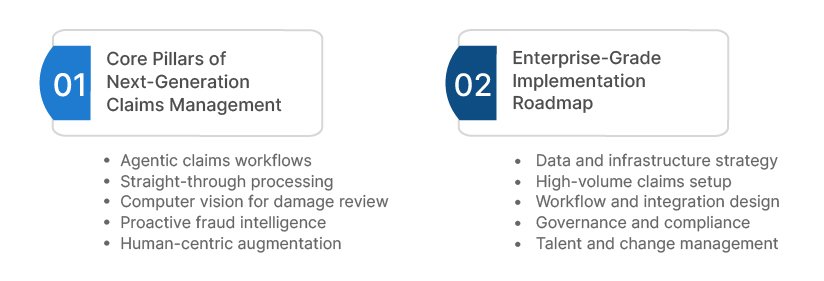
Core Pillars of Next-Generation Claims Management
- Agentic claims workflows: AI will move beyond summaries and alerts to coordinate triage, document review, routing, and next-best actions.
- Straight-through processing: Low-complexity claims can move faster when coverage, liability, severity, and fraud checks are validated early.
- Computer vision for damage review: AI can assess vehicle, property, and contents damage from images and videos to support repair estimates.
- Proactive fraud intelligence: Detection will shift from post-loss investigation to continuous monitoring across claimants, vendors, providers, and loss patterns.
- Human-centric augmentation: Adjusters can focus on negotiation, empathy, litigation exposure, and complex coverage questions.
Enterprise-Grade Implementation Roadmap
To build a sustainable AI-driven claims system, insurers must treat AI as core claims infrastructure, not an add-on tool. The roadmap should balance speed with governance, because claims decisions affect customers, reserves, and regulatory exposure.
- Data and infrastructure strategy: Move from fragmented legacy systems to AI-ready platforms with clean claims, policy, billing, and vendor data.
- High-volume claims setup: Prioritize HVLC claims where claims automation software insurance can create faster ROI and measurable cycle-time gains.
- Workflow and integration design: Connect AI with FNOL, reserving, settlement, subrogation, payments, and downstream reporting systems.
- Governance and compliance: Build auditable workflows for model monitoring, bias review, explainability, and regulatory reporting.
- Talent and change management: Upskill adjusters, examiners, and claims managers for AI-assisted review and exception-based handling.
How TxMinds Helps Enterprises Lead Claims Transformation With AI
At TxMinds, we approach claims transformation as an operating model shift. We help insurers connect strategy, data, workflows, AI engineering, and quality assurance into production-ready capabilities. Our work focuses on speed, accuracy, cost control, and governance together.
We design AI claims processing insurance solutions that fit enterprise realities. That means integrating with core claims systems, policy platforms, billing environments, documents, and downstream reporting. We also help teams build explainable workflows where humans remain accountable for complex decisions.
Our expertise spans AI-led claims, underwriting modernization, regulatory assurance, digital engineering, and quality engineering. We help insurers move beyond isolated claims automation software and insurance deployments toward scalable AI insurance claims management. The objective is simple. We help claims leaders create faster decisions, stronger controls, and more resilient operating performance.

Yuvraj Singh
Associate Director
Yuvraj Singh is an accomplished Associate Director of Delivery, renowned for leading strategic quality assurance initiatives that consistently deliver outstanding software outcomes across global markets. With deep expertise in both Property & Casualty (P&C) and Life & Annuities (L&A) insurance domains, Yuvraj excels at bridging the gap between complex business objectives and flawless execution.
FAQs
What is AI claims processing insurance?
AI claims processing insurance uses artificial intelligence to improve claims intake, triage, document review, fraud detection, reserving, and settlement decisions. It helps insurers move faster while improving accuracy and reducing manual workload.
How is AI different from claims automation software insurance?
Claims automation software insurance usually handles repetitive, rules-based tasks. AI goes further by analyzing claim data, identifying risk patterns, recommending actions, and supporting complex decision-making across the claim’s lifecycle.
What are the main benefits of AI insurance claims management?
AI insurance claims management can improve FNOL handling, reduce LAE, detect fraud earlier, support better reserve accuracy, and accelerate low-complexity settlements. It also helps adjusters focus on complex claims requiring human judgment.
Can AI replace human claims adjusters?
AI should not replace experienced adjusters in complex claims. It should support them with faster evidence review, better triage, sharper fraud signals, and more consistent recommendations for coverage, liability, and settlement decisions.
Discover more