

Recommended Blogs

Blog
2026 Banking Advantage: Leveraging AI for Real-Time Fraud Detection and Risk Control

 Last Updated: June 8th, 2026
 Read Time: 4 minutes
Table of Content
- Key Takeaways
- Turning Real-Time Fraud Detection Banking into a Boardroom Imperative: Risk, Regulation, and Reputation in 2026
- AI at the Core: How Banks Can Detect and Prevent Fraud Before It Happens
- Data Engineering as the Foundation: Building Real-Time, High-Fidelity Fraud Intelligence
- Operationalizing AI for Enterprise-Scale Fraud Control: Speed, Accuracy, and Compliance
- How TxMinds Enables Banks to Gain Real-Time Fraud Detection Banking Advantage and Measurable Results
Share On


Every financial leader faces a stark reality that fraud multiplies faster than defenses can catch up. Yesterday’s rule-based systems barely kept pace with simple scams. Today, generative AI allows fraud to evolve in minutes rather than days. According to industry research, 98 % of organizations now use AI in fraud and AML workflows, yet most still struggle to outmatch sophisticated threats.
A boardroom conversation about real-time fraud detection in banking is no longer theoretical. Institutions must defend profitability, customer trust, and brand reputation against adversaries that adapt instantly. Smarter controls in underwriting, transaction monitoring, and authentication aren’t just safeguards but they enable growth with confidence.
For leaders ready to act, this blog reveals the strategies that genuinely work and highlights where real-time advantage can be seized.
Key Takeaways
- 98% of organizations now use AI in fraud and AML workflows. Many still struggle to keep pace with evolving threats. Real-time detection in banking is critical.
- Advanced AI strategies detect and prevent fraud before losses. They use predictive risk scoring, behavioral biometrics, graph analysis, and automated document checks.
- High-quality data engineering ensures timely, accurate fraud intelligence. Real-time ingestion, unified feature stores, signal processing, geospatial analysis, and behavioral profiling are key.
- Models embedded in transaction pipelines can flag about 91% of true fraud cases before completion. This reduces false positives and provides scalable enterprise-level protection.
Turning Real-Time Fraud Detection Banking into a Boardroom Imperative: Risk, Regulation, and Reputation in 2026
For decades, banks relied on rule-based systems that flagged transactions when they crossed predefined thresholds. These systems worked when fraud patterns were obvious and static. Today, fraud is fluid, contextual, and adaptive. It hides within normal behavior, exploits authenticated sessions, and often leaves banks scrambling to respond after the fact rather than before.
This shift matters because fraud isn’t just a compliance checkbox. Boards must treat it as a strategic risk that affects customer trust, capital allocation, and long-term growth. Many systems still lag behind the threat due to fragmented data and insufficient real-time intelligence.
Boards and technology leaders must embrace real-time fraud detection banking as a core risk control and a competitive differentiator. It’s not merely about blocking losses. It’s about enabling digital channels without compromising safety.
Boards and technology leaders must embrace real-time fraud detection banking as a core risk control and a competitive differentiator. It’s not merely about blocking losses. It’s about enabling digital channels without compromising safety.
AI at the Core: How Banks Can Detect and Prevent Fraud Before It Happens
Modern banks stop fraud before it happens by replacing static rules with adaptive AI intelligence. This approach is multi-layered, proactive, and context-aware.
Predictive Risk Scoring
- Assigns probability-based risk scores to each transaction.
- Evaluates factors like location, device, transaction type, and merchant category.
Behavioral Biometrics & Profiling
- Builds baseline profiles of individual customer behavior.
- Flags unusual login times, atypical purchase patterns, or sudden changes in activity.
Graph Analysis & Network Detection
- Maps relationships across accounts and transactions.
- Detects coordinated or suspicious activity within networks.
Automated Document Analysis
- Reviews onboarding documents for tampering or inconsistencies.
- Verifies identity while detecting synthetic or fraudulent submissions.
Data Engineering as the Foundation: Building Real-Time, High-Fidelity Fraud Intelligence
Data engineering serves as the critical backbone for modern fraud detection. Well-designed, low-latency pipelines and integrated data architectures allow institutions to synthesize historical and real-time behavioral signals to identify and mitigate fraudulent activity.
The core architectural pillars of this approach include:
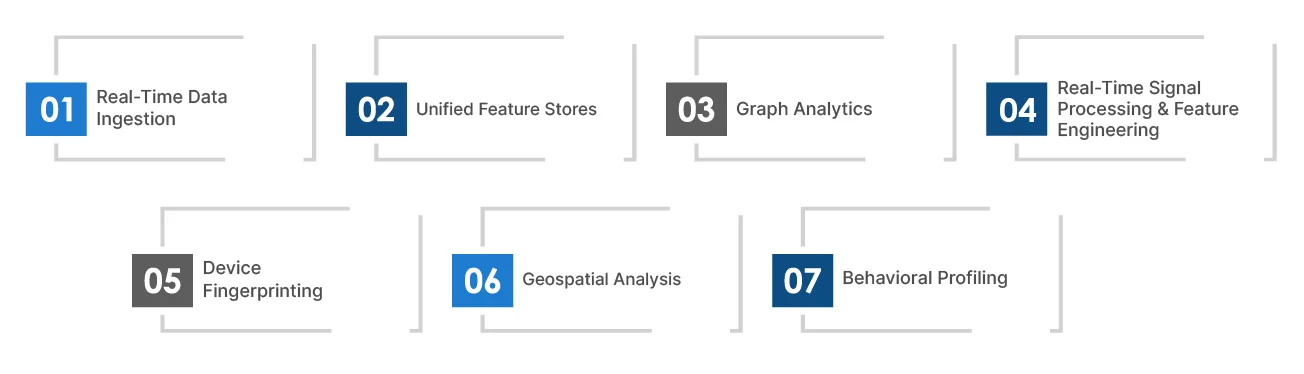
- Real-Time Data Ingestion: Pipelines process large volumes of concurrent events, including transactions and user interactions, without bottlenecks.
- Unified Feature Stores: Centralized storage ensures data is clean, normalized, and available for AI models in real time.
- Graph Analytics: Relationships between accounts and transactions are analyzed to detect suspicious patterns and networks.
- Real-Time Signal Processing & Feature Engineering: Incoming events are evaluated instantly to derive behavioral features that highlight anomalies.
- Device Fingerprinting: Identifies unusual device, browser, or network patterns to flag potential fraud.
- Geospatial Analysis: Examines transaction locations and sequences to detect unusual or impossible patterns.
- Behavioral Profiling: Tracks keystroke dynamics, mouse movement, and navigation patterns to distinguish genuine users from automated activity.
Model Execution and Decisioning
- High-frequency streams are processed with minimal latency, ensuring timely anomaly detection.
- Fast inference assigns initial risk scores to each transaction and blocks obvious anomalies.
- Complex transactions are routed to deep processing for nuanced evaluation using advanced AI models.
- Explainable AI translates outputs into actionable insights for investigators, maintaining transparency and auditability.
Business Value and Impact
- Reduces false positives while minimizing revenue loss from legitimate transactions.
- Streamlines workflows, saving operational hours.
- Enables scalable real-time fraud prevention across transactions, credit, and synthetic identity schemes.
Operationalizing AI for Enterprise-Scale Fraud Control: Speed, Accuracy, and Compliance
Deploying AI across millions of transactions in real time presents unique challenges that go far beyond lab environments. Institutions must integrate models into workflows where outputs feed seamlessly into case management, alerting, and investigations, ensuring that teams can respond efficiently to emerging threats. At the same time, the AI must remain transparent, offering explainable insights that satisfy both regulators and auditors without slowing down decision-making.
Scalability is critical. Distributed architectures allow detection systems to handle high transaction volumes without degradation in performance, while still enabling rapid interruption of unauthorized activities before they are completed. Analysts are freed from repetitive review tasks, focusing on high-risk or complex events where human judgment adds value.
When operationalized effectively, AI brings together speed, accuracy, and compliance into daily workflows, transforming fraud control from a reactive process into a proactive, intelligence-driven capability that consistently safeguards assets and customer trust.
How TxMinds Enables Banks to Gain Real-Time Fraud Detection Banking Advantage and Measurable Results
We help financial institutions turn AI and data engineering into strategic assets for fraud control. Our approach combines banking AI services, governance, and operational workflows into a production-ready framework, ensuring seamless integration across operations.
Our work includes:
- Data pipeline modernization: Structuring transaction, customer, and behavioral data for real-time scoring.
- AI model integration: Deploying models that detect anomalies, correlate multi-channel risk, and support explainable decisions.
- Workflow automation: Connecting AI outputs to case routing, alerts, and investigation processes.
By embedding these capabilities into core banking operations, we help reduce losses, accelerate detection, and strengthen compliance. Fraud detection becomes proactive, risk management becomes a strategic advantage, and operational efficiency improves simultaneously, giving institutions a reliable, real-time advantage against evolving fraud threats.
VP, Delivery North America
Amar Jamadhiar is the Vice President of Delivery for TxMind's North America region, driving innovation and strategic partnerships. With over 30 years of experience, he has played a key role in forging alliances with UiPath, Tricentis, AccelQ, and others. His expertise helps Tx explore AI, ML, and data engineering advancements.
FAQs
What is real-time fraud detection banking?
Real-time fraud detection in banking uses AI and advanced analytics to identify and prevent fraudulent transactions instantly, minimizing risk and protecting customer trust.
How does AI fraud prevention in financial services work?
AI fraud prevention financial services employ predictive risk scoring, behavioral profiling, network analysis, and automated document checks to detect suspicious activities before they impact transactions.
Why is data engineering important for banking AI services?
Data engineering ensures that transaction, behavioral, and historical data are clean, structured, and available in real-time, forming the backbone for accurate AI-driven fraud detection.
How effective is real-time fraud detection using AI?
When properly implemented, models embedded in real-time transaction pipelines can flag up to 91% of true fraud cases before completion, reducing losses and operational workload.
Discover more