

Recommended Blogs

Blog
AI-Led Compliance Operations: The Future of Customer Onboarding in Banking

 Last Updated: June 8th, 2026
 Read Time: 6 minutes
Table of Content
- Why Banking Onboarding Has Become a Compliance and Growth Bottleneck
- How AI in Financial Services is Changing Customer Onboarding
- Where Bank Compliance Automation Cuts Cost Without Cutting Corners
- The Data, Governance, and Architecture Banks Need to Scale AI Onboarding
- How TxMinds Helps Banks Build AI-Led Compliance Operations
Share On


Customer onboarding is often where a bank’s digital ambition meets its operational reality. A customer may see a short form, a document upload, and a waiting screen. Behind that screen, teams are managing identity checks, KYC reviews, AML screening, risk scoring, and audit expectations.
That gap creates a hard leadership question. How can banks make onboarding faster without weakening compliance confidence?
This is where AI in financial services becomes more than a technology trend. It gives banks a way to reduce manual review, improve decision consistency, and route risk exceptions with better context. For C-level technology leaders, the value is practical. AI can help turn onboarding from a cost-heavy control point into a faster, smarter, and more governed customer entry path.
This blog explains how banks are using AI-led compliance operations to accelerate customer onboarding, reduce manual compliance effort, and build onboarding models that are faster, safer, and easier to govern.
Key Takeaways
- Banking onboarding has become both a compliance burden and a growth bottleneck, especially where KYC, AML, and customer data workflows remain manual.
- AI in financial services helps banks improve onboarding speed through document intelligence, identity verification, risk scoring, and smarter exception routing.
- Bank compliance automation can reduce repetitive manual effort while keeping human oversight for sensitive, high-risk, or regulated decisions.
- Scalable AI for banking onboarding depends on trusted data, secure integrations, audit trails, explainability, and governance built directly into the workflow.
Why Banking Onboarding Has Become a Compliance and Growth Bottleneck
Banking onboarding has become a difficult leadership problem because two priorities now collide early in the customer relationship. Banks need to move customers from intent to activation quickly, but they also need every identity check, KYC review, AML screen, and risk decision to stand up to scrutiny.
The Compliance Burden
Banks are dealing with onboarding workflows that were built for control, not speed. That creates friction when customers expect digital-first account activation and near-real-time responses.
- Documentation overload: Commercial and SME customers often submit large volumes of documents. These may include business registrations, ownership records, tax files, identity documents, and source-of-funds information.
- Repeated customer follow-ups: Missing, expired, inconsistent, or unreadable documents often trigger back-and-forth requests. Each loop delays onboarding and increases operational effort.
- Fragmented legacy systems: Many banks still manage onboarding across disconnected KYC, AML, CRM, document, and core banking platforms. This forces teams to rekey data and reconcile information manually.
- Hardcoded compliance workflows: Regulatory changes, local KYC rules, and internal risk policies can be difficult to update quickly. As a result, low-risk customers may pass through the same queues as high-risk customers.
- High false-positive review effort: Screening alerts can consume significant analyst time when systems lack context. This slows decisions and diverts attention from genuinely risky cases.
The Growth Bottleneck
Onboarding friction does not stay inside compliance teams. It reaches customers, relationship managers, revenue teams, and leadership dashboards.
- Delayed revenue activation: A customer cannot generate full business value until onboarding is complete. Slow verification pushes revenue recognition and relationship development further out.
- Customer abandonment risk: Digital banking customers have little patience for unclear requests and long waiting periods. If onboarding feels slow or repetitive, they may move to faster alternatives.
- Higher operating cost per account: Every manual review, duplicate check, and avoidable escalation adds cost. Over time, onboarding becomes expensive even before the relationship becomes profitable.
- Reduced relationship manager productivity: Relationship teams often spend time chasing documents instead of deepening customer engagement. This weakens the customer experience at a critical first touchpoint.
- Limited scalability during growth periods: Manual onboarding models struggle when account volumes rise. Banks may add people to handle demand, but that rarely fixes the underlying workflow problem.
This is why bank compliance automation is becoming more important for banks. The goal is not to bypass controls. The goal is to make onboarding faster, more consistent, and easier to govern by using AI for banking onboarding where manual effort creates the most drag.
How AI in Financial Services is Changing Customer Onboarding
AI is changing customer onboarding from a slow, paper-heavy process into a more intelligent, secure, and adaptive workflow. By automating document checks, supporting real-time risk review, and guiding customers through each step, banks can reduce friction without weakening compliance control.
Instant Identity Verification for KYC and AML
- Automated document extraction: AI can read IDs, address proofs, tax documents, business registrations, and ownership records. This reduces manual data entry and helps onboarding teams detect missing or inconsistent information earlier.
- Identity and liveness checks: AI-supported verification can compare submitted documents with customer images or video inputs. This helps banks identify impersonation attempts, synthetic identities, and suspicious onboarding behavior.
- Sanctions and watchlist screening: AI can screen applicants against sanctions lists, politically exposed person records, adverse media, and internal risk signals. It helps compliance teams prioritize the alerts that need deeper investigation.
Conversational and Adaptive Onboarding Journeys
- AI-guided customer support: Intelligent assistants can help customers complete forms, understand document requirements, and respond to missing information requests. This reduces confusion and keeps more applicants moving through the process.
- Dynamic onboarding paths: Not every customer carries the same risk. AI can help banks create risk-based journeys where low-risk customers move faster, while complex cases receive deeper review.
- Fewer repeated requests: When AI identifies gaps early, banks can ask for the right information the first time. This reduces back-and-forth communication and improves the customer experience.
Enhanced Risk and Behavioral Assessment
- Behavioral risk signals: AI can assess patterns such as typing behavior, device activity, session behavior, and navigation flow. These signals can help distinguish genuine customers from suspicious applicants.
- Automated risk scoring: Machine learning models can combine customer data, document signals, transaction history, and risk indicators. This helps banks assess onboarding risk with more context and consistency.
- Smarter exception handling: AI can route high-risk or incomplete cases to the right compliance specialists. This improves review speed while keeping human judgment in the right places.
The strongest use of AI for banking onboarding is not full automation. It is intelligent orchestration. Banks can move faster when AI handles repetitive checks, highlights risk signals, and gives reviewers clearer evidence.
Where Bank Compliance Automation Cuts Cost Without Cutting Corners
Bank compliance automation reduces cost by removing the repetitive work that slows onboarding teams down. It also helps banks avoid the bigger risk of cutting costs in the wrong places. Compliance teams still need judgment, escalation, and accountability. What they do not need is endless manual checking, duplicate data entry, and avoidable rework.
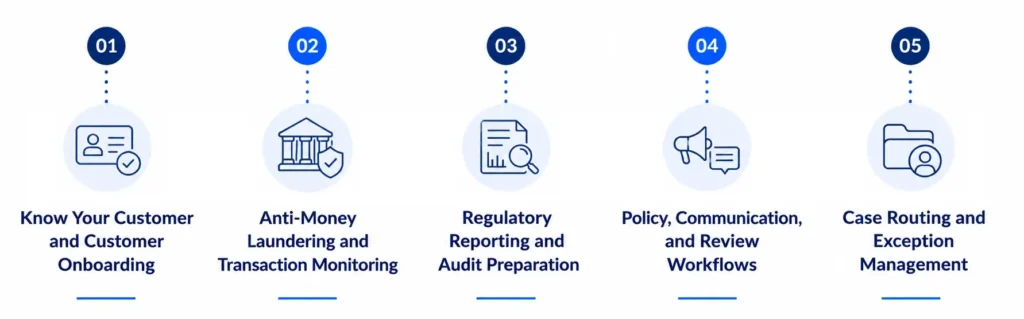
Key areas where automation creates value include:
-
Know Your Customer and Customer Onboarding
- Where cost reduces
AI can extract data from customer documents, verify required fields, and compare information across systems. This reduces manual review time and prevents teams from re-entering the same data across platforms. - Where control improves
Standardized checks help ensure customer verification follows approved rules. Low-risk files can move faster, while incomplete or higher-risk cases are escalated for human review.
- Where cost reduces
-
Anti-Money Laundering and Transaction Monitoring
- Where cost reduces
AI can help prioritize alerts by risk relevance and customer context. This reduces time spent reviewing low-value alerts and helps analysts focus on meaningful exceptions. - Where control improves
Better alert triage does not remove investigation. It helps compliance teams spend more time on cases that show credible risk signals.
- Where cost reduces
-
Regulatory Reporting and Audit Preparation
- Where cost reduces
Automation can bring customer data, screening results, case notes, and decision history into one structured workflow. This reduces manual effort when teams prepare reports or respond to audits. - Where control improves
Audit trails become easier to follow when every action, approval, exception, and data source is recorded. This makes compliance evidence more consistent and easier to review.
- Where cost reduces
-
Policy, Communication, and Review Workflows
- Where cost reduces
AI can help review customer communications, onboarding messages, and policy-related content against internal standards. This reduces manual checking across high-volume banking operations. - Where control improves
Predefined guardrails can flag unsupported claims, missing disclosures, or inconsistent language before communication reaches customers.
- Where cost reduces
-
Case Routing and Exception Management
- Where cost reduces
Automation can route onboarding cases based on risk, complexity, missing information, and reviewer availability. This reduces queue delays and avoids unnecessary handoffs. - Where control improves
High-risk cases still go to experienced teams. The difference is that reviewers receive better context before they begin.
- Where cost reduces
The value of bank compliance automation is not only lower cost. It is better control over where human effort goes. Banks can use automation to remove routine friction while keeping expert judgment focused on the decisions that matter most.
The Data, Governance, and Architecture Banks Need to Scale AI Onboarding
AI-led onboarding will not scale on weak foundations. Banks need connected customer, identity, account, transaction, risk, and compliance data before AI recommendations can be trusted. A customer file often contains IDs, ownership records, business documents, contracts, payment behavior, prior alerts, and internal risk notes. AI must understand that context safely and show where each recommendation came from. That makes data lineage, metadata, access controls, and audit logs essential for AI for banking onboarding. Without these controls, even a strong AI model can create confusion, inconsistent reviews, or compliance concerns.
Governance must also sit inside the onboarding workflow, not outside it. Banks need clear rules for what AI can recommend, what requires human approval, which data sources models can access, and how outputs are explained to reviewers. Architecture matters just as much. Modern onboarding needs secure integrations across core banking, CRM, KYC, AML, document, and case management platforms. A scalable AI onboarding stack should support document intelligence, identity verification, risk scoring, human-in-the-loop review, model monitoring, audit logs, and secure APIs. This is how banks scale intelligence while protecting customer trust and regulatory control.
How TxMinds Helps Banks Build AI-Led Compliance Operations
At TxMinds, we help financial enterprises move from fragmented onboarding workflows to governed AI-led compliance operations. We focus on practical modernization that connects customer onboarding, compliance workflows, data foundations, and platform reliability.
We work with banks to assess onboarding friction, data readiness, legacy constraints, and compliance workflow gaps. From there, we design AI-enabled workflows that improve speed, control, and reviewer productivity across KYC, AML, CRM, case management, and core banking systems.
We also design human-in-the-loop controls where compliance teams remain accountable for sensitive decisions. For banks exploring AI in financial services, we help build bank compliance automation that improves onboarding without cutting corners.
VP, Delivery, Digital Engineering
Vivek Gupta is the Vice President of Delivery at Tx with over 25 years of experience driving digital transformation. At Tx, he has built the foundation for DevOps, Digital, and Cloud practices, shaping strategies that empower businesses. Before joining Tx, Vivek held leadership roles at Infosys and Tech Mahindra. His leadership fuels innovation, strengthens delivery excellence, and enhances Tx's global impact. Vivek's commitment to driving change ensures our clients stay ahead in an evolving digital landscape.
FAQs
How is AI in financial services improving banking customer onboarding?
AI in financial services helps banks automate document review, identity verification, KYC checks, AML screening, and risk scoring. This reduces manual effort and helps onboarding teams move customers through verification faster while keeping compliance controls in place.
What is bank compliance automation in customer onboarding?
Bank compliance automation uses AI, workflow automation, rules engines, and data integration to reduce repetitive compliance work. It helps banks check documents, validate customer information, route exceptions, and maintain audit trails across onboarding workflows.
Can AI for banking onboarding reduce compliance costs without increasing risk?
Yes, AI for banking onboarding can reduce compliance costs when it is designed with human oversight, explainability, audit logs, and risk-based escalation. The goal is not to bypass compliance teams, but to help them focus on higher-risk decisions.
What do banks need before scaling AI-led onboarding?
Banks need trusted data, secure system integrations, clear governance rules, model monitoring, and human-in-the-loop workflows. Without these foundations, AI-led onboarding can create inconsistent decisions, weak traceability, and compliance concerns.
Discover more