


Recommended Blogs

Blog
Real-Time Data for Business: From Delayed Reporting to Decision Advantage
Table of Content
- Key Takeaways
- What Real-Time Data for Business Means for Enterprise Leaders
- The Business Cost of Delayed Intelligence
- Real-Time Data for Business: Turning Data Pipeline Benefits into Decision Advantage
- Building a Real-Time Data Strategy Without Adding Enterprise Complexity
- How TxMinds Helps Enterprises Move from Reporting Lag to Trusted Data Advantage
Share On


What happens when your business sees the signal only after the customer has left, the margin has slipped, or the operation has already failed? That is the quiet cost of delayed data. Leaders may have dashboards, reports, and analytics teams, yet still miss the moment where action would have mattered. When data arrives late, the enterprise is not managing performance. It is explaining what already went wrong.
That gap is now strategic. Reports suggest that the global real-time analytics market will reach US$43.8 billion in 2026, with growth projected to US$223.3 billion by 2033.
That growth signals a leadership shift, not just a technology trend. Enterprises are investing because delayed reporting can no longer support fast-moving decisions. Real time data for business helps leaders see risk earlier, respond with cleaner context, and act before small signals become expensive outcomes.
Explore this blog to understand what real-time data changes, what businesses miss without it, and how trusted pipelines turn speed into decision advantage.
Key Takeaways
- The real-time analytics market is projected to grow from US$43.8 billion in 2026 to US$223.3 billion by 2033.
- Only 49% of business leaders can reliably generate timely insights.
- 49% of data and analytics leaders say poor business context can lead to incorrect conclusions.
- Strong data pipelines help reduce latency, improve data quality, support AI readiness, and reduce manual reconciliation.
What Real-Time Data for Business Means for Enterprise Leaders
Real-time data does not mean every system updates every second. That is rarely necessary, and often expensive. It means the right data reaches the right workflow while the decision still matters.
For enterprise leaders, the definition should be business-led. A fraud signal may need seconds. A claims update may need minutes. A financial planning view may need hourly refreshes. The point is not absolute speed. The point is decision relevance.
From historical reporting to active intelligence
Traditional reporting explains what happened. Real-time business intelligence helps teams understand what is changing now. That shift matters because modern enterprises operate across connected systems, customers, suppliers, employees, applications, and partners.
Delayed reporting creates an operating lag. Leaders see performance after the business has already moved. Teams then spend time reconciling numbers instead of correcting issues.
What real-time looks like in practice
Real-time intelligence can support several leadership priorities:
- Operations teams can spot bottlenecks before service levels decline.
- Finance teams can monitor margin pressure closer to the transaction.
- Product teams can see adoption signals during active customer journeys.
- Risk teams can detect anomalies before exposure grows.
- Technology teams can connect system health with business impact.
The best real-time programs do not start with tooling. They start with decisions where delay creates measurable business risk.
The Business Cost of Delayed Intelligence
Delayed data looks harmless until it compounds. Salesforce’s 2026 data and analytics trends reported that only 49% of business leaders say they can reliably generate timely insights. The same research found that 49% of data and analytics leaders say poor business context can lead to incorrect conclusions.
Delayed intelligence can hurt the business in several ways:
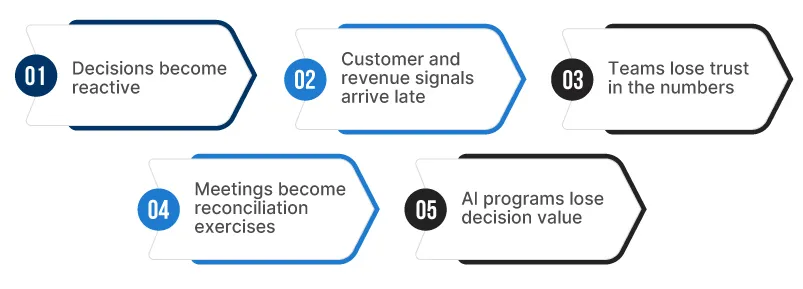
- Decisions become reactive: Leaders approve corrective action after the impact has already moved through operations.
- Customer and revenue signals arrive late: A delayed inventory signal can trigger missed demand. A delayed customer signal can turn frustration into churn.
- Teams lose trust in the numbers: Sales, finance, and operations may each work from different versions of performance data.
- Meetings become reconciliation exercises: Leaders spend time agreeing on the truth before they can decide what to do next.
- AI programs lose decision value: Stale, incomplete, or disconnected data weakens copilots, predictive analytics, personalization, and automation.
Real-time business intelligence reduces this operating gap. It helps leaders move from explaining variance to managing conditions while they can still influence outcomes. The goal is trusted visibility at the point where action still matters.
Real-Time Data for Business: Turning Data Pipeline Benefits into Decision Advantage
Real-time outcomes depend on what happens before the dashboard. Data must move from source systems into usable formats, then be validated, governed, monitored, and delivered where decisions happen. That is where the strongest data pipeline benefits emerge.
Strong pipelines create value in practical ways:
- They reduce latency across reporting and operational workflows.
- They improve data quality through validation and exception handling.
- They strengthen governance through lineage, access control, and ownership.
- They support AI readiness with cleaner and fresher inputs.
- They reduce manual reconciliation across teams and systems.
These benefits matter because real-time data can amplify both strength and weakness. Fast bad data is still bad data. Real time data for business works best when speed, trust, and governance move together.
Building a Real-Time Data Strategy Without Adding Enterprise Complexity
A real-time data strategy should not turn into another enterprise complexity layer. Leaders need a focused approach that moves the right data at the right speed, applies governance where trust matters, and starts with workflows where delay creates visible cost, customer friction, operational waste, or risk exposure.
1. Shift to ELT and Stream Processing
Instead of transforming data before it reaches a warehouse or lakehouse, enterprises can move raw data into a central platform first. Transformation can then happen closer to analytics, reporting, and operational use cases.
- Use ELT where flexibility matters. This helps teams ingest data faster and refine transformations as business needs change.
- Use streaming where timing matters. Event streams can capture updates, transactions, and operational signals as they happen.
This approach supports real-time business intelligence without forcing every workload into the same architecture.
2. Implement a Unified Semantic Layer
A real-time strategy can fail when every team builds its own point-to-point pipeline. That creates duplication, inconsistent definitions, and new maintenance pressure.
- Centralize core business definitions in a shared semantic layer.
- Make metrics reusable across dashboards, applications, and analytics workflows.
- Reduce dependency on custom queries for every new reporting need.
This gives business teams faster access to trusted answers. It also protects leaders from competing versions of revenue, margin, risk, or customer performance.
3. Start with a Vertical Slice Pilot
Do not begin with an enterprise-wide rollout. Choose one high-value workflow where real-time data can prove measurable value quickly.
- Select a use case tied to business impact, such as churn risk, service delay, claims routing, or inventory visibility.
- Map the systems, owners, and data flows needed for that specific outcome.
- Build a focused pilot that shows value before expanding the model.
A vertical slice keeps complexity contained. It also helps teams learn what governance, integration, and operating changes are required.
4. Decouple Governance and Architecture
Governance should not become a bottleneck for every real-time use case. At the same time, speed cannot come at the cost of trust, security, or accountability.
- Automate governance where possible through metadata, lineage, access rules, and quality checks.
- Embed controls into platforms and pipelines instead of relying only on manual approvals.
- Give teams a controlled access to data while maintaining visibility for risk and compliance leaders.
This balance helps the business move faster without creating unmanaged data exposure.
5. Consolidate Your Tech Stack
Too many tools can fracture data ownership and increase operational drag. A real-time strategy should simplify the environment, not add another layer of disconnected systems.
- Review tools that duplicate ingestion, transformation, governance, or reporting capabilities.
- Prioritize platforms that support both batch and real-time processing.
- Retire outdated systems that create redundant storage, manual work, or unclear ownership.
The strongest real-time strategies are focused and disciplined. They reduce complexity by aligning architecture, governance, and business priorities around the decisions that matter most.
How TxMinds Helps Enterprises Move from Reporting Lag to Trusted Data Advantage
At TxMinds, we help enterprises build trusted data foundations for faster, clearer, and more confident decisions. We approach real time data for business as an operating capability, not just a dashboard upgrade.
We work with leaders to identify where delayed data creates measurable business risk. Then we help modernize the data pipelines, cloud platforms, integration layers, and governance controls that support real-time intelligence.
Our teams bring data engineering, AI-native engineering, platform scalability, and enterprise modernization expertise into one delivery motion. We design trusted data pipelines that support analytics, AI, reporting, and operational workflows without losing control.
We also help organizations strengthen observability, data quality, lineage, and security from the start. That matters because real-time systems must be trusted before they can be scaled.
For enterprises moving from delayed reporting to decision advantage, TxMinds helps create practical, scalable, and AI-ready data foundations.

Rajiv Diwan
VP and Global Head Data & AI Practice
Results-oriented Data Analytics & AI Specialist with 24+ years of experience in multiple roles, including Practice Leader with P&L ownership. Expert in building Data Analytics practices, defining market strategies, and leading large-scale transformation initiatives. Skilled in Business Intelligence, Data Engineering, Cloud platforms (Azure, AWS, GCP), AI/ML, and Data Governance, with a strong focus on customer-centric solutions and strategic alliances.
FAQs
What is real time data for business?
Real time data for business means giving leaders timely, trusted information while decisions still matter. It helps teams act on current signals instead of waiting for delayed reports.
How does real time business intelligence help enterprises?
Real time business intelligence helps enterprises see operational changes earlier. It supports faster decisions, better customer response, stronger risk detection, and clearer performance visibility.
What are the main data pipeline benefits for real-time analytics?
Key data pipeline benefits include lower data latency, better data quality, stronger governance, cleaner analytics, and improved AI readiness. Strong pipelines help turn raw data into trusted business insight.
Does every business process need real-time data?
No. Not every process needs instant data. Leaders should prioritize workflows where delayed information creates cost, risk, customer friction, or missed business opportunities.
Discover more