


Recommended Blogs

Blog
From Code to Cloud: Rethinking Secure Application Development with DevSecOps
Table of Content
- Why Secure Application Development is Now a Leadership Priority
- Building a Secure SDLC that Moves Security into Every Delivery Stage
- Shift-Left Security: Catching Vulnerabilities Before They Reach Production
- Secure Application Development Best Practices from Code to Cloud
- How TxMinds Helps Enterprises Build Secure, Cloud-Ready Applications
Share On


Software now moves through more hands, tools, clouds, APIs, and automated pipelines than ever. That creates speed, but it also creates more places for risk to enter quietly. For C-level technology leaders, secure application development is no longer a late-stage security review. It is a delivery discipline that protects trust, uptime, customer data, and enterprise growth.
The value is practical. DevSecOps helps teams catch weaknesses earlier, reduce rework, and release software with stronger confidence. It also gives leaders better control across the secure SDLC, from design decisions and code changes to CI/CD pipelines, cloud configuration, and production monitoring.
This blog explains how DevSecOps reshapes application delivery from code to cloud. You will see where shift-left security fits, how developers can catch vulnerabilities early, and which application security best practices matter most for enterprise teams.
This blog gives leaders a practical way to compare both models and decide which cloud approach gives the enterprise stronger control over performance, cost, resilience, and modernization.
Key Takeaways
- By 2028, 50% of enterprise cybersecurity incident response efforts may involve custom-built AI-driven applications, making secure application development a leadership priority.
- DevSecOps strengthens the secure SDLC by moving security into design, coding, testing, deployment, and operations.
- Shift-left security helps developers catch vulnerabilities earlier through threat modeling, code scanning, dependency checks, secrets scanning, and infrastructure reviews.
- Application security best practices must extend from code to cloud, covering CI/CD pipelines, cloud configurations, access controls, APIs, data protection, and runtime visibility.
Why Secure Application Development is Now a Leadership Priority
Security failures no longer stay inside engineering or operations teams. They affect customer trust, regulatory exposure, business continuity, and executive risk decisions. Enterprise applications now depend on APIs, open-source packages, cloud services, containers, and automated pipelines. Each layer improves speed but also expands the attack surface.
Gartner predicts that by 2028, more than 50% of enterprises will use AI security platforms to secure third-party AI service usage and protect custom-built AI applications. That raises the stakes for secure application development across the full SDLC, especially as enterprises build more AI-enabled applications and workflows.
DevSecOps helps leaders reduce this risk by moving security closer to design, code, testing, deployment, and operations. It gives teams earlier visibility, clearer ownership, and stronger control before issues reach production.
Building a Secure SDLC that Moves Security into Every Delivery Stage
A secure SDLC strengthens existing development methods without adding unnecessary process weight. It brings security thinking, controls, and validation into every stage of delivery. For executives, this creates a more predictable delivery model with fewer late surprises. NIST’s Secure Software Development Framework recommends integrating secure software development practices into each SDLC implementation. That guidance matters because security cannot depend on heroic reviews or isolated specialists.
A practical secure SDLC should include:
- Threat modeling during planning and architecture design
- Secure coding standards inside daily engineering workflows
- Code review with security-relevant checks
- Automated testing across CI/CD pipelines
- Dependency scanning for open-source packages
- Infrastructure-as-code scanning before deployment
- Runtime monitoring after release
- Clear remediation ownership across product, engineering, security, and operations
The real shift is cultural. Security stops being a gate at the end and becomes an operating standard throughout delivery.
Shift-Left Security: Catching Vulnerabilities Before They Reach Production
What is shift-left security in DevSecOps? It means moving security earlier into design, development, and testing. Teams address risk while changes are still easier and less expensive. This does not mean every developer becomes a security expert. It means developers receive practical guidance, useful tools, and timely feedback inside their normal workflow.
How can developers catch vulnerabilities early
Developers catch vulnerabilities early when security checks run before code reaches production. A finding inside a pull request is more useful than a critical issue before launch. Early detection works best when teams combine automation with engineering judgment. Tools can flag risky patterns, exposed secrets, weak dependencies, and misconfigured infrastructure.
Strong shift-left security often includes these practices:
- Threat modeling before development: Teams identify abuse cases, sensitive data, trust boundaries, and likely attack paths.
- Static application security testing: SAST checks source code for risky patterns before the application runs.
- Software composition analysis: SCA identifies known vulnerabilities in open-source libraries and third-party components.
- Secrets scanning: Pipeline checks detect exposed tokens, keys, and passwords before merge.
- Infrastructure-as-code scanning: Cloud misconfigurations are detected before environments are provisioned.
Shift-left security works when it helps developers move faster with better confidence. It fails when security becomes another disconnected compliance layer.
Secure Application Development Best Practices from Code to Cloud
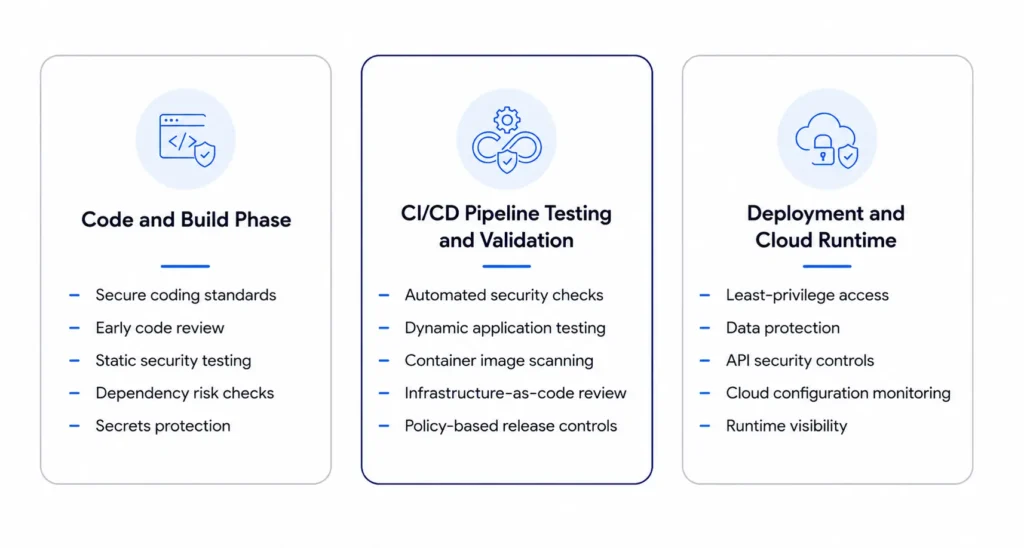
Secure application development from code to cloud means protecting software across the full secure SDLC. The practical answer is straightforward: security must be designed early, tested continuously, and monitored after deployment. These application security best practices help teams apply shift-left security without losing delivery momentum.
-
Code and Build Phase
- Secure coding standards: Define coding rules that prevent common flaws like injection, broken access, and unsafe input handling.
- Early code review: Review sensitive workflows, authentication logic, data handling, and permission checks before code moves forward.
- Static security testing: Scan source code during pull requests to catch risky patterns before merge.
- Dependency risk checks: Review third-party packages for known vulnerabilities, outdated versions, and unnecessary libraries.
- Secrets protection: Keep passwords, tokens, and keys out of code, repositories, and build logs.
-
CI/CD Pipeline Testing and Validation
- Automated security checks: Add security testing into CI/CD pipelines so risks are detected before release.
- Dynamic application testing: Test running applications in controlled environments for runtime weaknesses and misconfigurations.
- Container image scanning: Check container images for vulnerable packages, exposed files, and excessive permissions.
- Infrastructure-as-code review: Validate cloud templates before provisioning resources or changing environments.
- Policy-based release controls: Use defined security rules to decide whether a build can move forward.
-
Deployment and Cloud Runtime
- Least-privilege access: Give applications, services, and users only the permissions required for their roles.
- Data protection: Encrypt sensitive data at rest and in transit across applications, APIs, and cloud services.
- API security controls: Protect backend communication through strong authentication, authorization, rate limits, and input validation.
- Cloud configuration monitoring: Continuously check cloud resources for risky permissions, exposed storage, and weak network rules.
- Runtime visibility: Monitor application behavior, logs, access patterns, and alerts to detect threats early.
Strong DevSecOps maturity comes from making security repeatable. The goal is not only safer code, but controlled delivery from development to cloud operations.
How TxMinds Helps Enterprises Build Secure, Cloud-Ready Applications
At TxMinds, we help enterprises make secure modern application development part of delivery execution. We work with technology leaders who need speed, resilience, and security to move together.
We support secure SDLC adoption through application modernization, cloud-native engineering, platform thinking, DevSecOps automation, and quality engineering. Our teams help define security practices that fit existing delivery models, rather than forcing disconnected controls into fast-moving teams.
We help enterprises strengthen code-to-cloud delivery through secure architecture, CI/CD security checks, vulnerability management, cloud configuration review, and observability. We also help teams improve governance so ownership is visible across development, security, and operations.
Our approach is practical. We focus on reducing delivery friction, improving control, and helping leaders build applications that are secure by design. For enterprises strengthening secure application development, TxMinds helps shape the next step with clarity, engineering depth, and practical code-to-cloud execution.

Vivek Gupta
VP, Delivery, Digital Engineering
Vivek Gupta is the Vice President of Delivery at Tx with over 25 years of experience driving digital transformation. At Tx, he has built the foundation for DevOps, Digital, and Cloud practices, shaping strategies that empower businesses. Before joining Tx, Vivek held leadership roles at Infosys and Tech Mahindra. His leadership fuels innovation, strengthens delivery excellence, and enhances Tx's global impact. Vivek's commitment to driving change ensures our clients stay ahead in an evolving digital landscape.
FAQs
What is secure application development?
Secure application development is the practice of building security into every stage of software delivery. It covers design, coding, testing, deployment, cloud configuration, and runtime monitoring so vulnerabilities are reduced before applications reach production.
What is shift-left security in DevSecOps?
Shift-left security in DevSecOps means moving security checks earlier in the development lifecycle. Instead of waiting for final testing, teams use threat modeling, secure coding reviews, SAST, dependency scanning, and secrets scanning during development.
How do you build security into application development?
You build security into application development by creating a secure SDLC. This includes secure architecture, coding standards, automated CI/CD security checks, dependency reviews, infrastructure-as-code scanning, access controls, and continuous monitoring.
How can developers catch vulnerabilities early?
Developers can catch vulnerabilities early by using shift-left security practices. These include scanning code during pull requests, reviewing open-source dependencies, detecting exposed secrets, testing risky workflows, and checking cloud configuration before deployment.
Discover more