


Recommended Blogs
Blog
AI-Driven DevSecOps: How Enterprises Can Accelerate Delivery Without Expanding Risk
Table of Content
- Key Takeaways
- Why Speed Without Security is no Longer a Competitive Advantage
- AI-Driven DevSecOps: From Reactive Security to Intelligent Risk Prevention
- Embedding Security into Digital Engineering Services at Enterprise Scale
- The Strategic Role of AI in Enterprise DevSecOps Transformation
- How TxMinds Empowers Enterprises to Accelerate Secure Digital Delivery
Share On


How fast can an enterprise move before speed becomes its own risk? The challenge is no longer whether engineering can move quickly. It is whether leaders can trust what moves into production. AI-generated code, open-source dependencies, cloud sprawl, and regulatory pressure have turned software delivery into a system of executive risk.
IBM’s 2025 Cost of a Data Breach Report found that the global average breach cost reached USD 4.44 million, even after a 9% year-over-year decline driven by faster identification and containment.
That is the leadership dilemma. Speed matters, but trust decides whether speed scales. This blog talks about how AI-driven DevSecOps helps enterprises accelerate delivery, strengthen governance, and reduce risk across modern digital engineering services.
Key Takeaways
- Speed now carries risk. Enterprises must move faster without reducing trust in production.
- The cost of failure is high. IBM’s 2025 report cites USD 4.44 million as the global average breach cost, despite a 9% decline.
- AI-driven DevSecOps needs focus. The blog highlights five practical use cases across detection, automation, prioritization, policy, and runtime feedback.
- Enterprises need a model. The blog outlines four steps to make DevSecOps continuous, governed, and scalable.
Why Speed Without Security is no Longer a Competitive Advantage
Enterprise leaders no longer compete only on product features or launch timelines. They compete on how reliably their organizations can change. A new customer portal, claims platform, payment workflow, or data product must move quickly.
It must also withstand regulatory scrutiny, cyber threats, and operational failure. Traditional delivery models struggle with this balance. Security reviews often arrive late, after architecture decisions and coding patterns are already set.
The Hidden Cost of Delayed Security
Security debt does not usually begin with a major failure. It begins with one skipped review, one postponed fix, or one exception nobody revisits.
Over time, these small choices become business risk. Customers experience outages. Regulators ask harder questions. Leaders lose confidence in release decisions. It is why speed alone is not enough. A faster pipeline only helps when the organization can trust what it ships.
The real question is simple: can the enterprise move faster without hiding more risk? AI-driven DevSecOps helps answer that question by putting security inside daily engineering work. Security is no longer a final checkpoint. It becomes part of how software is designed, built, tested, and released.
AI-Driven DevSecOps: From Reactive Security to Intelligent Risk Prevention
DevSecOps automation AI is not about replacing security teams with algorithms. It is about giving teams the context, speed, and precision they need. Modern software estates generate more signals than humans can reasonably interpret.
Code commits, container images, APIs, infrastructure templates, secrets, dependencies, and runtime logs all carry risk indicators. AI helps convert that noise into decision-ready insight. It can classify vulnerabilities, prioritize exploitability, detect anomalous patterns, and recommend remediation paths.
Where AI Creates Real DevSecOps Value
Enterprises should focus on AI where volume, pattern recognition, and speed matter most.
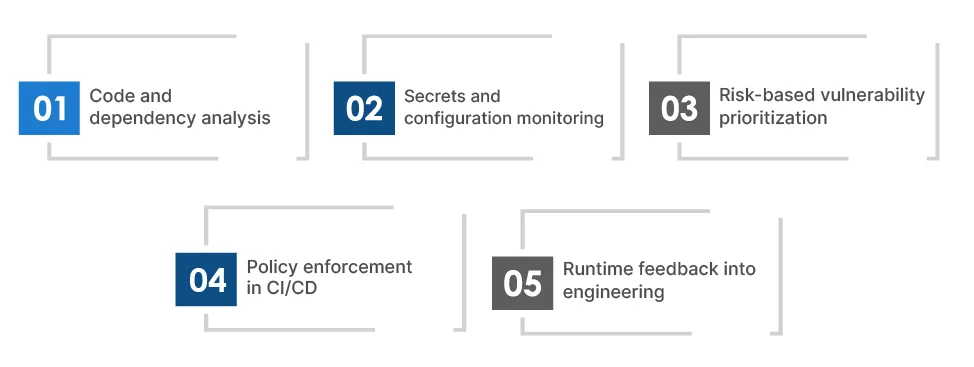
- Code and dependency analysis
AI can identify risky coding patterns and vulnerable packages earlier. It helps teams prevent defects before the pressure to release builds.
- Secrets and configuration monitoring
Automated scans can detect exposed keys, weak policies, and misconfigured environments across repositories and pipelines.
- Risk-based vulnerability prioritization
AI can help rank issues using exploitability, asset criticality, exposure, and business impact.
- Policy enforcement in CI/CD
Security rules can become automated gates rather than late-stage advisory comments.
- Runtime feedback into engineering
Production signals can inform backlog priorities, architecture hardening, and incident prevention.
The trade-off is simple. AI can help teams move faster, but it can also hide risk when governance is weak. Enterprises need clear guardrails, review workflows, and continuous checks to ensure AI supports engineering judgment rather than replacing it.
Embedding Security into Digital Engineering Services at Enterprise Scale
Digital engineering services are now the operating system of enterprise transformation. They cover modern application development, cloud platforms, data engineering, AI solutions, APIs, integration layers, and user experience.
Each layer expands the organization’s digital capability. Each layer also expands the attack surface. For large enterprises, this creates a structural challenge. Transformation programs often run across multiple business units, vendors, clouds, and legacy systems. Security standards may exist, but implementation varies widely.
Standardization Creates Executive Control
AI-driven DevSecOps helps bring consistency to distributed engineering. Leaders gain a repeatable model for secure delivery across portfolios. That model should include shared policies, automated evidence, reusable controls, and measurable engineering practices.
A mature approach usually includes:
- Secure coding standards embedded in developer workflows
- Automated SAST, DAST, SCA, IaC, and container security checks
- SBOM generation and third-party dependency visibility
- Identity, secrets, and access controls across pipelines
- Compliance evidence generated through automated delivery records
- Risk dashboards that translate technical issues into business exposure
This is where digital engineering services become strategic. Enterprises are not only securing what they build. They are also securing what they import, configure, extend, and deploy. AI-driven DevSecOps gives leaders better control over that reality.
The Strategic Role of AI in Enterprise DevSecOps Transformation
An AI digital transformation strategy should make DevSecOps more predictive, not just more automated. Automation can run checks faster. AI helps teams understand what those checks mean and where risk is building.
This difference matters at enterprise scale. A pipeline may produce thousands of alerts, but leaders still need clear answers. Which risks can delay a release? Which issues affect critical systems? Which patterns suggest a larger security gap?
AI helps connect signals across code, cloud, infrastructure, logs, and workflows. That gives teams a stronger view of risk before it becomes disruption. It also helps leaders move from isolated security checks to a continuous operating model.
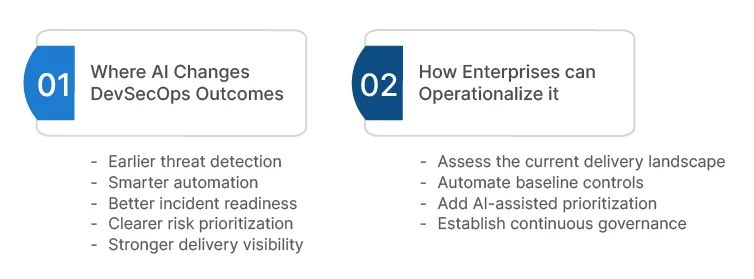
Where AI Changes DevSecOps Outcomes
AI becomes valuable when it improves decisions, not just task completion. For large enterprises, its role should focus on outcomes that reduce uncertainty.
- Earlier threat detection: AI can identify suspicious patterns, weak configurations, and risky code changes earlier in the lifecycle.
- Smarter automation: It reduces repetitive work across reviews, testing, triage, and reporting.
- Better incident readiness: AI can connect signals across systems and help teams spot failure patterns sooner.
- Clearer risk prioritization: It helps teams focus on vulnerabilities that carry real business exposure.
- Stronger delivery visibility: AI gives leaders a sharper view of bottlenecks, exceptions, and security posture across value streams.
How Enterprises can Operationalize it
AI-driven DevSecOps should not be treated as a tool rollout. It needs an operating model that connects engineering, security, architecture, compliance, and business ownership.
- Assess the current delivery landscape: Map application portfolios, pipelines, tools, environments, vulnerabilities, and release bottlenecks. Identify where manual reviews delay delivery or miss risk.
- Automate baseline controls: Integrate security checks into CI/CD workflows. Automate dependency scanning, infrastructure checks, container validation, and secrets detection.
- Add AI-assisted prioritization: Use AI to connect vulnerability data with asset criticality, exposure, and business context. It helps teams avoid treating every issue equally.
- Establish continuous governance: Create dashboards, audit trails, and feedback loops that make risk visible. Governance should guide decisions, not simply document failures.
This model also needs cultural discipline. Developers need timely feedback inside their normal tools, while security teams must act as enablement partners, not ticket reviewers. The real value is not that AI makes DevSecOps faster. It is that enterprises can make better release decisions under pressure and turn secure delivery into a business capability.
How TxMinds Empowers Enterprises to Accelerate Secure Digital Delivery
At TxMinds, we help enterprises embed security directly into DevOps practices without slowing delivery. Our DevSecOps implementation and automation services focus on continuous monitoring, assessment, analysis, and early identification of SDLC gaps.
We support teams with DevSecOps automation, CI/CD automation, GitOps, test automation, Infrastructure as Code, continuous monitoring, and automated infrastructure. This helps enterprises reduce manual effort, improve traceability, and make release decisions with stronger confidence.
We also bring built-in governance, policy control, audit readiness, and pipeline visibility into delivery workflows. Our approach helps security become part of engineering execution, not a separate approval layer.
For enterprises shaping an AI digital transformation strategy, we enable secure, scalable, and automation-led digital engineering services. With practical DevSecOps automation AI, we help organizations accelerate delivery while keeping risk visible, managed, and aligned with business priorities.

Amar Jamadhiar
VP, Delivery North America
Amar Jamadhiar is the Vice President of Delivery for TxMind's North America region, driving innovation and strategic partnerships. With over 30 years of experience, he has played a key role in forging alliances with UiPath, Tricentis, AccelQ, and others. His expertise helps Tx explore AI, ML, and data engineering advancements.
FAQs
How does AI-driven DevSecOps support digital engineering services?
AI-driven DevSecOps helps make digital engineering services more secure and scalable. It brings security checks, risk visibility, and governance into daily engineering workflows.
Why should enterprises include DevSecOps in their AI digital transformation strategy?
An AI digital transformation strategy should not focus only on speed. It should also help leaders reduce delivery risk, improve release confidence, and strengthen security governance.
What is DevSecOps automation AI?
DevSecOps automation AI uses artificial intelligence to support security testing, vulnerability prioritization, policy checks, and risk detection across the software delivery lifecycle.
Can AI-driven DevSecOps help enterprises release software faster?
Yes. AI-driven DevSecOps can reduce manual reviews, improve risk prioritization, and help teams fix issues earlier. It supports faster delivery without compromising security.
Discover more