

Recommended Blogs

Blog
Future-Proofing Mobile Banking: QA Strategies for Reliability and Scale

 Last Updated: June 9th, 2026
 Read Time: 5 minutes
Table of Content
- The Mobile-First Mandate: Why Banking Apps Can’t Fail
- Modern QA Challenges That Threaten Mobile Reliability
- Strategic QA Playbook for Reliability and Scale
- Scaling QA Across the Enterprise Without Compromising Speed
- How TxMinds Drives Enterprise-Grade Mobile Banking QA
Share On


Mobile banking is no longer a convenience. It is the frontline of customer trust, brand perception, and operational resilience. Every interaction, from logging in to completing transactions, communicates reliability or exposes risk. Yet many banks treat quality assurance as a back-office checkpoint rather than a strategic lever.
For executives, the stakes are clear. A minor flaw can cascade into customer frustration, operational inefficiency, and regulatory scrutiny. The challenge is not just preventing bugs but designing QA as an integral part of enterprise strategy that supports both speed and scale.
This blog explores how banking leaders can rethink mobile-first QA to protect trust, accelerate innovation, and maintain reliability across platforms. Gain actionable insights into aligning testing frameworks with business objectives, managing risk without slowing delivery, and ensuring that mobile apps remain resilient and customer-centric in 2026.
Key Takeaways
- Mobile banking apps have high stakes as 70% of users uninstall after a single crash, highlighting the critical need for reliable QA.
- Performance and user experience directly impact loyalty, with 15% of users ceasing use after repeated failures.
- Embedding QA throughout development and automating tests ensures apps remain secure, reliable, and performant across platforms.
- Continuous monitoring, risk-aware prioritization, and coverage across devices reduce operational risk and protect customer trust.
The Mobile-First Mandate: Why Banking Apps Can’t Fail
Mobile banking is the channel where perception turns into loyalty or churn. Users judge quality with every tap, swipe, and transaction. When an app fails at a critical moment, that failure becomes a psychological scar that is hard to erase.
-
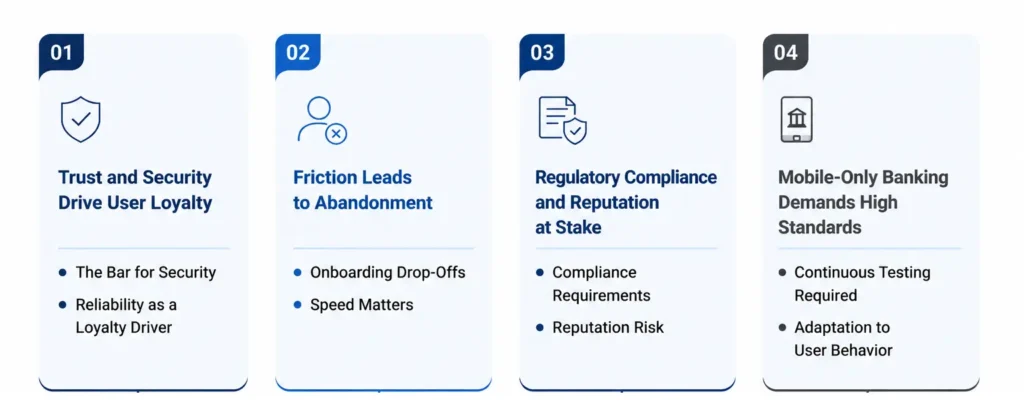
Trust and Security Drive User Loyalty
In banking, trust is the product. Users expect apps to function flawlessly for every transaction. Even minor glitches can erode confidence and increase churn.
- The Bar for Security: Security threats are a top concern for mobile banking users. Apps must combine strong protection, biometric logins, device binding, and multi-factor authentication while maintaining a smooth experience.
- Reliability as a Loyalty Driver: Studies show that nearly 70% of customer loyalty in mobile banking is influenced by app reliability and emotional design.
-
Friction Leads to Abandonment
Customers demand instant execution and intuitive design. Poor onboarding or slow performance pushes users toward competitors.
- Onboarding Drop-Offs: Confusing registration or setup processes can drive potential users away before their first transaction.
- Speed Matters: Slow load times or errors during key actions can permanently reduce engagement and brand trust.
-
Regulatory Compliance and Reputation at Stake
Mobile apps are now the perimeter for banking operations. Accessibility and data handling failures carry serious consequences.
- Compliance Requirements: Apps must meet standards for accessibility, secure data handling, and transaction integrity.
- Reputation Risk: Failures can lead to regulatory penalties, operational restrictions, and irreversible damage to brand trust.
-
Mobile-Only Banking Demands High Standards
For digital-first institutions, apps are the primary business channel. They must adapt continuously to changing user needs and maintain flawless performance.
- Continuous Testing Required: Proactive QA ensures users experience consistent reliability.
- Adaptation to User Behavior: Mobile-first apps must evolve quickly to meet new usage patterns without introducing errors.
Modern QA Challenges That Threaten Mobile Reliability
Mobile banking is now the primary interface between customers and financial institutions. Users expect apps to work reliably every time they open them. When an app fails at a critical moment, they may leave permanently. In 2026, research shows that 15% of users uninstall a mobile banking app after a single crash, and over 50% stop using it after just two or three crashes.
For banking leaders, this makes reliability not just a technical metric but a business metric directly tied to retention, revenue, and trust.
- Users abandon apps that are slow, confusing, or fail during key transactions.
- Onboarding friction or failed logins can prevent new customers from ever completing setup.
- Transaction errors during transfers or payments damage confidence and encourage competitors.
- Frequent app crashes increase customer support costs and reduce lifetime value.
- Regulatory and compliance risks rise when app failures affect data integrity or security.
For executives, QA must be treated as a strategic lever, ensuring mobile banking apps perform flawlessly under all conditions to protect trust, reduce churn, and maintain competitive advantage in 2026.
Strategic QA Playbook for Reliability and Scale
Building a mobile banking app that is both reliable and scalable requires a QA strategy designed for modern enterprise demands. QA cannot be a final checkpoint; it must be embedded throughout development, automated wherever possible, and continuously monitored. This approach ensures that performance, security, and usability are validated at every stage while supporting rapid release cycles.
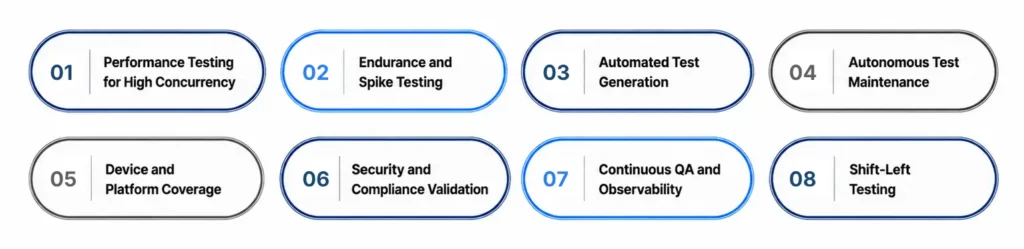
- Performance Testing for High Concurrency: Simulate thousands of simultaneous sessions to identify bottlenecks during peak usage.
- Endurance and Spike Testing: Continuously monitor system stability under sustained load and sudden traffic spikes to prevent unexpected outages.
- Automated Test Generation: Use AI or advanced frameworks to create test scenarios that reflect real user flows and edge cases.
- Autonomous Test Maintenance: Implement self-healing tests to automatically adjust when app updates introduce minor changes.
- Device and Platform Coverage: Validate performance and rendering across multiple devices, screen sizes, and operating systems.
- Security and Compliance Validation: Incorporate vulnerability scanning, encryption verification, and compliance checks into QA workflows.
- Continuous QA and Observability: Monitor app behavior in real time using analytics and application performance monitoring tools.
- Shift-Left Testing: Evaluate API definitions, requirements, and logic early to prevent defects before production release.
A modern QA playbook does more than detect defects. It builds confidence for both executives and engineering teams, reduces operational risk, and ensures that every update maintains reliability, security, and usability. With this approach, mobile banking apps can scale effectively while sustaining trust and performance in demanding enterprise environments.
Scaling QA Across the Enterprise Without Compromising Speed
Scaling QA in mobile banking requires both structure and visibility. A unified testing framework ensures consistency across teams, reduces silos, and provides a single source of truth for test definitions, shared libraries, and metrics. Coordinating QA across squads ensures that quality champions maintain standards, while centralized leadership aligns priorities across speed, compliance, and performance. Dashboards tracking coverage, defect resolution times, and production failures give executives actionable insights without requiring technical intervention.
Balancing speed and quality is critical. Fast feedback loops, automated gates, and continuous monitoring allow teams to release rapidly without sacrificing reliability. QA should be viewed as an enabler that strengthens confidence, reduces operational risk, and highlights systemic issues before they reach customers. When embedded into the enterprise workflow, QA supports rapid innovation while maintaining trust, performance, and regulatory compliance.
How TxMinds Drives Enterprise-Grade Mobile Banking QA
At TxMinds, we design QA strategies that align closely with enterprise goals. Our approach combines AI-native engineering, automation, and data-driven observability to ensure mobile banking apps are reliable, secure, and scalable. By embedding quality checks early in the development pipeline, we reduce risks before code reaches production.
We help banks build automated pipelines that catch user-impacting issues, validate functionality across devices and platforms, and bridge legacy systems with modern mobile interfaces. This approach provides executives with meaningful dashboards and metrics, offering visibility into QA health while supporting rapid release cycles.
Through reusable test infrastructure, predictive insights, and strategic QA frameworks, we empower financial institutions to maintain app reliability at scale without slowing innovation.
VP, Delivery North America
Amar Jamadhiar is the Vice President of Delivery for TxMind's North America region, driving innovation and strategic partnerships. With over 30 years of experience, he has played a key role in forging alliances with UiPath, Tricentis, AccelQ, and others. His expertise helps Tx explore AI, ML, and data engineering advancements.
FAQs
What are the best QA strategies for mobile banking apps in 2026?
The best QA strategies combine continuous testing, automated test pipelines, device coverage, risk-aware prioritization, and AI-enabled predictive QA. Embedding QA throughout the development lifecycle ensures reliability, security, and seamless user experiences across all platforms.
How does mobile-first digital transformation impact QA for banking apps?
Mobile-first transformation increases the reliance on mobile apps as the primary customer interface. QA must scale across multiple devices and OS versions, integrate with legacy systems, and validate performance, security, and usability in real time to maintain trust and operational resilience.
Why is QA critical for banking app reliability and customer retention?
Unreliable apps drive churn, increase support costs, and reduce loyalty. Studies show that a single crash can cause up to 70% of users to uninstall the app. Strong QA ensures consistent performance, regulatory compliance, and positive user experiences, protecting revenue and brand trust.
How can banks scale QA without slowing innovation?
Scaling QA requires standardized testing frameworks, cross-team coordination, automated regression testing, and continuous observability. These approaches allow rapid releases while maintaining quality, ensuring mobile apps remain performant and reliable at scale.
Discover more