

Recommended Blogs

Blog
AI for Nonprofit Grant Management: Turning Grant Workflows into Scalable Impact Engines

 Last Updated: June 8th, 2026
 Read Time: 5 minutes
Table of Content
- Why Grant Management Has Become a Strategic Technology Priority for Nonprofits
- Where AI for Nonprofit Grant Management Creates Enterprise Value
- Grant Automation Software is Not Enough Without Trusted Data and Governance
- A Practical Roadmap for Scaling AI-Enabled Grant Workflows
- How TxMinds Helps Nonprofits Build Scalable Grant Management Intelligence
Share On


For many nonprofits, the grant function has become a quiet constraint on mission scale. Funding opportunities move quickly, reporting expectations keep rising, and program teams often work harder than their systems allow.
A 2026 SAGE research article on nonprofit AI adoption surveyed 168 nonprofit organizations and included interviews with 14 executive directors, showing how leadership, culture, and external pressure shape GenAI adoption decisions. For C-level technology leaders, the question is no longer whether AI belongs in nonprofit operations. The sharper question is where it can create responsible leverage.
AI for nonprofit grant management can reduce administrative drag, strengthen funder confidence, and give leaders clearer evidence of program performance. The opportunity is not just faster paperwork alone. It is a better way to connect funding, compliance, data, and impact.
Explore this blog to understand where AI creates value, where governance matters, and how nonprofits can turn grant workflows into scalable impact engines.
Key Takeaways
- AI for nonprofit grant management reduces admin work and connects funding, compliance, data, and impact.
- A 2026 SAGE study covered 168 nonprofits and 14 executive directors on AI adoption drivers.
- A 2026 nonprofit AI study reported 92% AI adoption, but only 7% saw expanded team capacity.
- The same study found 47% had no AI policy, while another survey found 78% lacked AI audit confidence.
Why Grant Management Has Become a Strategic Technology Priority for Nonprofits
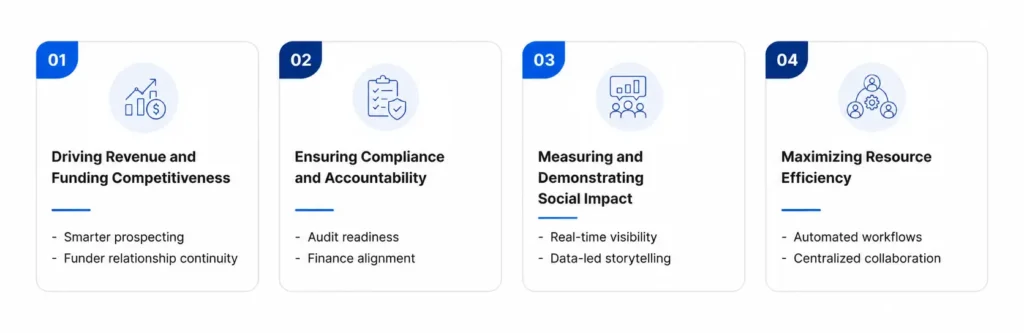
Grant management has become a leadership priority because funding now depends on speed, trust, and evidence. Nonprofits need connected workflows that help teams compete for grants, manage compliance, and show measurable program impact.
-
Driving Revenue and Funding Competitiveness
Securing grants is no longer only about strong proposals. It also depends on finding the right opportunities early, proving fit quickly, and maintaining funder confidence.
- Smarter prospecting: AI can help match funding opportunities with program goals, eligibility criteria, geography, and past performance.
- Funder relationship continuity: Connected records help teams track funder history, commitments, documents, and follow-ups across grant cycles.
-
Ensuring Compliance and Accountability
Restricted funds, reporting rules, and funder requirements demand stronger operational control. Manual tracking increases the risk of missed obligations.
- Audit readiness: Automated workflows can preserve documentation, approvals, deadlines, and reporting evidence in one place.
- Finance alignment: Grant, budget, and expense data can be connected earlier, reducing last-minute reconciliation pressure.
-
Measuring and Demonstrating Social Impact
Funders want evidence that contributions are producing tangible results. Nonprofits need systems that connect program activity with outcomes.
- Real-time visibility: Dashboards can help leaders monitor milestones, spend, and impact indicators across active grants.
- Data-led storytelling: Clean evidence helps teams explain results with more confidence, not only stronger language.
-
Maximizing Resource Efficiency
Lean teams cannot scale impact if they spend too much time managing administrative work. Grant automation software can reduce repetitive effort across the lifecycle.
- Automated workflows: Teams can streamline eligibility checks, approvals, deadline reminders, reporting tasks, and renewal preparation.
- Centralized collaboration: Shared systems reduce scattered email chains, duplicate files, and version-control issues across departments.
Where AI for Nonprofit Grant Management Creates Enterprise Value
AI for nonprofit grant management creates value when it improves decisions across the full grant lifecycle. In the pre-award stage, AI can help teams scan opportunities, check eligibility, compare funder requirements with program goals, and reuse approved proposal content more efficiently. It can also support smarter opportunity matching by considering mission fit, geography, documentation readiness, and past performance.
After funding is awarded, AI helps teams move from reactive reporting to continuous visibility. It can summarize program activity, flag missing documentation, compare delivery against funder commitments, and organize metrics, narratives, financial data, and impact evidence. The role of AI is support, not substitution. People remain accountable for claims, context, funder communication, and mission judgment.
Grant Automation Software is Not Enough Without Trusted Data and Governance
Grant automation software can streamline task tracking, reminders, approvals, document storage, and reporting. That is valuable. Yet automation alone will not fix weak data or unclear ownership.
Automation can expose old process debt
Many nonprofits carry years of process debt. Different teams may define beneficiaries, program completion, restricted spend, and impact metrics differently. When grant automation software moves those definitions into workflows, inconsistencies become visible. That visibility can feel uncomfortable. It is also necessary.
Technology leaders should address four questions before scaling automation.
- Who owns each grant data field?
- Which systems are trusted sources?
- Which workflows require human approval?
- Which actions need audit-ready evidence?
Governance turns AI from activity into confidence
A 2026 nonprofit AI benchmark study by Virtuous reported that 92% of nonprofits had adopted AI, but only 7% said it expanded what their team could accomplish. The same report said 47% of nonprofits had no AI policy.
AI governance should include practical controls:
- Approved data sources for AI-assisted outputs
- Human review for submissions and reports
- Role-based access to grant and beneficiary data
- Version history for proposal and reporting changes
- Clear rules for privacy, bias, and sensitive information
Governance should not slow mission delivery. It should make scaling safer and easier to defend.
A Practical Roadmap for Scaling AI-Enabled Grant Workflows
Scaling AI-enabled grant workflows works best as a phased roadmap. Nonprofits should first strengthen data clarity, then pilot focused use cases, and only then expand automation across the grant ecosystem.
Successful adoption requires more than adding AI to existing tasks. Leaders need a structured path that improves grant speed, reduces administrative burden, and protects compliance.
Phase 1: Assessment and Data Governance
- Workflow audit: Identify bottlenecks across proposal drafting, approvals, compliance tracking, reporting, and financial reviews.
- Data unification: Create a searchable source for past proposals, funder requirements, program results, and compliance documents.
- Risk mapping: Define which documents can use public AI tools and which require approved internal systems.
Phase 2: Pilot and Prove Value
- Select use cases: Start with repetitive, low-risk tasks such as eligibility screening, grant summaries, and reporting drafts.
- Define success measures: Track cycle time, documentation completeness, reporting readiness, and staff effort saved.
- Keep expert review: Let grant managers, finance teams, and program leaders approve AI-assisted outputs.
Phase 3: Integration and Automation
- System connectivity: Connect AI workflows with grant management, CRM, finance, and document systems.
- Multi-step workflows: Use AI to extract requirements, draft summaries, route approvals, and flag missing evidence.
- Staff enablement: Train teams on prompt discipline, review standards, privacy rules, and responsible AI use.
Phase 4: Scaling and Continuous Governance
- Standardization: Build reusable templates, workflows, and playbooks for common grant types and funder needs.
- Ongoing audit: Review AI outputs, access logs, policy alignment, and regulatory changes on a regular cadence.
How TxMinds Helps Nonprofits Build Scalable Grant Management Intelligence
At TxMinds, we help nonprofits modernize grant operations with a mission-first approach. We align technology decisions with funding realities, program goals, reporting expectations, and the need for transparency across leaders, funders, donors, and beneficiaries.
Our nonprofit solutions bring AI, cloud, data modernization, cybersecurity, and compliance capabilities together. For grant management, this can include AI-assisted workflows, secure data integration, document intelligence, reporting enablement, donor and funder visibility, and governed AI solutions that keep human review in control.
We also help organizations scale responsibly. Instead of forcing large upfront change, we start with focused opportunities, prove value, and expand as teams gain confidence. The goal is to build a connected grant intelligence layer that protects sensitive data, reduces operational burden, and helps nonprofits spend more time advancing the mission.
VP, Delivery, Digital Engineering
Vivek Gupta is the Vice President of Delivery at Tx with over 25 years of experience driving digital transformation. At Tx, he has built the foundation for DevOps, Digital, and Cloud practices, shaping strategies that empower businesses. Before joining Tx, Vivek held leadership roles at Infosys and Tech Mahindra. His leadership fuels innovation, strengthens delivery excellence, and enhances Tx's global impact. Vivek's commitment to driving change ensures our clients stay ahead in an evolving digital landscape.
FAQs
What is AI for nonprofit grant management?
AI for nonprofit grant management uses AI to support grant discovery, eligibility checks, proposal drafting, reporting, compliance tracking, and impact measurement.
How does grant automation software help nonprofits?
Grant automation software helps nonprofits reduce manual work, track deadlines, manage approvals, organize documents, and improve reporting readiness.
Can AI solutions replace grant managers?
No. AI solutions should support grant managers, not replace them. Human review is still needed for funder communication, compliance, budgets, and impact claims.
What should nonprofits do before adopting AI for grant workflows?
Nonprofits should review current workflows, clean grant data, define approval rules, protect sensitive information, and start with low-risk use cases.
Discover more