

Recommended Blogs

Blog
Data Governance in AI: The Leadership Discipline Behind Trusted Enterprise Intelligence

 Last Updated: June 1st, 2026
 Read Time: 5 minutes
Table of Content
- Key Takeaways
- Why Data Governance in AI has Become a Leadership Priority
- Why Data Governance in AI Fails Without Clear Ownership and Trust
- AI Data Compliance, Privacy, and Control: The New Executive Mandate
- What Strong Data Governance in AI Looks Like at Enterprise Scale
- How TxMinds Helps Enterprises Build AI-Ready Data Governance
Share On


AI does not fail only because the model is weak. It often fails because the data behind it is unclear, incomplete, or poorly governed. For C-level technology leaders, this turns data governance in AI into a boardroom discipline, not a back-office control.
The pressure is already visible. In the 2026 Drexel LeBow and Precisely research on data integrity and AI readiness, 43% of leaders cite data readiness as the most significant barrier to aligning AI with business objectives. The same research found that 71% of organizations with governance programs report high trust in their data, compared with 50% without governance programs.
That is the leadership signal. Strong data governance and quality services helps AI become usable, compliant, explainable, and trusted. Without it, enterprises scale uncertainty faster than intelligence.
This blog covers the governance gaps that hold enterprise AI back, the rising need for AI data compliance, the role of data privacy for AI, and the leadership practices that help organizations build trusted enterprise intelligence.
Key Takeaways
- 43% of leaders cite data readiness as the biggest barrier to aligning AI with business goals.
- Organizations with governance programs report 71% data trust, compared with 50% without governance programs.
- Documented AI incidents rose to 362 in 2026, up from 233 in 2024, making governance a leadership priority.
- 51% of data and analytics leaders identify data quality as their most common data integrity priority.
Why Data Governance in AI has Become a Leadership Priority
Enterprise AI has moved beyond pilots, copilots, and isolated productivity experiments. It now influences customer decisions, operational workflows, financial forecasting, risk management, and employee productivity. That raises the standard for data control.
Traditional data governance focused on accuracy, access, storage, and reporting. Data governance in AI must go further. It must govern how data is sourced, prepared, classified, used, monitored, and reused across intelligent systems.
AI changes the cost of poor data
When AI uses incomplete, biased, outdated, or unauthorized data, the risk spreads quickly. It can show up as weak recommendations, inconsistent customer treatment, compliance exposure, or operational rework.
Leaders should view AI data governance through four business questions:
- Can we trust the data feeding this AI system?
- Can we explain how that data influenced the output?
- Can we prove the data was used within policy?
- Can we control what changes when the model scales?
These questions turn governance into a leadership operating model. They also make AI investments more defensible when scrutiny increases.
Trust is now an enterprise capability
The 2026 Stanford AI Index reports that documented AI incidents rose to 362, up from 233 in 2024. That signals a wider accountability problem as AI capability expands faster than responsible controls. AI trust cannot depend on model performance alone. It must come from governed data, clear ownership, traceable decisions, and compliance-ready workflows.
Why Data Governance in AI Fails Without Clear Ownership and Trust
Many enterprises have data policies, but AI quickly exposes where those policies lack ownership. Governance fails when data rules remain documented but not embedded into delivery, testing, approval, and monitoring.
Ownership is often too fragmented
AI systems draw from customer records, transactions, contracts, claims, service tickets, and third-party sources. Data teams manage pipelines, business teams define meaning, security teams control access, and AI teams build models.
That split creates risk when nobody owns the full decision chain. Definitions change, sensitive data enters workflows, and outputs become difficult to explain during audit. The fix is a governance model with named owners, clear decision rights, and measurable controls.
Data quality becomes AI quality
AI quality depends on data quality, but also on business context. A technically accurate dataset can still mislead AI when definitions, lineage, or usage rights are unclear. 51% of data and analytics leaders identify data quality as their most common data integrity priority.
A strong governance model should define approved AI datasets, sensitive fields, quality rules, reuse approvals, and exception owners. AI needs repeatable controls, not tribal knowledge.
AI Data Compliance, Privacy, and Control: The New Executive Mandate
AI data compliance is moving from policy review to technical architecture, where data privacy for AI must be built into code, access controls, model workflows, audit trails, and governance routines so leaders can prove how enterprise data is used, protected, monitored, and corrected.
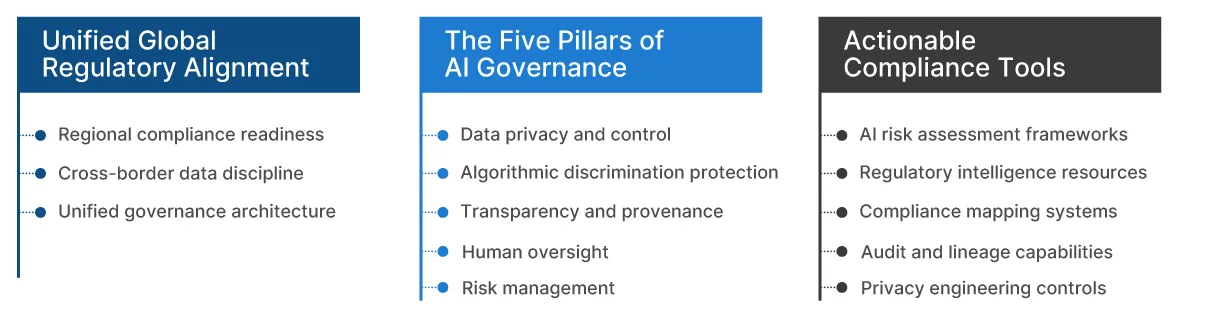
1. Unified Global Regulatory Alignment
Organizations face a fragmented regulatory environment that demands centralized, scalable controls. A single AI system may touch customers, employees, vendors, and jurisdictions with different privacy expectations.
- Regional compliance readiness: Enterprises need governance models that can adapt to local data protection rules, sector regulations, and emerging AI oversight requirements.
- Cross-border data discipline: AI workflows must account for data residency, consent, retention, and transfer requirements across markets.
- Unified governance architecture: Global enterprises need one control framework for data classification, access, lineage, auditability, and exception management.
2. The Five Pillars of AI Governance
To satisfy board-level accountability and regulatory scrutiny, AI systems must meet five core governance requirements. These pillars help leaders connect AI data compliance with practical enterprise control.
- Data privacy and control: Ensure individuals and organizations maintain clear transparency over how sensitive data is used in AI workflows.
- Algorithmic discrimination protection: Establish continuous checks to identify biased data patterns, unfair outcomes, and model behavior that needs review.
- Transparency and provenance: Maintain clear lineage for AI-generated outputs, source data, approvals, and synthetic content where relevant.
- Human oversight: Include review, escalation, and intervention paths for high-impact decisions and autonomous AI workflows.
- Risk management: Keep documentation trails that help teams trace decisions, investigate exceptions, and correct governance gaps.
3. Actionable Compliance Tools
To navigate evolving AI laws and enterprise risk, leaders need practical tools that help teams audit, secure, and govern data. These tools should support compliance without slowing every AI initiative.
- AI risk assessment frameworks: Use structured assessment methods to evaluate data sensitivity, workflow risk, model impact, and control readiness.
- Regulatory intelligence resources: Track changes in regional data protection rules, AI governance expectations, and industry-specific obligations.
- Compliance mapping systems: Connect policies to technical controls across platforms, pipelines, repositories, and AI-enabled applications.
- Audit and lineage capabilities: Maintain live records of data sources, transformations, approvals, access changes, and model usage.
- Privacy engineering controls: Apply masking, minimization, encryption, retention rules, and access restrictions before data reaches AI systems.
This creates a practical control layer for AI data compliance and data privacy for AI. It also helps teams scale intelligence without asking executives to accept hidden risk.
What Strong Data Governance in AI Looks Like at Enterprise Scale
Strong data governance in AI does not slow innovation when it is designed well. It gives teams a trusted path to build, test, and scale AI without creating hidden risk. The strongest governance models are practical, embedded, and measurable. They guide delivery from data discovery to production monitoring, while keeping ownership, compliance, and privacy visible to leadership.
- Data ownership: Every critical dataset has a business owner and technical steward.
- Data lineage: Teams can trace where data came from and how it changed.
- Metadata management: Data meaning, sensitivity, and usage rules are documented.
- Access control: Permissions reflect role, purpose, risk, and regulatory exposure.
- Quality monitoring: Rules detect missing, stale, duplicated, or inconsistent data.
- Privacy controls: Sensitive data is minimized, masked, encrypted, or restricted.
- Auditability: Teams can explain data usage, changes, approvals, and exceptions.
- Delivery governance: Data readiness, privacy exposure, lineage, and access should be tested before production.
- Operational metrics: Leaders should track ownership coverage, quality failures, privacy exceptions, and AI escalations.
These capabilities help executives separate responsible AI progress from unmanaged experimentation. They also make governance easier to measure, improve, and scale across teams. When governance is built into delivery, AI risk becomes visible before it reaches customers, regulators, or board-level review.
How TxMinds Helps Enterprises Build AI-Ready Data Governance
At TxMinds, we help enterprises build the trusted data foundations needed for scalable AI with our robust data governance and quality services. We approach data governance in AI as an operating discipline across data engineering, compliance, privacy, modernization, and AI-native delivery.
We work with leaders to assess data readiness, define governance models, improve data quality, and strengthen lineage across critical systems. We also help enterprises design AI-ready architectures where access, privacy, auditability, and control are built into delivery workflows.
Our teams support data integration, platform modernization, trusted data pipelines, application modernization, and AI-enabled engineering. We focus on practical governance that supports innovation without weakening accountability.
For enterprises moving from AI pilots to production, we help create the control layer behind trusted intelligence. The goal is simple. We help leaders scale AI with cleaner data, stronger compliance, better privacy controls, and greater business confidence.
VP and Global Head Data & AI Practice
Results-oriented Data Analytics & AI Specialist with 24+ years of experience in multiple roles, including Practice Leader with P&L ownership. Expert in building Data Analytics practices, defining market strategies, and leading large-scale transformation initiatives. Skilled in Business Intelligence, Data Engineering, Cloud platforms (Azure, AWS, GCP), AI/ML, and Data Governance, with a strong focus on customer-centric solutions and strategic alliances.
FAQs
What is data governance in AI?
Data governance in AI is the discipline of managing how enterprise data is sourced, classified, accessed, used, monitored, and audited across AI systems. It helps leaders build trusted AI outputs, reduce compliance risk, and improve accountability.
Why is AI data compliance important for enterprises?
AI data compliance helps enterprises prove that data used in AI workflows follows privacy rules, access policies, consent requirements, and industry regulations. It also supports auditability when AI influences customer, employee, financial, or operational decisions.
How does data privacy for AI differ from traditional data privacy?
Data privacy for AI goes beyond storing data securely. It controls how sensitive data moves through models, prompts, APIs, agents, retrieval systems, and automated workflows. This requires stronger rules for data minimization, masking, access, retention, and human review.
What are the best practices for strong data governance in AI?
Strong data governance in AI starts with clear ownership, trusted datasets, data lineage, access controls, quality monitoring, privacy safeguards, and audit trails. Leaders should also build governance into AI delivery checkpoints before models move into production.
Discover more