


Recommended Blogs

Blog
Insurance Data Modernization is Now a Competitive Advantage, Not an IT Upgrade
Table of Content
- Key Takeaways
- Why Insurance Data Modernization Has Become a Leadership Priority
- The Legacy Data Problem Holding Insurers Back
- From Data Fragmentation to Decision-Ready Insurance Intelligence
- The Executive Roadmap for Insurance Data Modernization
- How TxMinds Helps Insurers Build Modern, Trusted Data Foundations
Share On


For insurers, data has become the difference between operating through constraint and moving with confidence. Policy data, claims history, billing information, underwriting inputs, customer records, broker interactions, risk signals, and regulatory reports all shape how quickly an insurer can decide, respond, price, settle, and compete.
That is why insurance data modernization is no longer a backend IT upgrade. It is a leadership priority.
The investment signal is clear. Forrester expects U.S. insurance technology budgets, including staff costs, to reach $173 billion in 2026, up from $160 billion in 2025. This level of spending shows that insurers are no longer investing in technology only to maintain systems. They are investing to create intelligence, efficiency, differentiation, and stronger control.
Many insurance enterprises still depend on systems designed for transactional processing, not connected intelligence. These systems may continue to support critical operations, but they often make it difficult to unify data, trust reporting, scale analytics, or embed AI into business workflows.
This blog explores why insurance data modernization has become a competitive priority, how legacy systems hold insurers back, what decision-ready insurance intelligence looks like, and how leaders can build a practical roadmap for modern, trusted data foundations.
Key Takeaways
- Insurance data modernization is now a leadership priority, with U.S. insurance technology budgets expected to reach $173 billion in 2026, up from $160 billion in 2025.
- Legacy integration continues to slow modernization, with 42% of insurers citing it as a key challenge for AI, analytics, claims, and underwriting.
- Customer intelligence depends on trusted data, especially as 60% of customers are willing to share personal data for tailored insurance coverage.
- A phased roadmap helps insurers modernize with less risk by aligning discovery, strategy, architecture, implementation, governance, and measurable business outcomes.
Why Insurance Data Modernization Has Become a Leadership Priority
Insurance data modernization has become a leadership priority because it moves insurers from reactive legacy operations to connected, intelligence-led enterprises. By unifying fragmented systems into reliable sources of truth, modernization helps reduce operational friction, accelerate claims and underwriting workflows, improve risk visibility, and support stronger global regulatory confidence.
Leadership teams are focusing on data modernization for several critical business drivers:
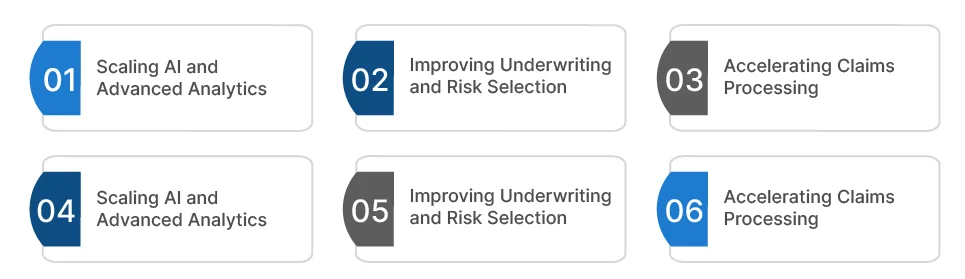
- Scaling AI and Advanced Analytics: AI, machine learning, and agentic workflows cannot perform reliably when data is fragmented, duplicated, or poorly governed. Modern data foundations clean, structure, and connect enterprise information so insurers can improve prediction, automate document-heavy processes, and support faster decisions across underwriting and claims.
- Improving Underwriting and Risk Selection: Better access to internal and external data gives underwriters a clearer view of risk. When historical policy data, claims patterns, exposure signals, and third-party inputs are connected, insurers can move toward more dynamic pricing, sharper risk appetite decisions, and more consistent referral handling.
- Accelerating Claims Processing: Claims performance depends on fast access to policy details, loss history, documents, customer information, repair data, and payment records. Modernized data environments reduce manual search and reconciliation, helping claims teams triage work faster, identify exceptions earlier, and improve policyholder experience.
- Strengthening Compliance and Audit Readiness: Insurers operate in highly regulated environments where reporting must be timely, traceable, and defensible. Centralized governance, lineage, and data quality controls help leaders understand where data came from, how it changed, who accessed it, and how it was used in decisions.
- Reducing Cost and Operational Drag: Aging data environments often require manual workarounds, duplicate integrations, and repeated reconciliation. A modern data foundation can reduce avoidable effort, simplify reporting, and lower the long-term cost of maintaining fragmented data flows across the enterprise.
- Meeting Shifting Customer and Broker Expectations: Policyholders, agents, and brokers expect faster responses, clearer communication, and more personalized digital experiences. Modern insurance technology gives insurers the data foundation needed to connect channels, personalize engagement, and launch new digital capabilities without adding more fragmentation.
For executive leaders, the issue is no longer whether modernization is technically useful. The issue is whether the business can compete without it. Modernization should improve underwriting precision, claims performance, regulatory visibility, customer intelligence, and AI readiness while helping the enterprise move faster without weakening governance.
The Legacy Data Problem Holding Insurers Back
Most insurers do not lack data. They lack connected, trusted data. Policy, claims, billing, underwriting, and customer information often sit across separate platforms with different definitions, formats, and ownership models. When these systems do not communicate well, leaders lose a unified view of risk, performance, and customer value.
A 2026 insurance operations report found that 42% of insurers cite legacy system integration as a key challenge. This shows why modernization is not only a technical priority; it is an execution barrier for AI, analytics, faster claims, and better underwriting.
The real cost of fragmentation includes:
- Reporting teams reconcile conflicting numbers.
- Underwriters wait for incomplete risk data.
- Claims teams depend on manual document review.
- Compliance teams struggle with lineage and traceability.
- Technology teams maintain costly point-to-point integrations.
- AI initiatives stall because the data foundation is not ready.
The goal is not to replace every legacy platform at once. A more practical approach is to modernize the data foundation around core systems so insurers can improve visibility, governance, and speed without disrupting mission-critical operations.
From Data Fragmentation to Decision-Ready Insurance Intelligence
Insurance data modernization creates value when it converts disconnected policy, claims, underwriting, billing, customer, risk, and compliance data into decision-ready intelligence.
A modern data foundation helps insurers connect the information that matters most:
- Policy and claims data for coverage accuracy, triage, settlement insight, and leakage control.
- Underwriting and risk data for sharper risk selection, pricing discipline, and referral decisions.
- Billing, customer, and broker data for stronger account visibility, relationship intelligence, and engagement.
- Regulatory and third-party data for auditability, external risk context, fraud insight, and reporting control.
When these domains are connected, insurers can evaluate risk with a broader context, identify claims complexity earlier, improve reporting consistency, and give executives fewer blind spots.
The Executive Roadmap for Insurance Data Modernization
An executive roadmap for insurance data modernization should turn legacy data infrastructure into a real-time, AI-ready asset. The goal is to reduce fragmented systems, lower compliance risk, and create measurable operational value through a phased approach.
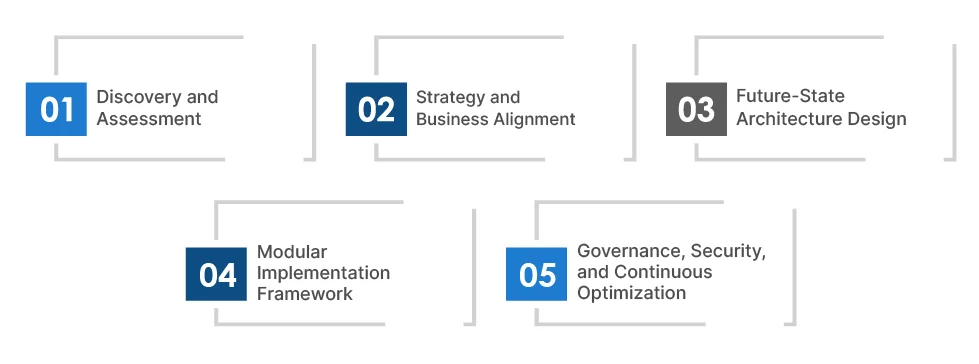
1. Discovery and Assessment
Before changing architecture, leaders need a clear view of the current data footprint.
- System audit: Inventory policy, claims, billing, underwriting, CRM, and data warehouse environments.
- Data flow mapping: Trace how data moves across systems to identify bottlenecks, duplicate records, and manual handoffs.
- Gap analysis: Assess weaknesses in data quality, security, compliance, lineage, metadata, and ownership.
2. Strategy and Business Alignment
A strong roadmap treats data as a business asset, not only a technical output.
- Define business goals: Align modernization with priorities such as faster claims cycles, better underwriting accuracy, improved reporting, and stronger customer intelligence.
- Prioritize use cases: Start with high-impact opportunities such as underwriting analytics, fraud detection, claims triage, customer 360, and regulatory reporting.
- Set ROI metrics: Measure progress through reduced reconciliation effort, faster reporting, improved data quality, stronger AI readiness, and lower integration complexity.
3. Future-State Architecture Design
The target architecture should support scalability, interoperability, governance, and speed across lines of business.
- Cloud data modernization: Move selected workloads to secure cloud or hybrid environments where they can scale efficiently.
- Unified data foundation: Build governed data lakes, lakehouses, data products, or warehouses that act as trusted sources of truth.
- Third-party integration: Use APIs and integration layers to connect external data sources for risk, fraud, geospatial, telematics, and customer insight.
4. Modular Implementation Framework
Insurers should avoid high-risk, big-bang transformation. A phased approach protects continuity while showing progress.
- Data cleansing: Standardize definitions, formats, naming conventions, and business rules before migration.
- Phased migration: Modernize by line of business, domain, or use case while keeping critical operations stable.
- Early wins: Launch dashboards, analytics workflows, or AI-ready data products that demonstrate value quickly and maintain stakeholder confidence.
5. Governance, Security, and Continuous Optimization
Modern data ecosystems need ongoing control to remain trusted and compliant.
- Data governance framework: Assign ownership, define stewardship, track lineage, and monitor data quality.
- Security and privacy: Build encryption, access control, anomaly detection, and compliance controls into the architecture.
- AI and optimization: Monitor data performance, improve pipelines continuously, and scale AI use cases as business needs evolve.
The strongest roadmap is not the one that modernizes everything at once. It is the one that helps insurers build trusted data foundations in controlled stages while creating measurable business value.
How TxMinds Helps Insurers Build Modern, Trusted Data Foundations
TxMinds helps insurers move from fragmented legacy data environments to governed, scalable foundations for intelligence, automation, and enterprise control. Our approach is practical and outcome-led, helping insurance leaders understand the current system landscape, identify high-value modernization priorities, and design data foundations that improve speed, trust, and scalability without disrupting core operations.
Through insurance data management services, TxMinds helps insurers create the data discipline needed for faster decisions, stronger controls, and AI-ready operations. We understand that insurance modernization is domain-specific. Policy, claims, underwriting, billing, compliance, broker, and customer data all carry different rules, risks, and dependencies, so modernization must be designed around real insurance workflows.
TxMinds brings together insurance technology expertise, AI-native engineering, data trust, application modernization, and platform scalability to help insurers build stronger enterprise foundations. For insurers, the opportunity is not simply to upgrade systems. It is to create a modern data foundation that improves how the business sees, decides, and acts in the next phase of insurance technology.

Rajiv Diwan
VP and Global Head Data & AI Practice
Results-oriented Data Analytics & AI Specialist with 24+ years of experience in multiple roles, including Practice Leader with P&L ownership. Expert in building Data Analytics practices, defining market strategies, and leading large-scale transformation initiatives. Skilled in Business Intelligence, Data Engineering, Cloud platforms (Azure, AWS, GCP), AI/ML, and Data Governance, with a strong focus on customer-centric solutions and strategic alliances.
FAQs
What is insurance data modernization?
Insurance data modernization is the process of improving how insurers collect, integrate, govern, store, and use data across policy, claims, underwriting, billing, customer, and compliance systems. It helps insurers move from fragmented legacy data to trusted, decision-ready intelligence.
Why is insurance data modernization important for insurers?
Insurance data modernization is important because it helps insurers improve underwriting accuracy, claims speed, regulatory reporting, customer intelligence, and AI readiness. It also reduces the operational drag caused by disconnected legacy systems and manual reconciliation.
How do insurance data management services support modernization?
Insurance data management services support modernization by helping insurers improve data integration, governance, quality, lineage, cloud readiness, and analytics enablement. These capabilities make data more reliable, accessible, and useful across insurance operations.
How does insurance technology benefit from modern data foundations?
Insurance technology becomes more effective when it is supported by clean, connected, and governed data. Modern data foundations help insurers scale AI, automate workflows, improve reporting, personalize customer experiences, and make faster business decisions.
Discover more