


Recommended Blogs

Blog
Cloud Data Modernization Beyond Migration: Building AI-Ready Analytics Foundations
Table of Content
- Why Cloud Data Modernization Has Become an AI Readiness Priority
- From Migration to Intelligence: What AI-Powered Data Modernization Changes
- How Analytics-Driven Cloud Platforms Improve Decision Speed and Trust
- The Executive Roadmap for Building AI-Ready, Governed Data Foundations
- How TxMinds Helps Enterprises Modernize Cloud Data for AI and Analytics
- Conclusion
Share On


Enterprise data modernization is no longer only about where data resides. It is about whether data can support faster decisions, trusted AI, predictive operations, and real-time responsiveness. For C-level leaders, this makes Cloud Data Modernization a strategic priority. Modern cloud ecosystems go beyond infrastructure efficiency by unifying fragmented data, improving quality, strengthening governance, and enabling AI-driven insights.
That shift matters because AI programs often fail when the data foundation is not ready. Gartner predicts that through 2026, organizations will abandon 60% of AI projects unsupported by AI-ready data.
AI pilots are easier to launch than AI-ready operating models. Many enterprises can experiment with AI, but scaling it across business-critical workflows requires trusted data, governed pipelines, clear ownership, and platforms that can support analytics and machine learning at enterprise scale. AI and analytics are changing what modernization must deliver. Intelligent cloud platforms, automated pipelines, real-time analytics, and governed data products are becoming essential to enterprise decision-making. Organizations that deploy a data intelligence strategy for modernization, as opposed to a simple migration effort, will be better positioned to realize enterprise value.
Key Takeaways
- Cloud Data Modernization is now central to AI readiness, analytics maturity, and executive decision-making.
- AI-powered data modernization helps enterprises improve data quality, automate data operations, and strengthen governance.
- Analytics-driven cloud platforms enable predictive analytics, real-time intelligence, and faster business decision-making.
- Machine learning and automation can improve anomaly detection, forecasting, pipeline reliability, and data insights.
Why Cloud Data Modernization Has Become an AI Readiness Priority
Many enterprises have invested in AI pilots, dashboards and cloud migrations, but still struggle with inconsistent reporting, duplicated data, and unclear ownership. These challenges are not trivial technical issues, but executive risks that corrode decision-making and erode trust in data.
If data is fragmented or poorly governed, AI systems will provide less reliable insights, and analytics teams will spend more time fixing data than analyzing it. This is where data modernization in the cloud comes in. It provides a common governed data foundation that makes data more accessible, more secure and more trusted for analytics.
From Migration to Intelligence: What AI-Powered Data Modernization Changes
Traditional data modernization often focused on movement. Enterprises migrated warehouses, consolidated platforms, reduced infrastructure dependency, or shifted workloads to the cloud. Those steps still matter, but they are no longer enough.
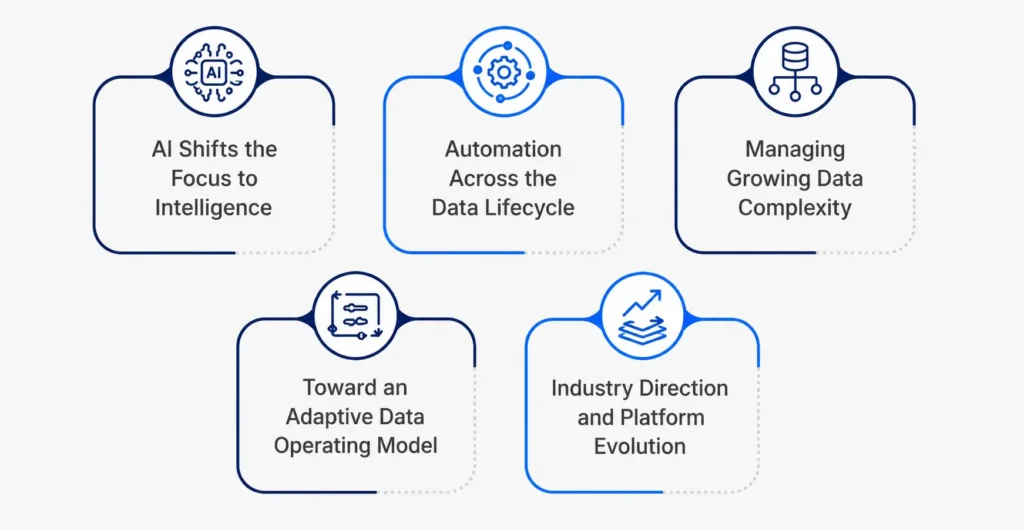
AI Shifts the Focus to Intelligence
AI-powered data modernization shifts the focus from relocating data to building intelligent, adaptive data systems. It enables organizations to automate data processes, improve data quality, and generate actionable insights, helping businesses make faster, more informed decisions while supporting scalable analytics and AI-driven innovation.
Automation Across the Data Lifecycle
AI can help data teams automate and improve several parts of the data lifecycle. It can support metadata discovery, schema mapping, data classification, anomaly detection, pipeline monitoring, data quality checks, and documentation. Machine learning can identify patterns in data usage, detect unusual behavior, forecast capacity needs, and recommend improvements to data flows.
Managing Growing Data Complexity
This matters because enterprise data environments are becoming too complex to manage solely through manual processes. Large organizations often operate across legacy databases, cloud warehouses, SaaS platforms, APIs, streaming systems, data lakes, BI tools, and AI workbenches. Manual governance and manual data operations cannot keep pace with this complexity.
Toward an Adaptive Data Operating Model
An adaptive data operating model connects automation with ownership. Data teams still need standards for quality, access, lineage, cost, privacy, and business definitions. AI can improve detection and recommendation, but governance decides which actions are trusted, approved, and operationalized.
Industry Direction and Platform Evolution
Major cloud platforms are already moving in this direction. Google Cloud positions BigQuery as an autonomous data-to-AI platform that automates the data lifecycle from ingestion to AI-driven insights, while also supporting predictive analytics, machine learning, and AI-powered assistance for data teams. This is one example of a broader platform direction, not a recommendation that one cloud platform is the answer for every enterprise.
The lesson for enterprise leaders is not that one platform solves every problem. The lesson is that the market is moving toward intelligent data foundations. Cloud data modernization must prepare the enterprise for that operating reality.
How Analytics-Driven Cloud Platforms Improve Decision Speed and Trust
The business value of modernization becomes apparent when data is easier to use, easier to trust, and easier to act on. That is why the analytics-driven cloud is becoming so important.
Moving from Delayed Reporting to Predictive and Real-Time Intelligence
Modern analytics platforms help enterprises move from delayed reporting to predictive and real-time intelligence. Instead of waiting for static reports at the end of a cycle, leaders can monitor changing business signals, forecast likely outcomes, and respond earlier.
The Role of Predictive Analytics in Executive Decision-Making
Predictive analytics is especially important for executive decision-making. It can support demand forecasting, customer behavior analysis, risk modeling, operational planning, fraud detection, churn prediction, and resource optimization. When predictive analytics is connected to governed cloud data, leaders can make decisions with better context and greater confidence.
Why Real-Time Intelligence Matters
Real-time intelligence adds another layer of value. In many industries, business conditions change too quickly for batch reporting alone to suffice. Customer behavior, supply chain disruption, cyber risk, claims activity, financial exposure, service reliability, and market demand can shift within hours. Enterprises need data platforms that can support faster detection and response.
Balancing Speed with Data Trust
A dashboard that updates quickly but reflects poor-quality data does not help leaders. A predictive model trained on inconsistent data can mislead the business. A real-time alert without clear ownership can create noise instead of action.
The strongest analytics-driven cloud strategies combine four elements:
- Trusted data pipelines that improve accuracy, lineage, and repeatability.
- Scalable cloud architecture that supports growing data volumes and analytics workloads.
- Predictive analytics and machine learning that help leaders anticipate outcomes.
- Governance and business context that ensure data insights are explainable, secure, and useful.
This is where Cloud Data Modernization becomes a business decision support capability. It gives leadership teams the confidence to move from hindsight to foresight.
The Executive Roadmap for Building AI-Ready, Governed Data Foundations
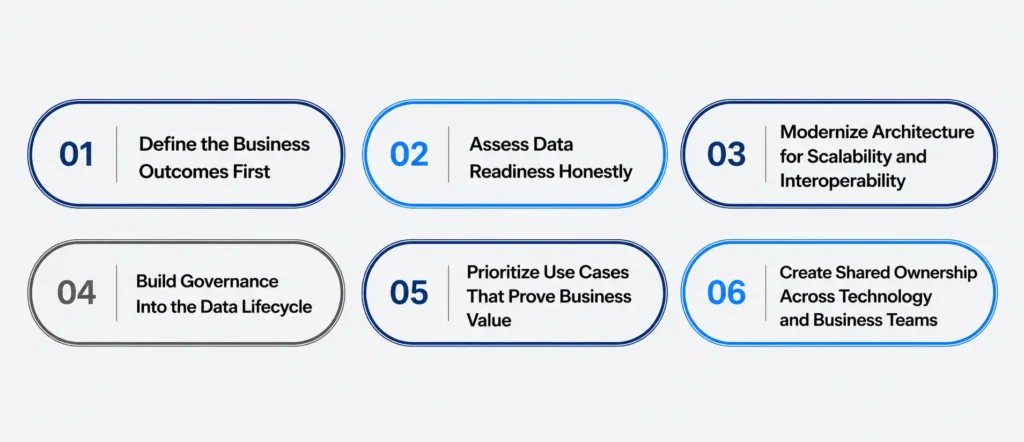
For C-level technology leaders, cloud data modernization should begin with strategic clarity. The first question is not which platform to choose. The first question is what the business must be able to decide, predict, optimize, or automate with greater confidence. A practical roadmap should focus on six leadership decisions.
-
Define the Business Outcomes First
Modernization should be tied to measurable outcomes. These may include faster executive reporting, improved forecasting, stronger regulatory confidence, reduced operational risk, better customer intelligence, or AI-ready data foundations.
-
Assess Data Readiness Honestly
Before scaling AI or analytics, leaders need a realistic view of data quality, accessibility, ownership, duplication, lineage, and governance gaps. This assessment should include both technology and operating model maturity. Data readiness is often where AI ambition meets enterprise reality.
-
Modernize Architecture for Scalability and Interoperability
The target architecture should support structured, semi-structured, and unstructured data. It should connect with business applications, analytics tools, AI platforms, and governance systems. It should also support workload scalability without creating uncontrolled cost or complexity. Cloud modernization should reduce fragmentation, not move fragmentation into a newer environment.
-
Build Governance Into the Data Lifecycle
Governance cannot sit outside modernization. Access controls, lineage, retention rules, quality standards, metadata management, privacy controls, and auditability should be built into the data lifecycle. As AI and analytics become more embedded in business decisions, governance becomes a value enabler rather than an administrative layer.
-
Prioritize Use Cases That Prove Business Value
Leaders should start with use cases where better data can improve speed, accuracy, cost control, or risk visibility. Strong candidates include predictive maintenance, customer analytics, claims intelligence, underwriting support, financial forecasting, supply chain visibility, service reliability, and executive performance reporting.
-
Create Shared Ownership Across Technology and Business Teams
Cloud data modernization cannot be owned solely by IT. It requires participation from data leaders, business functions, security, compliance, finance, operations, and executive sponsors. The operating model should clarify who owns data definitions, who approves access, who validates quality, and who is accountable for business outcomes.
How TxMinds Helps Enterprises Modernize Cloud Data for AI and Analytics
- TxMinds helps enterprises approach Cloud Data Modernization as a strategic foundation for AI, analytics, and business decision support. We work with leaders who need to modernize complex data ecosystems while protecting trust, governance, and operational continuity.
- Our approach connects data engineering, cloud modernization, AI-native engineering, analytics enablement, and platform scalability. We help enterprises assess data maturity, define modernization priorities, design cloud-ready data architectures, and build pipelines that support trusted analytics and AI-powered use cases.
- For organizations pursuing AI-powered data modernization, TxMinds supports the shift from fragmented data operations to more intelligent, governed, and scalable data environments. This includes modern data pipelines, cloud data platforms, data integration, quality engineering, governance alignment, analytics modernization, and machine learning readiness.
Conclusion
AI and analytics are redefining enterprise data expectations. Leaders now need platforms that support prediction, automation, governance, and real-time decisions, not just storage and reporting. Cloud Data Modernization has become essential, enabling better insights, scalable machine learning, and stronger predictive analytics.
Success depends less on having more AI tools and more on building a clear, governed, and scalable data foundation. Organizations that align cloud modernization with business outcomes will move faster and make better decisions. Ultimately, AI and analytics deliver value only when supported by modern, trusted, and scalable data systems.

Rajiv Diwan
VP and Global Head Data & AI Practice
Results-oriented Data Analytics & AI Specialist with 24+ years of experience in multiple roles, including Practice Leader with P&L ownership. Expert in building Data Analytics practices, defining market strategies, and leading large-scale transformation initiatives. Skilled in Business Intelligence, Data Engineering, Cloud platforms (Azure, AWS, GCP), AI/ML, and Data Governance, with a strong focus on customer-centric solutions and strategic alliances.
Discover more