


Recommended Blogs

Blog
From Hidden Risk to Strategic Foresight: How AI Is Transforming Insurance Fraud Prevention
Table of Content
- Key Takeaways
- The New Fraud Reality: Why Traditional Detection is No Longer Enough
- From Data Chaos to Fraud Intelligence: The Role of Data Engineering
- How AI Insurance Fraud Detection Moves Insurers from Reaction to Prevention
- What Enterprise Leaders Should Expect from Fraud Detection Software in Insurance
- Insurance AI Services as a Competitive Advantage, Not Just a Technology Upgrade
- How TxMinds Helps Insurers Build Future-Ready Fraud Prevention Ecosystems
Share On


The dangerous claim is not always the one that raises an alarm. It is the one that looks ordinary, clears familiar checks, and quietly becomes paid loss. That is where insurance fraud becomes a leadership problem, not just a claims problem.
Deloitte’s 2026 global insurance outlook estimates that AI-driven, real-time fraud analytics could help P&C insurers save up to US$160 billion by 2032. The opportunity is not simply finding fraud faster. It is building the foresight to stop suspicious activity before it drains capital, trust, and operational bandwidth.
For enterprise leaders, AI insurance fraud detection offers a sharper way forward. It turns scattered data signals into earlier decisions, stronger governance, and cleaner customer journeys.
Key Takeaways
- AI-driven, real-time fraud analytics could help P&C insurers save up to US$160 billion by 2032.
- 35% of insurance executives rank fraud detection among their top five generative AI priorities.
- AI insurance fraud detection works best when supported by clean, connected, and governed data.
- Fraud prevention still needs human judgment, especially for complex, high-risk claims decisions.
The New Fraud Reality: Why Traditional Detection is No Longer Enough
Insurance fraud has become more coordinated, digital, and difficult to isolate. Fraudsters no longer rely only on inflated claims or staged incidents. They use synthetic identities, manipulated documents, collusive networks, and behavioral mimicry.
Rules-based systems still have value in familiar fraud scenarios. Yet they struggle when patterns shift across channels, geographies, and product lines. A rule can catch yesterday’s fraud pattern. It cannot always understand tomorrow’s intent.
Deloitte notes that insurers are moving from traditional rules-based methods toward advanced exposure and prevention techniques. Its survey found that 35% of insurance executives ranked fraud detection among the top five areas for generative AI development or implementation.
Why fraud now hides in plain sight
Modern insurance operations create large volumes of useful signals. Claims notes, policy changes, call transcripts, images, payments, provider behavior, and device data all matter. The problem is that these signals often live apart.
Fraud hides inside that separation. A claim may look valid inside the claims platform. The same claimant may show suspicious behavior across prior policies. A provider may look clean in isolation. Their network may tell a very different story.
This is why AI insurance fraud detection is becoming a strategic capability. It helps insurers connect weak signals before they become expensive outcomes.
From Data Chaos to Fraud Intelligence: The Role of Data Engineering
Data engineering turns scattered insurance information into usable fraud intelligence by connecting claims data, policy records, customer histories, payment activity, documents, and external signals into one trusted foundation, helping AI insurance fraud detection models catch patterns that siloed systems often miss.
From Chaos to Intelligence
For years, fraud management relied on manual audits and static rules, which still catch obvious red flags but struggle against organized fraud networks, unstructured evidence, and fast-changing claim patterns. Key building blocks include:
- Data sourcing brings together structured policy data, claims notes, images, invoices, call records, and third-party signals.
- Data pipelines move and refresh information across systems, so fraud teams are not working from stale records.
- Feature engineering creates predictive variables from raw data, including claim frequency, provider patterns, location signals, and document inconsistencies.
Core Use Cases of Fraud Intelligence
With clean and trusted data at the center, insurers can move from reactive investigation to proactive fraud prevention. The shift is practical, not theoretical. Fraud intelligence supports use cases such as:
- Real-time anomaly detection spots unusual claim behavior before payment decisions are finalized.
- Network analysis reveals hidden links between claimants, providers, vehicles, addresses, and accounts.
- Predictive machine learning scores incoming claims by risk, helping teams prioritize high-risk cases faster.
This is where data engineering becomes a business capability. It helps leaders reduce leakage, protect honest customers, and make fraud decisions with greater confidence.
How AI Insurance Fraud Detection Moves Insurers from Reaction to Prevention
Traditional fraud detection often starts after a claim enters the system. AI changes the timing by flagging risk during intake, policy changes, documentation review, and payment routing.
Prevention does not mean blocking every suspicious claim automatically. It means sending the right claim to the right review path, before loss becomes harder to recover.
Where AI Finds Signals that Humans Miss
AI models can spot unusual sequences, repeated patterns, and hidden links across large data volumes. That helps insurers move faster without reviewing every claim manually.
- Anomaly detection identifies claims that differ from expected patterns.
- Network analysis exposes suspicious links across people, providers, vehicles, and accounts.
- Document intelligence checks invoices, records, estimates, and images for inconsistencies.
- Predictive triage scores incoming claims, helping teams prioritize high-risk cases.
What Enterprise Leaders Should Expect from Fraud Detection Software in Insurance
Enterprise leaders should expect insurance teams use to move beyond static alerts. The stronger platforms support autonomous monitoring, faster triage, and cleaner decisions across the claims lifecycle.
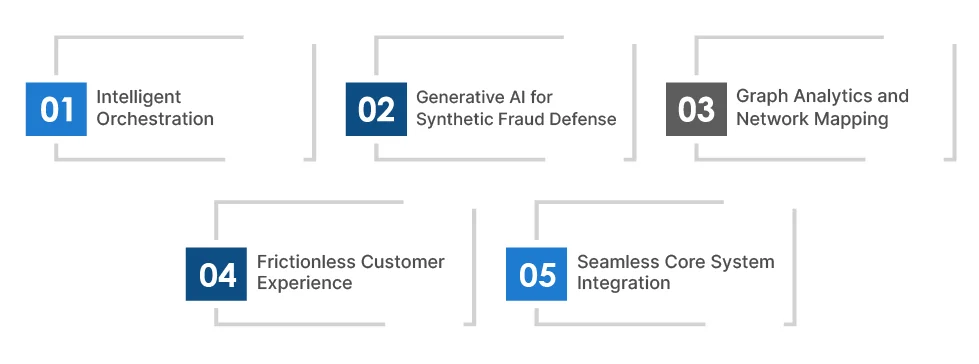
1. Intelligent Orchestration
Fraud systems should continuously monitor claims, documents, payments, and behavioral signals. They should help teams flag risk early without adding unnecessary friction.
- Automated response routes suspicious claims for review and holds risky actions temporarily.
- Straight-through processing clears low-risk claims faster, while high-risk cases receive deeper review.
2. Generative AI for Synthetic Fraud Defense
Fraud tactics now include manipulated documents, AI-generated estimates, and synthetic identities. Leaders need tools that can inspect both content and context.
- Metadata and anomaly analysis checks text, images, timestamps, and claim consistency.
- Predictive modeling helps anticipate emerging fraud patterns before they spread.
3. Graph Analytics and Network Mapping
Fraud rarely operates in isolation. Strong platforms should reveal hidden relationships across claimants, providers, vehicles, addresses, and payment accounts.
- Relationship mapping helps investigators detect organized fraud rings faster.
- Network scoring highlights suspicious clusters that single-claim reviews may miss.
4. Frictionless Customer Experience
Fraud prevention should protect margins without punishing genuine policyholders. The best systems reduce false positives and keep clean claims moving.
- Risk-based triage applies deeper checks only where signals justify them.
- Customer-friendly workflows reduce delays for low-risk claims and trusted customers.
5. Seamless Core System Integration
Modern fraud platforms should fit into existing insurance operations. They must connect with policy administration, claims systems, document workflows, and payment tools.
- Modular APIs support integration across legacy and modern platforms.
- Real-time workflow triggers enable risk checks at intake, review, approval, and payout.
Insurance AI Services as a Competitive Advantage, Not Just a Technology Upgrade
Insurance AI services are no longer just a technology investment. They are becoming a strategic lever for margin protection, faster decisions, and stronger customer trust.
What makes AI services valuable
The real value comes from connecting fraud insights across the enterprise. A claim signal can improve underwriting rules. A provider pattern can strengthen partner controls. A policy activity trend can expose identity risk earlier.
Core advantages include:
- Sharper risk selection through connected claims and underwriting intelligence.
- Faster claims movement by clearing low-risk cases with greater confidence.
- Better investigators focus by routing complex cases to expert teams.
- Stronger governance through explainable models and measurable controls.
When insurance AI services combine these elements, fraud prevention becomes more than a control function. It becomes a durable advantage in cost, trust, and decision quality.
How TxMinds Helps Insurers Build Future-Ready Fraud Prevention Ecosystems
At TxMinds, we help insurers move from fragmented fraud detection to connected fraud prevention. We bring AI, data engineering, cloud, application modernization, and quality engineering into one execution model. Our focus is not limited to building models. We help engineer the foundations that make AI reliable, explainable, and scalable.
We unify insurance data across legacy systems, modern platforms, third-party sources, and operational workflows. We design governed pipelines, validation controls, and AI-ready data products that support fraud scoring, investigation workflows, and executive visibility. That means insurers can move beyond isolated AI pilots and build fraud prevention systems that are measurable, governed, and ready for production scale.
We also understand that insurers need speed with control. Our approach helps carriers reduce hidden risk, improve fraud triage, and build prevention ecosystems that stand up to business, compliance, and customer expectations.

Yuvraj Singh
Associate Director
Yuvraj Singh is an accomplished Associate Director of Delivery, renowned for leading strategic quality assurance initiatives that consistently deliver outstanding software outcomes across global markets. With deep expertise in both Property & Casualty (P&C) and Life & Annuities (L&A) insurance domains, Yuvraj excels at bridging the gap between complex business objectives and flawless execution.
FAQs
What is AI insurance fraud detection?
AI insurance fraud detection uses machine learning, anomaly detection, document intelligence, and network analysis to identify suspicious claims earlier. It helps insurers detect hidden fraud patterns across claims, policies, payments, providers, and customer behavior.
How does fraud detection software insurance teams use reduce false positives?
Modern fraud detection software for insurance reduces false positives by using risk-based scoring, cleaner data, and contextual analysis. Instead of flagging every unusual claim, it prioritizes cases with stronger fraud signals for deeper review.
Why is data engineering important for AI insurance fraud detection?
Data engineering connects claims data, policy records, payment activity, documents, and external signals into a trusted foundation. Without clean and connected data, AI insurance fraud detection models may miss patterns or produce unreliable alerts.
What role do insurance AI services play in fraud prevention?
Insurance AI services help insurers design, deploy, and manage AI-driven fraud prevention systems. They support better fraud triage, stronger governance, faster claims decisions, and more scalable use of fraud detection software insurance teams rely on.
Discover more