


Recommended Blogs

Blog
5 Signs Your Data Warehouse is No Longer Built for Enterprise Growth
Table of Content
- Key Takeaways
- The Silent Risk Behind a Warehouse That Still “Works”
- Why Enterprise Growth Demands Data Warehouse Modernization
- 5 Signs Your Data Warehouse is No Longer Built for Enterprise Growth
- From Legacy Data Warehouse Problems to a Future-Ready Data Foundation
- How TxMinds Helps Enterprises Modernize Data Warehouses for Scalable Growth
Share On


Most enterprises do not replace a data warehouse because it suddenly fails. They replace it because business teams stop trusting what it gives them. Sales has one view of revenue, finance has another, and leadership waits for reconciled numbers before making decisions. The warehouse is still online, but confidence is slipping. That is where growth starts to slow.
The warning signs are already visible across large enterprises. A 2026 report found that only 16% of organizations have operationalized AI enterprise-wide, while 41% remain limited to functional or business-unit deployments.
That gap matters because AI, automation, and real-time intelligence all depend on trusted data foundations. Read through this blog to see the five signs your warehouse is limiting growth, where data warehouse modernization creates the most value, and how leaders can move forward without adding unnecessary risk.
Key Takeaways
- Only 16% of enterprises have operationalized AI enterprise-wide, which shows how many enterprises still lack the data foundation needed for scaled intelligence.
- 41% of organizations remain limited to functional or business-unit AI deployments, often because data remains fragmented across teams, systems, and workflows.
- A warehouse can still be operational while creating legacy data warehouse problems such as delayed reporting, metric conflicts, rising costs, and stalled AI initiatives.
- Data warehouse modernization helps enterprises build trusted, scalable, and AI-ready foundations without weakening governance, control, or decision confidence.
The Silent Risk Behind a Warehouse That Still “Works”
A working warehouse can hide a slow operational drag. Reports still load, yet teams spend hours checking extracts, questioning metrics, and explaining gaps between systems. Leaders may not see a system failure. They see hesitation in meetings where decisions should be clear.
That hesitation compounds as the enterprise grows. Every new market, acquisition, product, or AI initiative adds more pressure to an already stretched data layer. The risk is not that the warehouse stops running. The risk is that it keeps running while the business outgrows it.
Why Enterprise Growth Demands Data Warehouse Modernization
Enterprise growth puts pressure on data in ways legacy systems were never built to handle. More customers, regions, products, applications, and regulations create more data movement. Leaders still need one reliable view of the business, but that view becomes harder to produce when the warehouse cannot keep pace.
It is where data warehouse modernization becomes a strategic growth priority, not a backend technology project.
1. Decisions now need fresher data
Leadership teams cannot wait days for reconciled reports during fast-moving market shifts.
2. Data now comes from more systems
ERP, CRM, SaaS platforms, partner systems, and cloud apps must work together.
3. Growth increases governance pressure
More access points create more risk unless controls, lineage, and ownership improve.
4. AI needs a stronger data foundation
Models perform poorly when data is fragmented, stale, duplicated, or poorly governed.
5. Cost discipline matters more at scale
Growing workloads can quickly turn inefficient architectures into expensive operating burdens.
The point is to remove the data friction that slows growth. When the warehouse supports speed, trust, and scale together, leaders can act with more confidence.
5 Signs Your Data Warehouse is No Longer Built for Enterprise Growth
When analytics infrastructure starts behaving like a bottleneck instead of an accelerator, growth begins to feel harder than it should. Leaders see the symptoms in delayed reports, competing numbers, rising costs, and AI programs that never move beyond controlled pilots.
Watch for these five warning signs before legacy data warehouse problems become enterprise-wide constraints.
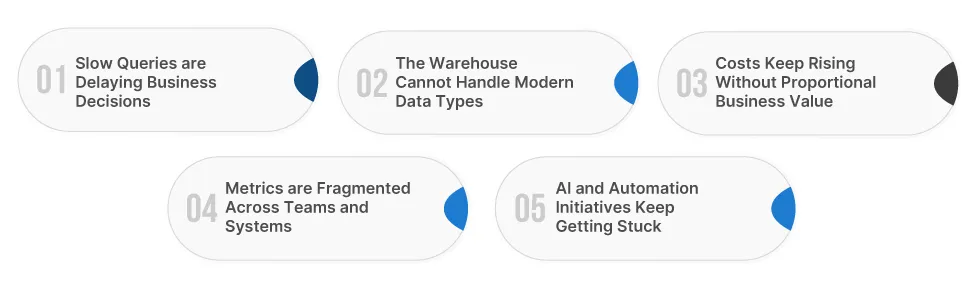
1. Slow Queries are Delaying Business Decisions
- The problem: Reports that once loaded quickly now take too long during critical review cycles. As data volume grows and more teams run concurrent workloads, the warehouse struggles to respond at business speed.
- Enterprise impact: Leaders wait longer for answers, teams rely on outdated extracts, and decisions become slower than market conditions require. This creates frustration across finance, operations, sales, and customer-facing teams.
- The fix: Modernize the architecture so compute, storage, ingestion, and workload management can scale independently. A stronger foundation helps teams access trusted data without waiting for manual intervention.
2. The Warehouse Cannot Handle Modern Data Types
- The problem: Many legacy environments were built mainly for structured reporting data. They struggle when the enterprise needs to work with application logs, sensor data, documents, images, audio, or other complex formats.
- Enterprise impact: Engineering and analytics teams spend too much time building custom pipelines around the warehouse. AI and advanced analytics programs slow down because useful data remains outside the core decision environment.
- The fix: Move toward a modern data environment that can support structured, semi-structured, and unstructured data more naturally. This makes enterprise data easier to prepare, govern, and use across business functions.
3. Costs Keep Rising Without Proportional Business Value
- The problem: Query costs, storage costs, infrastructure overhead, and support effort continue to increase. Yet business teams do not see better speed, better access, or better confidence in return.
- Enterprise impact: Budget conversations become harder because the warehouse consumes more resources without visibly improving outcomes. Teams may also overprovision capacity just to keep essential workloads running.
- The fix: Optimize workloads, archive low-value data, and separate high-priority use cases from routine processing. Effective data warehouse modernization should improve cost control while preserving room for growth.
4. Metrics are Fragmented Across Teams and Systems
- The problem: Different departments define the same business metric in different ways. Sales, finance, marketing, and operations may all report valid numbers, yet those numbers do not always match.
- Enterprise impact: Executive meetings shift from decision-making to reconciliation. Leaders spend valuable time asking which number is right instead of discussing what action the business should take next.
- The fix: Create a stronger semantic layer, standardize business logic, and improve data lineage across the enterprise. Clear ownership and governance help teams work from shared definitions.
5. AI and Automation Initiatives Keep Getting Stuck
- The problem: The warehouse still supports traditional BI, but it cannot support AI-ready workflows at scale. Data may be stale, fragmented, poorly labeled, or difficult to connect across systems.
- Enterprise impact: Data science and automation teams lose time preparing data instead of building useful models. Generative AI, predictive analytics, and intelligent workflows remain limited to narrow use cases.
- The fix: Use data modernization services to improve data quality, integration, governance, and accessibility. AI becomes easier to scale when the enterprise has a trusted data foundation behind it.
These signs do not always appear as a single failure. They often show up as delays, workarounds, and recurring debates that leaders gradually accept as normal. Once those patterns become familiar, modernization is no longer a technology preference. It is a growth requirement.
From Legacy Data Warehouse Problems to a Future-Ready Data Foundation
Modernization does not require reckless replacement. In many enterprises, the smarter path is phased transformation. Leaders can prioritize workloads by value, complexity, and risk.
A practical modernization path includes the following steps:
- Assess current pain points across cost, performance, access, and governance.
- Prioritize high-value workloads that affect executive decisions.
- Modernize data pipelines before moving every historical dataset.
- Establish governance standards before scaling self-service access.
- Optimize continuously as workloads, teams, and use cases evolve.
This approach reduces disruption while creating visible business value. It also avoids the trap of modernizing infrastructure without improving decisions.
How TxMinds Helps Enterprises Modernize Data Warehouses for Scalable Growth
At TxMinds, we help enterprises modernize cloud data platforms without losing trust during the move. We focus on the areas that usually slow programs down, including readiness, reconciliation, governance, quality, and post-migration drift.
We design business-aligned cloud data architectures across warehouse, lakehouse, ingestion, orchestration, and governance layers. Our approach keeps modernization tied to business domains, KPIs, operational outcomes, and cost-performance goals.
Our data modernization services help enterprises move from legacy constraints to AI-ready data foundations. We combine cloud modernization, data engineering, governance enforcement, and quality assurance so leaders can scale analytics, automation, and AI with greater confidence.

Rajiv Diwan
VP and Global Head Data & AI Practice
Results-oriented Data Analytics & AI Specialist with 24+ years of experience in multiple roles, including Practice Leader with P&L ownership. Expert in building Data Analytics practices, defining market strategies, and leading large-scale transformation initiatives. Skilled in Business Intelligence, Data Engineering, Cloud platforms (Azure, AWS, GCP), AI/ML, and Data Governance, with a strong focus on customer-centric solutions and strategic alliances.
FAQs
What is data warehouse modernization?
Data warehouse modernization is the process of upgrading legacy data architecture so it can support faster reporting, stronger governance, scalable analytics, and AI-ready workflows. For enterprises, it is less about replacing technology and more about improving decision speed, data trust, and long-term scalability.
What are the common legacy data warehouse problems enterprises face?
Common legacy data warehouse problems include slow query performance, fragmented metrics, rising infrastructure costs, limited data type support, and weak governance visibility. These issues often appear as reporting delays, manual reconciliations, and repeated debates over which data source is accurate.
When should an enterprise consider data warehouse modernization?
An enterprise should consider data warehouse modernization when its current warehouse slows decision-making, cannot support new data sources, becomes expensive to maintain, or blocks AI and automation initiatives. These signs suggest the data foundation is no longer aligned with business growth.
How do data modernization services support enterprise growth?
Data modernization services help enterprises improve data quality, integrate fragmented systems, strengthen governance, and build scalable cloud data platforms. This gives leaders more reliable insight, better operational visibility, and a stronger foundation for analytics, automation, and AI.
Discover more