


Recommended Blogs

Blog
Modern Enterprise Data Platforms: How to Build for Governance, Scale, and AI Readiness
Table of Content
- Key Takeaways
- Why Modern Enterprise Data Platforms Are Now a Strategic Growth Priority
- What Defines a Modern Data Platform AWS Strategy for Large Enterprises
- Building a Data Engineering Platform Architecture for Scale, Governance, and Agility
- How a Modern Data Platform AWS Approach Strengthens Governance and Compliance
- Preparing Enterprise Data Ecosystems for AI, Automation, and Smarter Decisions
- Why TxMinds for Cloud Data Platform Services and Enterprise Data Modernization
Share On


The uncomfortable truth about enterprise AI is simple. Most organizations are asking advanced models to reason over broken foundations. The ambition is modern, but the data estate often is not.
Salesforce’s 2025 State of Data and Analytics research found that 84% of data and analytics leaders believe their data strategies need overhauls for successful AI.
For enterprise leaders, this is more than a technology warning. It is a growth, risk, and competitiveness issue. AI value does not come from models alone. It comes from governed, accessible, trusted, and scalable data. A modern enterprise data platform gives leaders a cleaner path to faster decisions, stronger compliance, and responsible AI adoption.
For businesses evaluating a modern data platform AWS strategy, the sharper question is clear. Is your data platform ready to carry the next decade of enterprise intelligence?
Explore this blog to understand how to build for governance, scale, and AI readiness without slowing enterprise momentum.
Key Takeaways
- 84% of data and analytics leaders believe their data strategies need overhauls for successful AI.
- A modern data platform AWS strategy should align architecture with business outcomes.
- Strong data engineering platform architecture improves scale, governance, reliability, and reuse.
- AI readiness depends on trusted data, governed access, reusable data products, and continuous monitoring.
Why Modern Enterprise Data Platforms Are Now a Strategic Growth Priority
Most large enterprises already have more data than they can use well. The problem is rarely data scarcity. The problem is trust, speed, ownership, and usability.
A modern enterprise data platform changes that operating model. It creates a shared foundation where data can move securely across teams, systems, and use cases. It also gives leaders more confidence in decisions powered by analytics and AI.
The old model cannot carry the new workload
Legacy data estates were built around reporting cycles, departmental systems, and fixed pipelines. That model worked when data questions were predictable and slower moving. It struggles when enterprises need real-time insight, personalization, automation, and AI experimentation.
- Teams create duplicate pipelines for similar data needs.
- Business units use different definitions for the same metric.
- Data scientists spend more time preparing data than modeling outcomes.
- Governance teams become reviewers instead of design partners.
- Cloud spend grows without clear ownership or architectural discipline.
The executive case is about strategic flexibility
A modern platform gives leaders strategic optionality. It supports analytics today, AI tomorrow, and new operating models later. That matters because market conditions rarely wait for technical readiness.
Executives should view data platforms as enterprise capability systems. They influence product innovation, customer experience, risk management, and operational productivity. They also determine how quickly teams can test new ideas without creating uncontrolled risk.
What Defines a Modern Data Platform AWS Strategy for Large Enterprises
A modern data platform AWS strategy starts with business outcomes, not service selection. AWS offers a broad data and analytics ecosystem, but architecture still needs discipline. The goal is not to assemble more tools. The goal is to create a coherent platform that scales across domains.
The foundation is cloud-native, modular, and governed
A modern platform usually brings together ingestion, storage, processing, cataloging, governance, analytics, and AI enablement. Each layer should be loosely coupled, observable, and secured by design.
For large enterprises, the architecture should support several realities:
- Data will come from cloud, on-premises, SaaS, and third-party sources.
- Different workloads will require different storage and processing patterns.
- Governance must work across business domains, not only central teams.
- AI systems will demand traceable, high-quality, and reusable data products.
- Cost control must be engineered into the platform from the beginning.
This is why many enterprises move toward lakehouse-style patterns. They need the flexibility of data lakes and the performance of warehouses. They also need open formats, metadata discipline, and governed access across the estate.
AWS services should map to enterprise capabilities
Service selection should follow capability design. For example, Amazon S3 often supports scalable object storage. AWS Glue can support integration and metadata management. Amazon Redshift can serve warehouse and analytics workloads. Amazon Athena can support serverless querying. Amazon SageMaker can support machine learning workflows.
The architectural point is bigger than any single service. Leaders should ask whether the platform supports reusable data products, automated governance, and measurable business outcomes. Without that clarity, cloud platforms can reproduce the same fragmentation at higher speed.
Building a Data Engineering Platform Architecture for Scale, Governance, and Agility
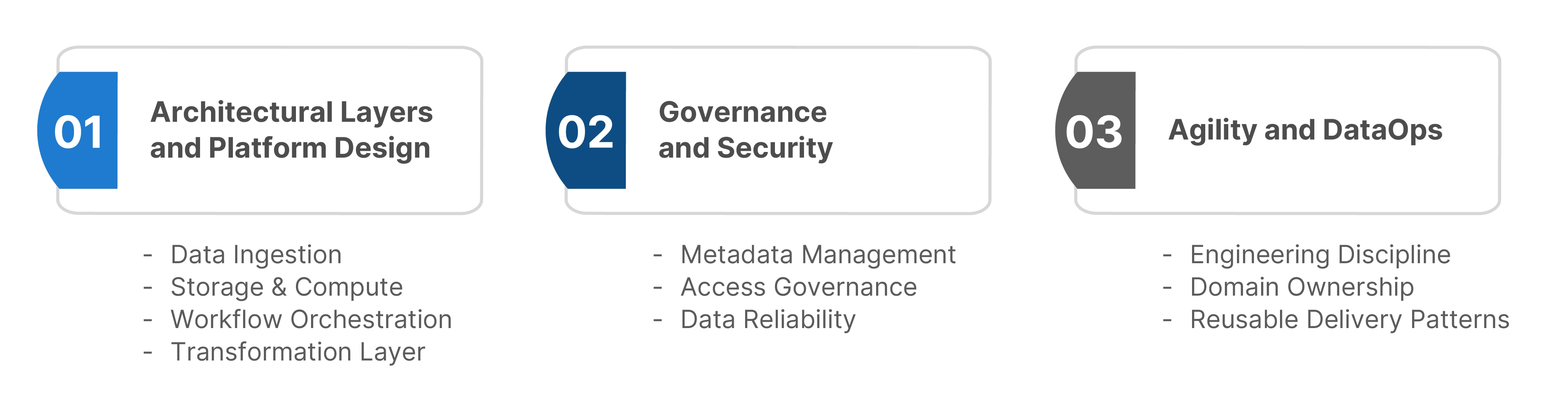
A scalable, governed, and agile data platform depends on an architecture that separates core functions, standardizes delivery, and embeds control into every layer. To achieve this, enterprises often adopt a domain-aligned operating model supported by a modern lakehouse foundation.
1. Architectural Layers and Platform Design
- Data Ingestion: Design ingestion for both real-time and scheduled data movement. The architecture should support diverse enterprise sources while keeping pipelines modular, resilient, and easier to manage.
- Storage & Compute: Build a unified lakehouse foundation that supports raw, refined, and curated data zones. Keep storage and compute loosely coupled so workloads scale without unnecessary operational friction.
- Workflow Orchestration: Establish a centralized orchestration layer to manage dependencies, scheduling, retries, and monitoring. This brings consistency to pipeline execution and improves reliability across teams.
- Transformation Layer: Create a transformation framework that promotes reusable logic, testing discipline, and maintainable code. This helps engineering teams deliver trusted datasets with stronger consistency and lower maintenance effort.
2. Governance and Security
- Metadata Management: Put metadata at the center of platform design. A strong metadata layer improves discoverability, lineage visibility, policy enforcement, and shared business understanding across domains.
- Access Governance: Implement fine-grained access controls aligned with business roles, data sensitivity, and usage context. This enables secure access without forcing teams into slow approval cycles.
- Data Reliability: Embed quality checks directly into pipelines and operational workflows. This helps teams identify freshness issues, schema changes, and anomalies before they affect reporting, decisions, or AI use cases.
3. Agility and DataOps
- Engineering Discipline: Treat data delivery as a structured engineering function. Development, testing, release management, and rollback practices improve stability while accelerating enterprise change.
- Domain Ownership: Move away from centralized bottlenecks by giving business-aligned teams ownership of their data products. A shared platform team can still provide standards, guardrails, and self-service capabilities.
- Reusable Delivery Patterns: Standardize common patterns for ingestion, transformation, quality, and monitoring. This reduces reinvention, shortens delivery cycles, and helps teams scale with greater architectural consistency.
When these layers work together, the platform becomes easier to govern and faster to evolve. That balance is what turns architecture into a long-term enterprise advantage.
How a Modern Data Platform AWS Approach Strengthens Governance and Compliance
Governance is where enterprise platforms either gain trust or lose it quickly. Business teams need speed, while risk teams need control and transparency.
- Governance must be designed into the data flow: A modern data platform AWS approach should embed governance across ingestion, storage, transformation, and consumption. Access policies should reflect role, purpose, data sensitivity, geography, and compliance context.
- Metadata is the operating language of governance: Metadata connects technical assets with business meaning. It helps teams understand data ownership, lineage, quality, usage, and approval status. With strong metadata, governance becomes more automated and less subjective. Leaders gain better visibility into whether data is trusted, current, and fit for decision-making.
- Compliance should not become a bottleneck: Large enterprises operate across regions, industries, and regulatory requirements. The platform must support that complexity without slowing every data request. Sensitive data should be classified early, access should be automated where possible, and exceptions should remain traceable and auditable.
Preparing Enterprise Data Ecosystems for AI, Automation, and Smarter Decisions
AI readiness depends on more than model adoption. It requires trusted data, clear ownership, governed access, and feedback loops that keep systems reliable after deployment. A modern enterprise data platform should make approved data available for analytics, automation, and AI without creating new silos or uncontrolled risk.
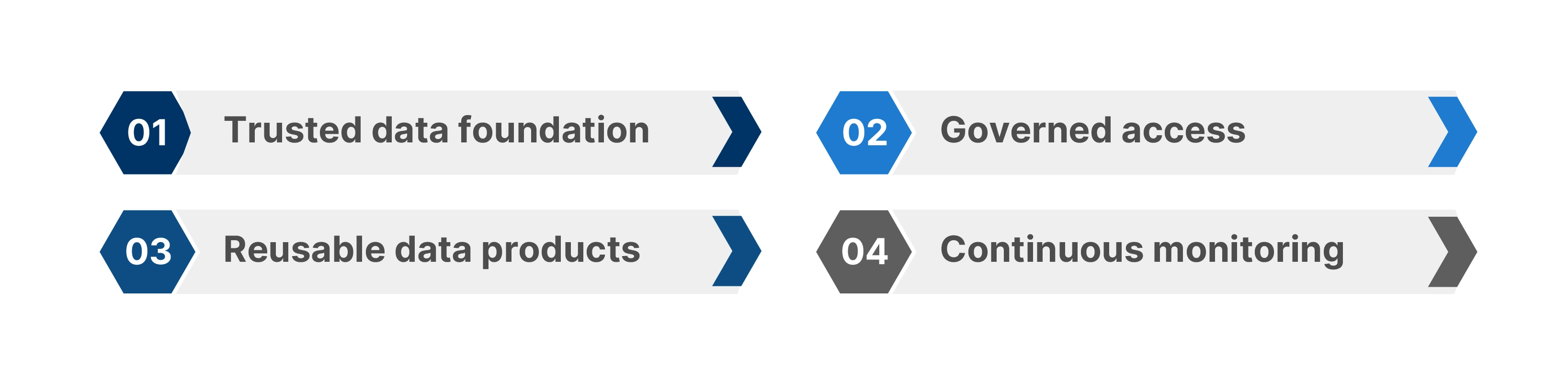
- Trusted data foundation: AI systems need accurate, current, and contextual data to produce dependable outputs.
- Governed access: Sensitive enterprise data should be protected through role-based policies, audit trails, and usage controls.
- Reusable data products: Curated datasets help teams build analytics, models, and applications without repeating engineering work.
- Continuous monitoring: Quality checks, lineage, and performance signals help leaders detect drift, gaps, and operational risk early.
When these capabilities work together, AI becomes less dependent on isolated experiments. It becomes a governed enterprise capability that supports smarter, faster, and more accountable decisions.
Why TxMinds for Cloud Data Platform Services and Enterprise Data Modernization
At TxMinds, we help enterprises modernize cloud data platforms with trust built into every stage. Our approach combines architecture, migration, validation, governance, and quality engineering, so data modernization does not stop at movement. It proves business readiness. We design business-aligned lakehouse and warehouse architectures, support scalable ingestion and transformation, and embed security, privacy, and policy controls into delivery.
Our cloud data platform services also focus on reconciliation, regression validation, drift detection, and continuous monitoring, helping enterprises protect confidence after go-live.
For businesses building a modern data platform AWS strategy, we bring practical execution across modernization assessment, data engineering, integration, and AI-ready foundations. We work to reduce complexity, strengthen data quality, and build trusted platforms that scale with enterprise goals. That is how we help leaders move from migration activity to measurable data value.

Rajiv Diwan
VP and Global Head Data & AI Practice
Results-oriented Data Analytics & AI Specialist with 24+ years of experience in multiple roles, including Practice Leader with P&L ownership. Expert in building Data Analytics practices, defining market strategies, and leading large-scale transformation initiatives. Skilled in Business Intelligence, Data Engineering, Cloud platforms (Azure, AWS, GCP), AI/ML, and Data Governance, with a strong focus on customer-centric solutions and strategic alliances.
FAQs
What is a modern data platform AWS strategy?
A modern data platform AWS strategy is an enterprise approach to building scalable, governed, and AI-ready data foundations on AWS. It connects ingestion, storage, processing, governance, analytics, and machine learning capabilities into one coherent architecture.
Why does data engineering platform architecture matter for large enterprises?
A strong data engineering platform architecture helps enterprises standardize pipelines, improve data quality, reduce duplication, and support faster decision-making. It also makes data easier to govern, reuse, and scale across business domains.
How do cloud data platform services support AI readiness?
Cloud data platform services support AI readiness by modernizing data pipelines, improving metadata, strengthening governance, and creating trusted data products. These capabilities help AI systems use accurate, secure, and business-ready data.
How does governance fit into a modern enterprise data platform?
Governance should be built into the platform from the start. It should include access controls, metadata management, lineage, quality checks, and auditability, so teams can use data faster without increasing risk.
Discover more