


Recommended Blogs

Blog
Turning Strategy into Execution: A Data Modernization Framework for Enterprise Scale
Table of Content
- Why Enterprise Data Modernization Strategies Fail in Execution
- Defining a Business-Aligned Data Strategy for Measurable Outcomes
- Designing a Scalable Data Modernization Architecture (Cloud, Lakehouse, Data Mesh)
- Operationalizing Data Modernization: Governance, DataOps, and Cost Optimization
- How TxMinds Enables Enterprise-Scale Data Modernization Execution
Share On


Enterprises are investing aggressively in data, cloud, and AI, yet the outcomes rarely match the ambition. The problem is not intent but the execution.
IBM’s 2025 CEO Study found that only 16% of AI initiatives have successfully scaled across the enterprise, while up to 95% of generative AI pilots fail to move beyond experimentation. Poor data quality and weak data foundations remain central reasons for this gap.
That is the real modernization challenge. Not shifting data from legacy systems to the cloud, but making it usable, governed, scalable, and ready for enterprise-wide intelligence.
This blog will explore how enterprises can turn data strategy into execution through a practical, scalable, and business-aligned data modernization framework.
Key Takeaways
- Only 16% of AI initiatives scale, and up to 95% of GenAI pilots fail.
- Modernization fails when strategy, execution, governance, and costs are misaligned.
- Data strategy must tie directly to measurable business outcomes.
- Scalable architectures need cloud, lakehouse, data mesh, governance, DataOps, and cost controls.
Why Enterprise Data Modernization Strategies Fail in Execution
Enterprise data modernization rarely fails because of one isolated issue. It usually breaks down when strategic intent, technical execution, governance, operating models, and cost controls are not aligned.
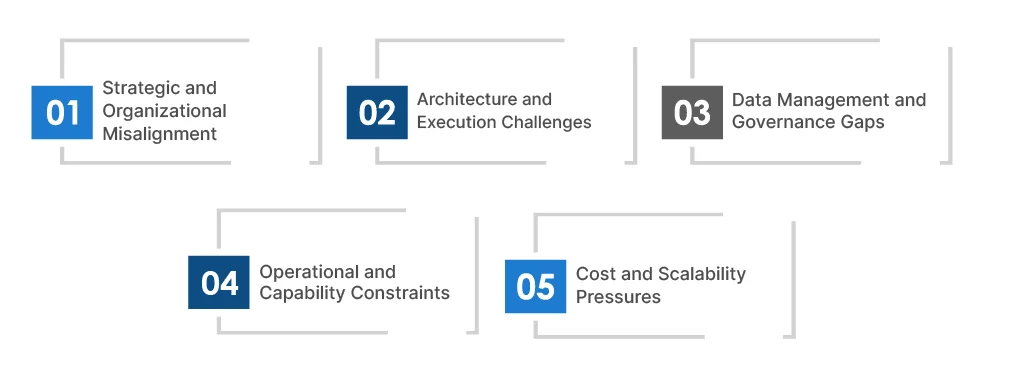
Strategic and Organizational Misalignment
- Technology-Led Instead of Outcome-Led Thinking: Many organizations prioritize platform upgrades and cloud adoption without clearly defining the business problems they are solving. This leads to modern infrastructure with limited business impact.
- Disconnect Between Business and Data Teams: Data initiatives are often driven by IT, while business stakeholders remain passive consumers. This lack of shared ownership results in solutions that do not align with real operational needs.
- Unclear Data Ownership and Accountability: Without defined data owners or domain accountability, data quality, governance, and usability suffer across the organization.
- Undefined Success Metrics: Modernization efforts frequently lack measurable KPIs, making it difficult to track progress or demonstrate return on investment.
Architecture and Execution Challenges
- Complex Legacy Ecosystems: Enterprises operate on deeply interconnected legacy systems with undocumented dependencies, making migration and integration far more complex than anticipated.
- One-Time Transformation Mindset: Treating modernization as a single large-scale project rather than an iterative journey often leads to delays, cost overruns, and incomplete outcomes.
- Fragmented Data Landscape: Data remains distributed across multiple systems without standardization, leading to inconsistencies and duplication.
- Limited Real-Time Capabilities: Many organizations fail to move beyond batch processing, restricting their ability to generate timely insights.
Data Management and Governance Gaps
- Inconsistent Data Quality Standards: Without automated validation and monitoring, data becomes unreliable, directly impacting analytics and AI outcomes.
- Weak Governance Frameworks: Policies exist on paper but are not embedded into systems, resulting in poor enforcement of security, compliance, and access controls.
- Lack of Data Lineage and Transparency: Inability to trace data origins and transformations reduces trust and slows down decision-making.
- Security and Compliance Risks: As data volumes grow, insufficient controls increase exposure to regulatory and operational risks.
Operational and Capability Constraints
- Skill Gaps in Modern Data Technologies: Shortage of expertise in cloud data platforms, distributed systems, and advanced analytics limits execution capability.
- Siloed Ways of Working: Teams operate independently with their own tools and data definitions, preventing integration and reuse.
- Manual and Inefficient Processes: Lack of automation in data pipelines leads to delays, errors, and higher operational overhead.
- Change Management Challenges: Employees are often not equipped or incentivized to adopt new tools and workflows, slowing down transformation.
Cost and Scalability Pressures
- Uncontrolled Cloud Spending: Without proper cost governance, cloud adoption can lead to rapidly increasing expenses without proportional value.
- Inefficient Resource Utilization: Over-provisioned systems and unused data assets contribute to waste.
- Scaling Without Standardization: Expanding data platforms without consistent architecture leads to complexity and operational inefficiency.
Defining a Business-Aligned Data Strategy for Measurable Outcomes
A business-aligned data strategy ensures that every data initiative is tied to a clear business objective. Instead of focusing on platforms or tools, organizations prioritize outcomes such as revenue growth, cost efficiency, risk reduction, and improved customer experience. This approach shifts data from being a technical asset to a driver of measurable business value.
Key Pillars of a Business-Aligned Data Strategy
-
Outcome-Driven Approach:
Start by identifying high-impact business problems such as customer churn, operational inefficiencies, or supply chain delays. Data initiatives should directly contribute to solving these challenges.
- KPI and ROI Alignment:
Define measurable success metrics that connect data efforts to business performance. This includes metrics like revenue uplift, cost savings, process cycle time reduction, and customer lifetime value.
-
Use Case Prioritization:
Focus on use cases that deliver quick wins while building long-term capabilities. Prioritization should be based on business impact, feasibility, and data readiness.
-
Data as a Product Mindset:
Treat data assets as products with defined ownership, quality standards, and lifecycle management. This improves usability, consistency, and reuse across teams.
-
Cross-Functional Collaboration:
Align business leaders, data engineers, analysts, and governance teams to ensure that solutions are both technically sound and business relevant.
-
Governance Embedded from the Start:
Integrate data governance, quality controls, and compliance requirements into the strategy rather than treating them as an afterthought.
Designing a Scalable Data Modernization Architecture (Cloud, Lakehouse, Data Mesh)
A strong data modernization architecture gives enterprises the room to grow without forcing every new use case into another workaround. The objective is not to replace one legacy platform with one modern platform. It is to create a flexible foundation where data can move securely across systems, support real-time analytics, and serve business teams without creating another layer of complexity.
Core Building Blocks of a Modern Data Architecture
-
Cloud Data Platform:
Cloud platforms give enterprises elastic storage, scalable compute, and faster deployment cycles. They also help reduce dependency on fixed-capacity infrastructure.
-
Data Lakehouse:
A lakehouse brings together the flexibility of a data lake and the structure of a data warehouse. It supports reporting, analytics, machine learning, and large-scale data processing from a common data foundation.
-
Data Mesh:
Data mesh shifts ownership closer to business domains. Instead of one central team managing every dataset, domain teams own, govern, and improve the data they understand best.
-
Data Fabric:
A data fabric connects data across distributed environments using metadata, automation, and integration layers. It helps enterprises improve discovery, access, lineage, and governance.
Architecture Capabilities Enterprises Need
-
Batch and Real-Time Data Pipelines:
Modern platforms must support scheduled processing as well as streaming data for use cases such as fraud detection, supply chain visibility, and customer personalization.
-
Unified Data Governance:
Access control, data lineage, cataloging, data quality, and compliance should be built into the architecture from the start.
-
Open and Interoperable Design:
Enterprises need platforms that work across BI tools, AI platforms, cloud services, APIs, and legacy applications.
-
AI-Ready Data Foundation:
Clean, governed, and well-structured data is essential for machine learning, predictive analytics, and generative AI use cases.
-
Cost-Aware Scalability:
Architecture should scale with demand, but with visibility into storage, compute, workload usage, and cloud spend.
A scalable architecture helps enterprises move from fragmented data systems to a connected, governed, and AI-ready data ecosystem. It improves data access, speeds up analytics, supports cloud data modernization, and gives teams a stronger foundation for enterprise-wide decision-making.
Operationalizing Data Modernization: Governance, DataOps, and Cost Optimization
A modern data platform creates value only when it can be operated reliably every day. That means governance, DataOps, security, automation, and cost control must be built into the way data moves, transforms, and gets consumed across the enterprise. Without this operational layer, even the best architecture can become expensive, fragile, and difficult to trust.
- Data Governance: Define ownership, access controls, data lineage, cataloging, and compliance rules from the start.
- Data Quality and Observability: Use automated checks, anomaly detection, and monitoring to keep data accurate, complete, and reliable.
- DataOps: Apply CI/CD, version control, automated testing, and deployment discipline to data pipelines.
- Security and Compliance: Protect sensitive data through encryption, role-based access, auditing, and policy enforcement.
- Cloud Cost Optimization: Track storage, compute, and workload usage to avoid uncontrolled cloud spend.
- Automation: Reduce manual work across ingestion, transformation, validation, and release cycles.
- Continuous Value Tracking: Measure platform performance, adoption, cost savings, and business impact over time.
Real-World Example
A North American financial services firm struggled with inconsistent data pipelines and manual validation processes. By implementing CI/CD-driven DataOps and automated data quality checks, the organization significantly improved pipeline reliability and reduced manual effort across its data workflows.
You can explore the full case study here: https://www.txminds.com/case-study/ci-cd-automation-data-quality-north-america-financial-services/
How TxMinds Enables Enterprise-Scale Data Modernization Execution
At TxMinds, we help enterprises turn data modernization strategies into tangible outcomes. Our approach focuses on building cloud-native data platforms that are scalable, governed, and aligned with business needs. We start by understanding your current data landscape and defining a clear roadmap that connects architecture, data engineering, and governance with measurable goals.
We bring together modern cloud data modernization services, real-time pipelines, and strong governance practices to ensure your data is reliable and accessible. Our QA-led execution model sets us apart, where we embed data quality checks, validation, and testing into every stage of the pipeline. This reduces risk and improves consistency at scale.
By combining DataOps, automation, and continuous monitoring, we enable faster releases, better performance, and controlled costs, helping you build a data foundation that supports long-term growth and AI readiness.


Rajiv Diwan
VP and Global Head Data & AI Practice
Results-oriented Data Analytics & AI Specialist with 24+ years of experience in multiple roles, including Practice Leader with P&L ownership. Expert in building Data Analytics practices, defining market strategies, and leading large-scale transformation initiatives. Skilled in Business Intelligence, Data Engineering, Cloud platforms (Azure, AWS, GCP), AI/ML, and Data Governance, with a strong focus on customer-centric solutions and strategic alliances.
Discover more