


Recommended Blogs
Blog
Data Modernization or Migration? The Strategic Choice That Shapes Enterprise Agility
Table of Content
- Key Takeaways
- Data Modernization vs Data Migration: Why the Difference Matters for Enterprises
- How Data Modernization Services Turn Legacy Data into Enterprise Intelligence
- The Executive Decision Framework: Choosing Between Modernization, Migration, or Both
- Business Outcomes that Define a Successful Data Modernization Strategy
- How TxMinds Empower Enterprises Modernize Data for Scalable and Intelligent Growth
Share On


Every enterprise has a data ambition. Far fewer have a data estate that can keep up with it. Leaders want faster decisions, AI-enabled operations, and sharper customer intelligence. Yet many still run these priorities on fragmented systems built for another decade. The gap is now visible in business outcomes.
In the ISG State of Enterprise AI Adoption Report, only 31% of prioritized AI use cases reached full production, despite heavy enterprise investment. That is not only an AI problem. It is a data foundation problem.
This is where the choice becomes strategic. Do you migrate legacy data into a newer environment, or modernize the way data is structured, governed, and used? For C-level leaders, the answer shapes agility, cost control, risk exposure, and enterprise readiness.
This blog clarifies that decision before another platform move becomes another missed opportunity.
Key Takeaways
- Only 31% of prioritized AI use cases reached full production, showing why strong data foundations matter.
- Data migration moves data safely, while data modernization improves how data is governed, accessed, and used.
- Data modernization services help enterprises improve agility, analytics readiness, customer intelligence, and operational efficiency.
- Many enterprises need both migration and modernization, especially when legacy systems limit decision-making and AI readiness.
Data Modernization vs Data Migration: Why the Difference Matters for Enterprises
Data modernization vs data migration is a decision about whether the enterprise only changes where data lives or also changes how data creates value.
Data migration moves data from one system, platform, or environment to another. Data modernization improves the architecture, quality, governance, accessibility, and usability of data. Migration helps enterprises transition safely. Modernization helps enterprises operate intelligently.
| Decision Area | Data Migration | Data Modernization |
| Primary goal | Move data securely and accurately | Make data usable, trusted, and scalable |
| Executive question | Where should the data live next? | What should the data enable next? |
| Typical Scope | System-to-system movement | Architecture, governance, quality, and analytics |
| Business value | Continuity and platform transition | Agility, intelligence, automation, and AI readiness |
| Common trigger | Cloud move, ERP upgrade, system retirement | Fragmented data, slow reporting, poor AI readiness |
Where Data Migration Fits
Migration is essential when the enterprise must retire legacy systems, reduce infrastructure risk, or move workloads into a modern environment. Strong legacy data migration services protect continuity during these changes.
The work usually includes data mapping, validation, cleansing, security controls, cutover planning, and reconciliation. These steps reduce operational disruption when core systems change.
Where Data Modernization Fits
Modernization starts with a broader ambition. It treats data as an enterprise asset, not a technical payload. The goal is to make data easier to access, govern, trust, analyze, and apply across business functions.
This is where data modernization services create strategic leverage. They help enterprises build stronger foundations for analytics, automation, AI, regulatory visibility, and real-time decision-making.
How Data Modernization Services Turn Legacy Data into Enterprise Intelligence
Data modernization services help enterprises convert fragmented legacy data into governed, accessible, analytics-ready intelligence. The real outcome is not a cleaner data stack. It is faster decisions, stronger AI readiness, and greater business responsiveness.
For business leaders, this matters because agility now depends on data movement, data trust, and data usability working together. A modern enterprise cannot wait weeks for reconciled reports. It cannot scale AI on inconsistent definitions. It cannot personalize customer experiences when data remains trapped across functions.
How Modernization Turns Data into Intelligence
- Cloud-ready data foundations: Modernization moves critical data workloads toward scalable cloud or hybrid environments. This helps reduce infrastructure limits and improves enterprise-wide access.
- Modern data architecture: Enterprises redesign around data lakes, lakehouses, warehouses, fabrics, or meshes. The right model depends on governance maturity, business domains, and analytics needs.
- Data transformation and engineering: Teams standardize formats, remove duplication, improve quality, and automate pipelines. This makes historical and operational data ready for analysis.
- AI and analytics enablement: Modernized data supports machine learning, predictive analytics, and generative AI workflows. These use cases require reliable data context, lineage, and access controls.
- Governance and compliance controls: Modernization strengthens ownership, cataloging, access management, lineage, and data quality monitoring. This improves trust without blocking business users.
Key Business Benefits of Modernization
- Real-time decision-making: Leaders can respond faster to market shifts, operational risks, and customer behavior changes.
- Increased enterprise agility: Teams can adopt new platforms, launch new analytics use cases, and scale data capabilities faster.
- Improved customer intelligence: Unified data helps enterprises understand customer journeys, preferences, service history, and revenue opportunities.
- Operational efficiency: Automated pipelines reduce manual reconciliation, repeated reporting work, and avoidable infrastructure overhead.
- Stronger AI readiness: Clean, governed, connected data improves the reliability of AI models and automation initiatives.
Legacy data migration services can move data safely, but modernization makes that data valuable. Migration supports transition. Modernization builds the intelligence layer needed for enterprise agility.
The Executive Decision Framework: Choosing Between Modernization, Migration, or Both
The choice is rarely migration or modernization forever. The smarter question is sequence, scope, and business intent.
Choose Migration When Continuity is the Priority
Migration is appropriate when the business outcome is primarily platform movement. It is also suitable when a system must be retired quickly.
Choose migration when:
- The current platform is unsupported or too costly.
- The target system already defines the operating model.
- Data structures can move with limited redesign.
- The main risk is downtime or data loss.
- Business teams need continuity more than reinvention.
Choose Modernization When Agility is the Priority
Modernization is the better choice when the enterprise needs new capabilities. This is especially true when leaders want faster decisions, self-service analytics, AI readiness, or enterprise-wide data consistency.
Choose modernization when:
- Business teams distrust current reports.
- Data remains trapped inside functional silos.
- AI and analytics programs lack scalable foundations.
- Legacy architecture slows product or market expansion.
- Governance is either too weak or too restrictive.
Choose Both When Transformation is Strategic
Many large enterprises need both migration and modernization. Migration moves data to the right environment. Modernization improves how that data is managed, accessed, and used.
A practical approach starts with the most important data domains. These may include customer, finance, supply chain, risk, or product data. This helps teams reduce disruption and show value earlier.
Business Outcomes that Define a Successful Data Modernization Strategy
A successful data strategy should show clear business improvement. It should not be measured only by platform migration or system cutover.
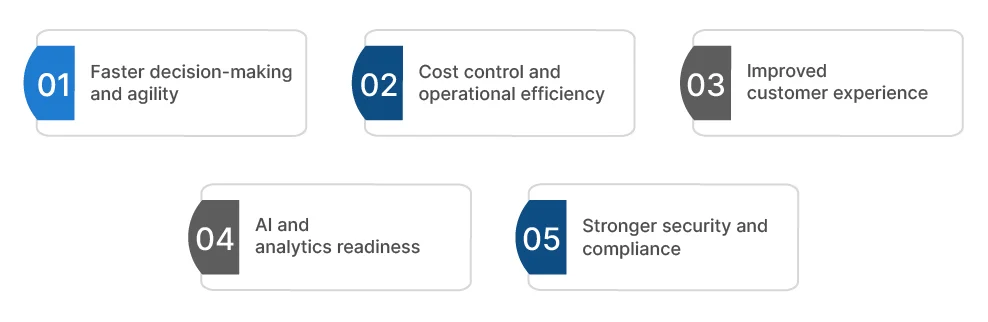
Faster decision-making and agility
- Real-time visibility: Leaders can access current data across operations, finance, customers, and risk.
- Reduced time-to-insight: Teams spend less time preparing data and more time using it.
- Faster response: Business units can adjust quickly to market changes and customer needs.
Cost control and operational efficiency
- Lower legacy dependency: Enterprises reduce reliance on outdated systems and manual workarounds.
- Better resource use: Teams avoid repeated data extraction, reconciliation, and duplicate reporting.
- Improved operations: Automated pipelines reduce manual handling and improve process consistency.
Improved customer experience
- Unified customer data: Teams can see customer history, preferences, issues, and opportunities in one view.
- Better personalization: Sales, service, and marketing teams can respond with more relevant actions.
- Higher service quality: Faster access to accurate data helps teams resolve issues sooner.
AI and analytics readiness
- Trusted data foundation: Modern data platforms support analytics, automation, and AI initiatives.
- Better data access: Business users can work with governed data without depending on long request cycles.
- Stronger model reliability: Clean and consistent data improves the quality of AI-driven outputs.
Stronger security and compliance
- Clear data ownership: Modernization defines who owns, manages, and approves critical data assets.
- Improved traceability: Data lineage helps teams track where data comes from and how it changes.
- Better control: Access management and quality checks reduce compliance and operational risk.
For executives comparing data modernization vs data migration, these outcomes matter most. Migration success means data moved safely. Modernization success means data is trusted, usable, secure, and ready for business growth.
How TxMinds Empower Enterprises Modernize Data for Scalable and Intelligent Growth
At TxMinds, we help enterprises modernize cloud data platforms with quality, security, and governance built into every stage. Our data modernization services cover migration readiness, legacy dependency assessment, target architecture planning, data validation, and continuous quality checks.
We support data warehouse modernization, data lake migration, schema optimization, data harmonization, and large-scale structured or semi-structured data movement. Our focus is to reduce reconciliation gaps, improve KPI trust, and prepare enterprise data for analytics, automation, and AI initiatives.
We also provide legacy data migration services for enterprises moving from outdated systems to modern cloud platforms. We help ensure that data is migrated accurately, validated properly, and made usable for business teams.

Rajiv Diwan
VP and Global Head Data & AI Practice
Results-oriented Data Analytics & AI Specialist with 24+ years of experience in multiple roles, including Practice Leader with P&L ownership. Expert in building Data Analytics practices, defining market strategies, and leading large-scale transformation initiatives. Skilled in Business Intelligence, Data Engineering, Cloud platforms (Azure, AWS, GCP), AI/ML, and Data Governance, with a strong focus on customer-centric solutions and strategic alliances.
FAQs
What is the difference between data modernization and data migration?
Data migration moves data from one system or platform to another. Data modernization improves data architecture, quality, governance, accessibility, and usability. In simple terms, migration changes where data lives, while modernization changes how data supports business decisions.
When should an enterprise choose data modernization services?
Enterprises should choose data modernization services when legacy systems limit reporting, analytics, AI readiness, or operational agility. Modernization is also useful when business teams struggle with inconsistent data, slow insights, and poor visibility across functions.
Are legacy data migration services still needed during modernization?
Yes. Legacy data migration services are often part of modernization programs. They help move data securely from outdated systems to modern platforms while reducing data loss, downtime, and reconciliation issues.
How does data modernization improve AI readiness?
Data modernization improves AI readiness by creating cleaner, governed, and more accessible data. This helps AI models use reliable inputs, consistent definitions, and traceable data sources, which improves the quality of AI-driven outputs.
Discover more