


Recommended Blogs

Blog
Cloud Data Migration Readiness: 12 Decisions Leaders Should Make Before Moving the Warehouse
Table of Content
- Key Takeaways
- Why Cloud Data Migration Readiness Matters Before the Warehouse Moves
- The 12 Decisions Leaders Should Make Before Moving the Warehouse
- AWS, Azure, or Hybrid: Choosing the Right Path for Data Warehouse Migration to Cloud
- What Successful Cloud Data Migration Looks Like After Go-Live
- How TxMinds Helps Enterprises Move from Migration Readiness to Cloud Data Advantage
Share On


A warehouse move can look clean on a roadmap and still fail in the business. The code may migrate. The dashboards may load. Yet leaders can still inherit slower decisions, higher costs, and weaker trust. That is the real risk behind cloud data migration.
A 2025 peer-reviewed article in the World Journal of Advanced Research and Reviews found that organizations moving to cloud-based warehousing reported 78% improved data accessibility and a 42% reduction in operational costs within the first migration year.
The opportunity is clear. The trap is assuming the platform creates the outcome. For C-level leaders, readiness is the difference between a warehouse relocation and a data advantage.
This blog gives you the 12 decisions to make before the move begins. It helps you challenge assumptions, align ownership, and protect enterprise value before capital, talent, and trust are committed.
Key Takeaways
- Cloud data migration should start with readiness, not just platform selection, so leaders can protect cost, trust, governance, and business continuity.
- Organizations moving to cloud-based warehousing reported 78% better data accessibility and 42% lower operational costs within the first migration year.
- Pre-migration assessments matter because they were linked to 75% more successful implementations and 60% fewer migration-related disruptions.
- Leaders should make key decisions upfront, including migration approach, data scope, governance model, security posture, validation, and cutover planning.
Why Cloud Data Migration Readiness Matters Before the Warehouse Moves
Cloud data migration is a controlled decision. Leaders are deciding how the enterprise will govern data, serve analytics, fund workloads, and prepare for AI.
The warehouse often carries more institutional memory than people realize. It contains legacy logic, finance rules, customer definitions, risk reports, and operational exceptions. Moving it without readiness can expose years of undocumented compromise.
The cost of moving too early
Many enterprises start because the legacy warehouse feels expensive or slow. That pressure is real. But speed without readiness usually shifts the pain elsewhere.
A rushed data warehouse migration to the cloud can create several avoidable problems:
- Finance sees unpredictable cloud consumption.
- Business teams question report accuracy after cutover.
- Security teams inherit unclear access patterns.
- Data engineers rebuild brittle pipelines under pressure.
- Executives lose confidence during the first major discrepancy.
Cloud platforms offer elasticity, resilience, and modern analytics capability. They do not automatically resolve poor data ownership or broken definitions.
Readiness protects strategic intent
Readiness forces leaders to decide what the migration must accomplish. Is the goal cost control, AI readiness, faster reporting, regulatory confidence, or market agility?
Research also found that organizations with comprehensive pre-migration assessments achieved successful implementations 75% more frequently than those without structured evaluation processes. The same research reported 60% fewer migration-related disruptions from detailed readiness assessments.
The 12 Decisions Leaders Should Make Before Moving the Warehouse
A warehouse migration exposes decisions the enterprise has postponed for years. It reveals unclear ownership, outdated logic, duplicated data, and fragile reporting dependencies.
That is why cloud data migration should begin with leadership alignment. The technical roadmap only works when the decision roadmap is already clear.
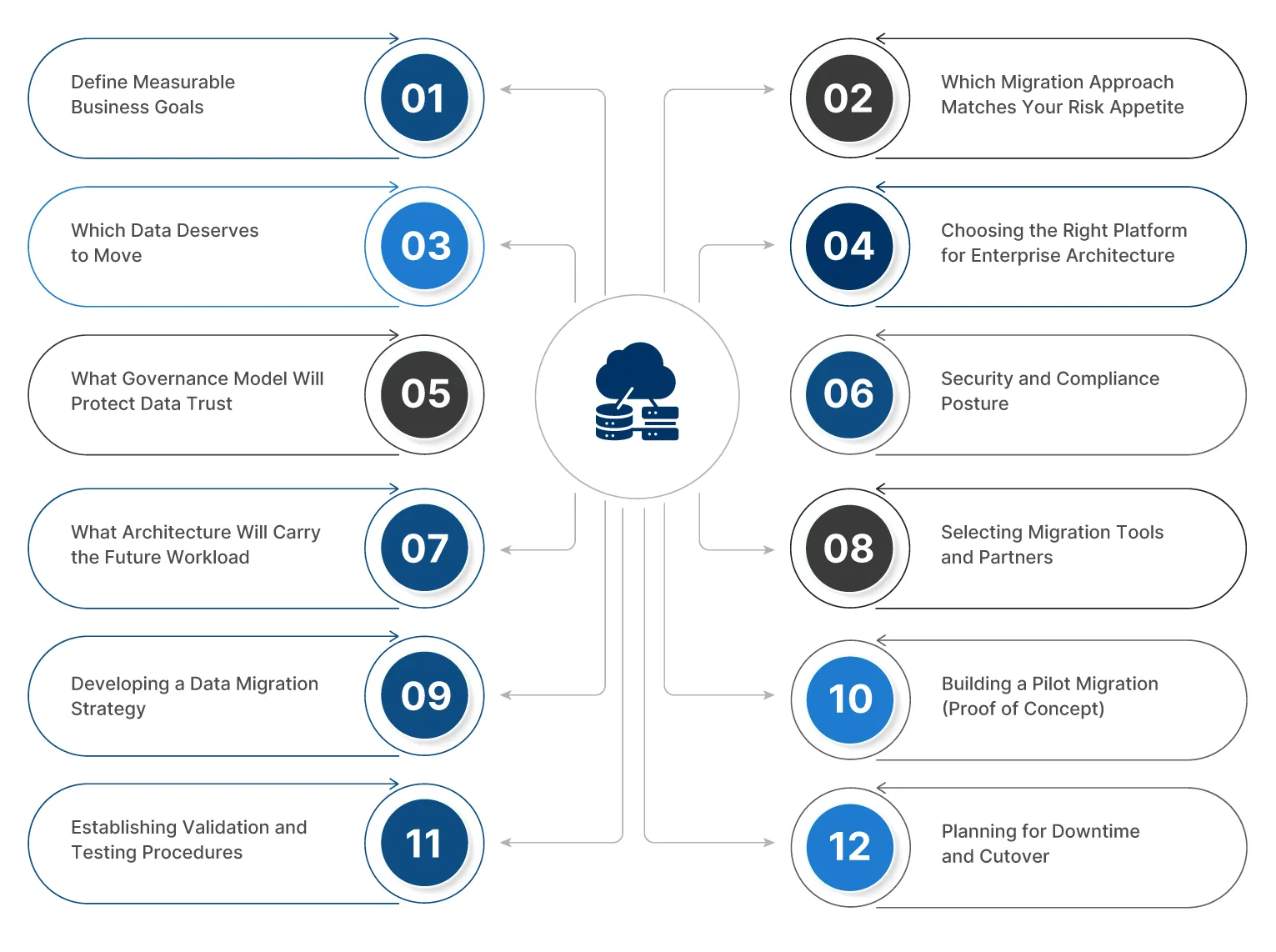
1. Define Measurable Business Goals
The first decision is not where the data will live. It is what the enterprise must achieve after the move.
Leaders should define measurable goals before architecture discussions begin. Examples include faster executive reporting, lower infrastructure dependency, stronger governance, or AI-ready data foundations.
2. Which Migration Approach Matches Your Risk Appetite
Every enterprise has a different tolerance for disruption. That tolerance should shape the migration approach from the beginning. A lift-and-shift approach may work when speed matters most. A replatforming approach fits teams that want cloud-native performance without a full redesign. A rebuild is harder, but it may remove deeper technical debt.
The right choice depends on urgency, complexity, and business dependency. Leaders should not let convenience masquerade as strategy.
3. Which Data Deserves to Move
A data warehouse often contains years of accumulated clutter. Moving everything can transfer cost, confusion, and compliance exposure into the cloud. Before migration, leaders should require a clear data inventory. It includes schemas, pipelines, dependencies, owners, usage patterns, and business criticality.
The harder question is what to leave behind. Redundant, obsolete, and low-value data should not receive premium cloud treatment.
4. Choosing the Right Platform for Enterprise Architecture
The cloud provider decision should be based on enterprise fit, not market noise. AWS, Azure, Snowflake, Databricks, and hybrid models each serve different priorities. For data warehouse migration to the cloud, leaders should evaluate ecosystem alignment, security requirements, integration needs, talent availability, and commercial commitments.
The decision should also consider future analytics direction. A platform that supports today’s reports may not support tomorrow’s AI ambitions.
5. What Governance Model Will Protect Data Trust
Data governance cannot be added after the warehouse moves. By then, access patterns and reporting behaviors are already established. Hence, leaders should define data ownership, stewardship, lineage, retention rules, and approval workflows before migration begins. These controls protect both agility and accountability.
Good governance does not slow the business. It prevents every department from creating its own version of the truth.
6. Security and Compliance Posture
Security decisions must be embedded into the migration design. It includes identity management, access controls, encryption, key management, audit logging, and regulatory mapping. Sensitive data also needs classification before movement begins.
Large enterprises should design for least privilege from day one. Anything broader becomes difficult to unwind later.
7. What Architecture Will Carry the Future Workload
The target architecture must support more than the current warehouse workload. It should account for growth, latency, resilience, analytics, and AI-readiness.
Leaders should challenge whether the design supports high availability, backup, disaster recovery, and workload isolation. They should also ask how performance will scale during peak usage.
8. Selecting Migration Tools and Partners
The right tools depend on source systems, target platforms, transformation needs, and validation requirements. Enterprises may need discovery tools, replication tools, ETL or ELT tooling, orchestration platforms, and monitoring capabilities. Some migrations also require experienced partners to reduce delivery risk.
The decision is not whether tools are available. The decision is which tools match the migration’s complexity.
9. Developing a Data Migration Strategy
Enterprise leaders must decide how data will move, synchronize, validate, and reconcile. They should also define whether batch migration, continuous replication, or hybrid synchronization is required.
The strategy should reflect the business’s tolerance for downtime. A finance warehouse demands different safeguards than a sandbox analytics environment.
10. Building a Pilot Migration (Proof of Concept)
A pilot should test assumptions before the enterprise commits fully. It should not be a symbolic exercise with a low-risk dataset. Therefore, choose a workload that is meaningful but not mission-critical. It should include real dependencies, actual users, and measurable performance expectations.
A good pilot reveals friction early. That friction is valuable because it appears before executive trust is at stake.
11. Establishing Validation and Testing Procedures
Migration success depends on trust in the numbers. If business users doubt the reports, the platform has already lost credibility.
Testing should cover record counts, reconciliation, transformations, performance, access, lineage, and reporting outputs. Business users must participate in acceptance testing.
12. Planning for Downtime and Cutover
A cloud warehouse changes how teams request data, govern access, monitor cost, and build analytics. That shift requires more than a launch email.
Decision-makers should define roles, training needs, support channels, and ownership after go-live. They should also prepare business teams for new workflows and accountability.
AWS, Azure, or Hybrid: Choosing the Right Path for Data Warehouse Migration to Cloud
Choosing the right path for data warehouse migration to the cloud is about matching workload behavior, compliance needs, existing architecture, and long-term analytics goals. When leaders plan to migrate data warehouses to AWS or Azure environments, they need to weigh control, scalability, cost visibility, and continuity before committing to a platform strategy.
| Migration Path | Best Fit For | Executive Considerations |
| AWS | AWS-heavy enterprises | Ecosystem fit, scalability, security, tooling, and internal skills. |
| Azure | Microsoft-aligned enterprises | Identity, Power BI, Fabric, governance, licensing, talent. |
| Hybrid Cloud | Regulated or phased migrations | Complexity, synchronization, residency, governance, and exit plan. |
| Multi-Cloud | Distributed business units | Cost visibility, interoperability, governance, and skill depth. |
| Cloud-Native Warehouse Platforms | Analytics modernization | Elasticity, performance, workload isolation, and AI-readiness. |
The strongest cloud data migration strategy starts with enterprise realities. AWS, Azure, hybrid, or multi-cloud can all work when the choice reflects business risk, data maturity, and future demand. The right path is the one that helps the warehouse become faster, governed, scalable, and trusted after go-live.
What Successful Cloud Data Migration Looks Like After Go-Live
A successful migration feels different across the enterprise. Business teams trust the numbers. Data teams ship faster. Security teams see access clearly. Finance understands consumption patterns.
The visible signs of success:
- Reports reconcile during and after cutover.
- Business users see faster access to trusted data.
- Data lineage supports audit and root-cause analysis.
- Workloads scale without constant infrastructure negotiation.
- Cost trends are monitored before budget surprises appear.
- New analytics use cases move from request to delivery faster.
The real value emerges after the warehouse stops being only a reporting system. It becomes a foundation for forecasting, decision automation, customer intelligence, and AI adoption.
How TxMinds Helps Enterprises Move from Migration Readiness to Cloud Data Advantage
At TxMinds, we provide cloud data migration services that help enterprises move with clarity, control, and confidence. We begin by understanding your business goals, current infrastructure, workloads, and long-term data strategy. From there, we help define the right path across AWS, Azure, Google Cloud, hybrid, or multi-cloud environments.
We do more than move systems from one place to another. We help modernize for the cloud through secure architecture, data mapping, integration, governance, and performance optimization. Our approach is built to protect business continuity while reducing avoidable migration risk.
For leaders planning a data warehouse migration to the cloud, our cloud data migration services help turn readiness into a scalable, governed, and future-ready cloud data advantage.

Rajiv Diwan
VP and Global Head Data & AI Practice
Results-oriented Data Analytics & AI Specialist with 24+ years of experience in multiple roles, including Practice Leader with P&L ownership. Expert in building Data Analytics practices, defining market strategies, and leading large-scale transformation initiatives. Skilled in Business Intelligence, Data Engineering, Cloud platforms (Azure, AWS, GCP), AI/ML, and Data Governance, with a strong focus on customer-centric solutions and strategic alliances.
FAQs
What is cloud data migration?
Cloud data migration is the process of moving data, workloads, pipelines, and warehouse systems from on-premises or legacy environments to cloud platforms for better scalability, accessibility, governance, and analytics performance.
Why is readiness important before data warehouse migration to cloud?
Readiness helps leaders assess data quality, ownership, security, costs, dependencies, and business goals before migration, reducing disruption and improving trust after go-live.
Should enterprises migrate data warehouse AWS Azure or use a hybrid model?
Enterprises should migrate data warehouse AWS Azure or choose hybrid based on current architecture, compliance needs, internal skills, cost visibility, integrations, and long-term analytics goals.
What decisions should leaders make before cloud data migration?
Leaders should define migration goals, choose the right platform, decide what data should move, set governance rules, plan security controls, test validation procedures, and prepare for cutover.
Discover more