


Recommended Blogs

Blog
Data Migration and Validation: A Step-by-Step Framework for Pre-, In-, and Post-Migration Checks
Table of Content
- Building Your Migration Quality Assurance Framework
- The Step-by-Step Data Migration Framework: Pre, In, and Post
- Data Integrity and Reconciliation Across All Migration Phases
- Common Data Migration Validation Mistakes and How to Avoid Them
- How TxMinds Strengthens Data Migration Quality and Validation
Share On


Here is something that every enterprise leader must pause at.
An IBM report found stated that over a quarter of enterprises estimate they lose more than USD 5 million annually because of poor data quality. During a data migration, that kind of risk only grows, because issues such as missing values, broken relationships, duplicates, and mismatched records can easily move from the source system into the target environment if they are not caught early.
That is why migration success depends not just on moving data, but on validating it at every stage. A structured data migration validation framework helps teams run pre-migration data checks, monitor in-migration validation, and complete post-migration validation with greater confidence.
This blog talks about a step-by-step framework for managing data checks before, during, and after migration so organizations can reduce risk, protect data integrity, and make cutover more reliable.
Key Takeaways
- IBM reports that 25% of enterprises lose over $5 million yearly due to poor data quality, especially during migration.
- A solid data migration validation framework helps reduce risks and ensures smooth migration.
- Key tasks for pre-migration include profiling data, defining the scope, and running pilot migrations.
- Skipping data profiling, delaying validation, and relying on row counts can lead to errors are common mistakes enterprises must avoid.
Building Your Migration Quality Assurance Framework
Before migration begins, teams need a clear migration quality assurance framework to define how validation will work, who owns each check, and what thresholds must be met before cutover. This foundation makes pre-migration data checks more consistent and gives the broader data migration validation framework a clear structure.

- Define success criteria early: Set measurable targets for completeness, accuracy, and reconciliation instead of relying on broad quality goals.
- Create a validation rulebook: Document mappings, transformation rules, mandatory fields, and exception thresholds for each dataset.
- Plan rollback in advance: Establish rollback triggers, decision-makers, and recovery steps before migration starts.
- Assign clear ownership: Use a RACI model so validation, approvals, and issue resolution are not left unclear.
With these elements in place, teams can approach migration with clearer controls, fewer surprises, and a stronger foundation for validation across every stage.
The Step-by-Step Data Migration Framework: Pre, In, and Post
A successful migration is never about moving data alone. It depends on having a step-by-step data migration framework that applies the right checks before, during, and after the move. When teams treat migration as a phased process instead of a one-time event, they are better positioned to catch quality issues early, protect business-critical records, and reduce downstream risk.
That is where a strong data migration validation framework becomes essential.
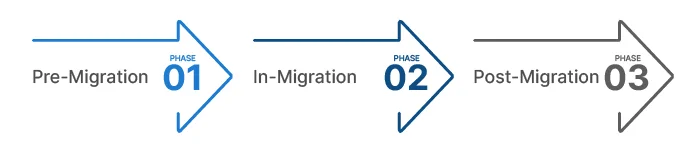
Phase 1: Pre-Migration
The pre-migration phase is where the groundwork is laid. Teams need to understand the current state of the source data, decide what should move, and define how it will be handled in the target system. Strong pre-migration data checks at this stage help prevent avoidable issues later.
- Profile and assess source data: Review source systems for missing values, duplicate records, outdated entries, inconsistent formats, and broken relationships. This is the foundation of pre-migration data profiling and validation.
- Define the migration scope: Decide which data should be migrated, archived, cleaned, or left behind. Moving unnecessary or poor-quality data only increases risk.
- Document mapping and transformation rules: Clearly define how source fields will map to target fields, what conversions are required, and how business rules will be applied.
- Choose the migration approach: Select a migration model that fits the project, whether that means a full cutover or a phased rollout.
- Prepare backups and rollback plans: Confirm that source data is backed up and that rollback steps are documented before migration begins.
- Run a pilot migration: Test the process with a smaller dataset to validate rules, identify issues, and improve execution before full deployment.
Phase 2: In-Migration
This is the execution phase, where data is extracted, transformed, and loaded into the target system. In-migration validation is critical here because even small issues can spread quickly if they are not detected in time.
- Validate extraction and transformation: Check that records are being extracted fully and transformed according to the agreed mapping and business rules.
- Verify target-side loading: Confirm that data is landing in the target system with the correct structure, format, and constraints.
- Monitor the migration in real time: Track throughput, failed records, delays, and processing errors throughout the migration window. This is a core part of in-flight data validation during migration.
- Handle exceptions immediately: Records that fail should be logged, reviewed, corrected, and reprocessed. Nothing should be allowed to drop silently.
Phase 3: Post-Migration
Once the migration is complete, the focus shifts to proving that the data in the target system is complete, accurate, and ready for business use. This is where post-migration validation and reconciliation carry the most weight.
- Reconcile source and target data: Compare row counts, totals, key fields, and critical relationships to confirm that the migrated data matches the source. This is central to data reconciliation migration and post-migration reconciliation best practices.
- Validate business use cases: Business teams should confirm that reports, workflows, and operational processes work as expected in the new environment.
- Review system performance: Make sure the new system can support expected volumes, query loads, and day-to-day usage.
- Retire legacy systems carefully: Decommission old systems only after validation, reconciliation, and stakeholder approvals are complete.
- Update documentation: Record the final mappings, validation outcomes, issue logs, and operating procedures to support future audits and maintenance.
Taken together, these phases form a practical step-by-step data migration validation process that helps teams improve data integrity and make migration outcomes more reliable.
Data Integrity and Reconciliation Across All Migration Phases
Data integrity should not be treated as something to check only after migration is complete. It needs to be built into the entire process through regular validation and reconciliation at every stage. From pre-migration data checks to in-migration validation and post-migration validation, the goal is to make sure records remain complete, accurate, and consistent as they move from source to target.
Some checks can be automated, such as row counts, duplicate detection, checksum verification, and referential integrity checks. Others need business review, especially when teams must validate reports, workflows, or exceptions. When both are used together, the migration process becomes easier to control and far more reliable.
Common Data Migration Validation Mistakes and How to Avoid Them
Even with a solid plan in place, a few mistakes continue to cause problems in migration projects. Most of them come from weak validation, incomplete testing, or poor visibility into the data being moved.
Common Data Migration Validation Mistakes
- Skipping source data profiling: When teams move data without first understanding its condition, issues like duplicates, missing values, and inconsistent formats usually carry over into the target system.
- Leaving validation until the end: Validation works best when it happens throughout the migration, not only after cutover. Waiting too long makes issues harder to trace and fix.
- Depending only on row counts: Matching totals may look reassuring, but row counts alone cannot confirm that the data is accurate, complete, or usable.
- Missing transformation issues: Poorly tested mapping or conversion rules can change values, break formats, or distort business logic in the target system.
- Testing without real data conditions: Small or artificial test sets often fail to expose the issues that show up with production data.
How to Avoid Validation Mistakes
- Start with proper data profiling: Early pre-migration data checks help teams identify gaps, clean up records, and set a reliable baseline.
- Make validation part of every phase: A strong data migration validation framework includes checks before, during, and after the move.
- Use reconciliation throughout the process: Comparing counts, totals, and key records between source and target improves data reconciliation migration and reduces surprises later.
- Run pilot migrations: Smaller test runs make it easier to catch errors in mapping, logic, and load behaviour before full migration.
- Review transformation rules carefully: Every conversion, mapping rule, and field-level change should be tested against expected business outcomes.
- Set clear ownership: Validation, approvals, and issue handling should all have named owners from the start.
- Keep a rollback plan ready: If major validation issues appear during cutover, the team should already know how to respond.
How TxMinds Strengthens Data Migration Quality and Validation
We approach migration with a clear focus on trust, control, and long-term usability. Our data services span assessment, engineering and integration, governance and quality, cloud data modernization, and data quality assurance, which allows us to support migration from planning through validation and cutover. We also follow a shift-left approach, bringing validation into the process early so issues can be identified before they affect operations.
For teams looking to strengthen their data migration validation framework, that means we do more than move data from one system to another. We build quality gates into the data lifecycle, validate the chain from source to dashboards, use automated testing to catch defects early, and apply measurable controls such as clear ownership and data SLOs. This helps improve reconciliation, reduce production issues, and make migration outcomes more reliable.


Rajiv Diwan
VP and Global Head Data & AI Practice
Results-oriented Data Analytics & AI Specialist with 24+ years of experience in multiple roles, including Practice Leader with P&L ownership. Expert in building Data Analytics practices, defining market strategies, and leading large-scale transformation initiatives. Skilled in Business Intelligence, Data Engineering, Cloud platforms (Azure, AWS, GCP), AI/ML, and Data Governance, with a strong focus on customer-centric solutions and strategic alliances.
FAQs
What is a data migration framework, and why are pre-in-post checks important?
A data migration framework outlines the steps for validating data before, during, and after migration. Pre-in-post checks ensure that data quality issues are identified and addressed at each phase, reducing risks during the migration process.
Why is a step-by-step data migration validation process necessary?
A step-by-step validation process ensures that data is thoroughly checked at every stage of the migration, from pre-migration profiling to post-migration reconciliation. This approach helps maintain data integrity and minimize errors.
What is pre-migration data profiling and validation, and why is it important?
Pre-migration data profiling and validation involve assessing the source data for issues like duplicates, missing values, and inconsistent formats. This helps prevent poor-quality data from being migrated, ensuring a cleaner target system.
How does in-flight data validation during migration help?
In-flight data validation ensures that data is correctly extracted, transformed, and loaded during migration. It helps monitor real-time progress, identify issues early, and correct errors before they impact the migration outcome.
Discover more