


Recommended Blogs

Blog
Legacy Systems are Slowing Enterprise Growth. AI can Change the Modernization Equation
Table of Content
- Key Takeaways
- Why Legacy Application Modernization is Now a Boardroom Priority
- The Cost of Standing Still: What Legacy Systems are Really Taking from the Enterprise
- AI is Changing How Enterprises Modernize Legacy Software
- Choosing the Right Application Modernization Services Partner
- TxMinds: Turning Legacy Constraints into AI-Ready Growth Engines
Share On


Enterprise leaders rarely lose momentum because they lack ambition. They lose it because their core systems were built for a different era. The CRM that cannot speak to the data platform. The ERP that takes months to change. The claims, billing, logistics, or finance application that still carries decades of business logic but cannot support real-time intelligence.
That is why legacy application modernization has moved from the CIO agenda to the boardroom. In McKinsey’s 2025 global AI survey, 88% of respondents said their organizations use AI in at least one business function, yet only 39% reported enterprise-level EBIT impact from AI. The message is clear: AI adoption is rising, but enterprise value still depends on the systems, workflows, and data foundations beneath it.
This blog explores how AI is changing the legacy application modernization equation, why modernization has become a boardroom priority, and how enterprises can turn legacy constraints into AI-ready growth engines.
Key Takeaways
- Legacy application modernization is now a boardroom priority, directly tied to growth, agility, risk, and AI readiness.
- AI adoption is rising, but value is lagging. McKinsey reports 88% AI usage, while only 39% see enterprise-level EBIT impact.
- Legacy technology is becoming an AI barrier. Cognizant reports 85% executive concern and 79% slow tech-debt retirement expectations.
- AI-enabled modernization helps enterprises move faster, prioritize high-value systems, reduce risk, and build scalable growth foundations.
Why Legacy Application Modernization is Now a Boardroom Priority
Legacy systems are often described as “stable.” In reality, many are stable in the same way a dam is stable before pressure builds. They keep the enterprise running, but they limit how fast it can adapt.
For large enterprises, the issue is no longer whether an old system still works. The sharper question is whether it can support the next operating model.
A legacy application can quietly restrict:
Speed to market: Product changes, integrations, and feature releases take longer than business conditions allow.
Enterprise intelligence: Data stays trapped in silos, making AI, analytics, and automation harder to scale.
Customer experience: Disconnected systems create slow service, inconsistent journeys, and limited personalization.
M&A and ecosystem growth: Integrating platforms, partners, and acquired entities becomes costly and fragile.
Resilience: Older architectures increase operational risk, security exposure, and continuity concerns.
This is why application modernization services are becoming a strategic capability. Enterprises do not need isolated upgrades. They need structured modernization programs that connect business priorities, technical debt, AI readiness, security, and measurable value. For enterprise leaders, modernization is now a growth equation:
| Executive Priority | Legacy Constraint | Modernization Outcome |
| Revenue growth | Slow product launches | Faster digital innovation |
| Cost efficiency | High maintenance overhead | Lower run costs and improved productivity |
| AI adoption | Fragmented data and rigid systems | AI-ready architecture and workflows |
| Risk management | Unsupported technologies | Stronger security and compliance |
| Customer experience | Disconnected journeys | Integrated, responsive digital services |
The organizations that treat modernization as a strategic portfolio decision will move faster than those that treat it as a backlog of IT fixes.
The Cost of Standing Still: What Legacy Systems are Really Taking from the Enterprise
Legacy systems rarely fail all at once. They erode enterprise performance gradually by consuming budgets, slowing decisions, increasing security exposure, and making AI adoption harder than it should be.
For businesses, the real cost is not just technical debt. It is the lost speed, flexibility, and market responsiveness that competitors may already be gaining through legacy application modernization. Cognizant’s 2025 research found that 85% of senior executives are concerned their existing technology estate could limit AI integration, while 79% expect to retire less than half of their technology debt by 2030.
The cost of standing still often appears in these areas:
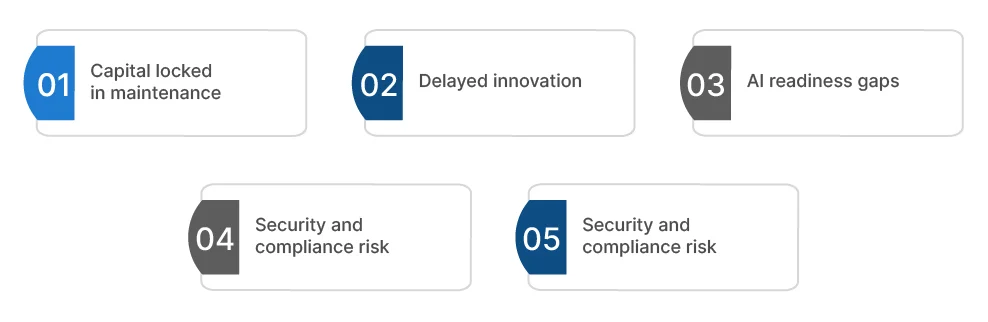
- Capital locked in maintenance: Budgets remain tied to hosting, licensing, patching, and support instead of growth-focused innovation.
- Delayed innovation: Small changes require multiple dependencies, long approval cycles, and fragile integrations.
- AI readiness gaps: Fragmented data, undocumented logic, and rigid workflows make it harder to modernize legacy software with AI.
- Talent dependency: Older technologies rely on specialized skills that are becoming harder to retain or replace.
- Security and compliance risk: Unsupported platforms increase exposure across regulated, data-intensive environments.
This is why modernization cannot remain a delayed IT initiative. The longer enterprises wait, the more legacy systems shape business strategy by limitation rather than ambition. The right application modernization services help leaders reduce risk, unlock agility, and turn modernization into a measurable growth lever.
AI is Changing How Enterprises Modernize Legacy Software
For years, modernization has been slowed by high cost, complex dependencies, incomplete documentation, manual code analysis, and the risk of disrupting business-critical systems. AI is changing that model. It gives enterprises a faster and more intelligent way to assess legacy estates, understand hidden business logic, reduce technical debt, and move legacy application modernization from long discovery cycles to outcome-led execution.
To modernize legacy software with AI does not mean replacing enterprise judgment with automation. It means using AI to accelerate repetitive, time-intensive, and risk-prone modernization tasks while keeping architecture, governance, security, and human expertise in control.
AI can support modernization across key areas:
- Portfolio assessment: Identifies which applications carry the highest business risk, cost, and modernization priority.
- Code understanding: Interprets legacy codebases and extracts business logic that may no longer be documented.
- Dependency mapping: Reveals integrations, data flows, and downstream impacts before migration begins.
- Refactoring support: Assists with code transformation, framework upgrades, cloud readiness, and modularization.
- Test generation: Improves regression coverage and reduces release risk.
- Migration planning: Helps define the right path across rehosting, replatforming, refactoring, rewriting, replacing, or retiring applications.
AI-enabled application modernization services help enterprises modernize with greater visibility, stronger prioritization, and lower execution risk. Instead of treating modernization as a series of technical fixes, leaders can shape it into a roadmap tied to business value, AI readiness, resilience, and scalable growth.
Choosing the Right Application Modernization Services Partner
For C-level leaders, choosing a modernization partner is a strategic decision. The right partner should not only upgrade systems, but also connect legacy application modernization to business growth, AI readiness, risk reduction, and operational agility.
A strong application modernization services partner should bring:
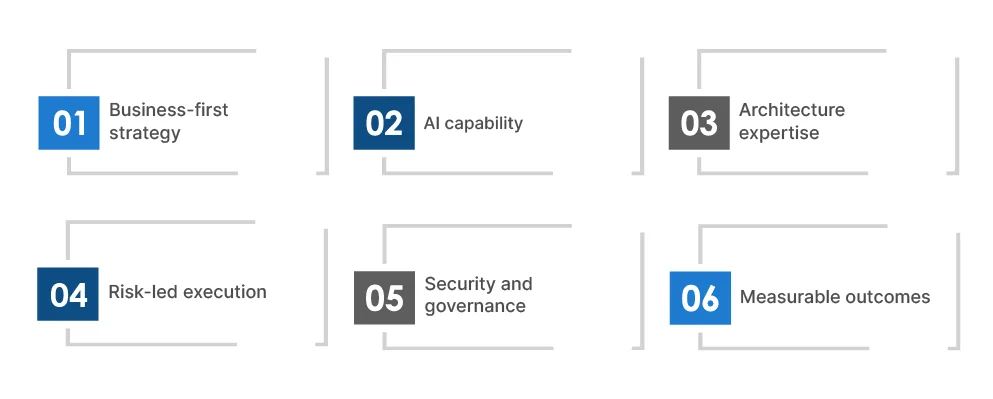
- Business-first strategy: Clear alignment between modernization priorities and enterprise outcomes.
- AI capability: Ability to use AI for assessment, code analysis, documentation, testing, and migration planning.
- Architecture expertise: Experience with cloud, APIs, microservices, integration, DevOps, and data modernization.
- Risk-led execution: A phased roadmap that protects business continuity while reducing technical debt.
- Security and governance: Strong controls for compliance, data protection, and enterprise resilience.
- Measurable outcomes: KPIs tied to cost reduction, faster releases, better performance, and AI enablement.
A capable partner helps enterprises modernize legacy software with AI while turning transformation into a repeatable, value-driven growth engine.
TxMinds: Turning Legacy Constraints into AI-Ready Growth Engines
At TxMinds, we approach legacy application modernization as a business transformation, not just a technical fix. We help enterprises transform outdated applications into agile, intelligent, secure digital assets that support speed, scalability, and long-term growth.
Our application modernization services cover cloud-native migration, data and integration modernization, application architecture re-engineering, UI/UX modernization, DevOps and CI/CD enablement, platform migration, low-code/no-code modernization, and security and compliance modernization, supported by advanced data engineering and integration services. We help enterprises move from monolithic systems, outdated interfaces, and limited cloud scalability toward modern architectures built for real-time access, API-driven integration, intelligent automation, and resilient delivery.
We also support enterprises that want to modernize legacy software with AI by building modernization roadmaps aligned with business goals, operational priorities, and future AI readiness. With outcome-centric delivery, cloud-first thinking, and deep engineering expertise, we help turn legacy constraints into scalable digital foundations for enterprise growth.

Amar Jamadhiar
VP, Delivery North America
Amar Jamadhiar is the Vice President of Delivery for TxMind's North America region, driving innovation and strategic partnerships. With over 30 years of experience, he has played a key role in forging alliances with UiPath, Tricentis, AccelQ, and others. His expertise helps Tx explore AI, ML, and data engineering advancements.
FAQs
What is legacy application modernization?
Legacy application modernization is the process of transforming outdated enterprise applications into more scalable, secure, cloud-ready, and agile systems. It may involve rehosting, replatforming, refactoring, rewriting, replacing, or retiring legacy applications based on business value and technical risk.
Why is legacy application modernization important for enterprises?
Legacy application modernization helps enterprises reduce technical debt, improve operational efficiency, strengthen security, enable faster innovation, and prepare systems for AI adoption. For C-level leaders, it is a strategic growth priority, not just an IT upgrade.
How can enterprises modernize legacy software with AI?
Enterprises can modernize legacy software with AI by using AI for code analysis, documentation recovery, dependency mapping, test generation, refactoring support, and migration planning. This helps reduce manual effort, improve visibility, and accelerate modernization decisions.
What should enterprises look for in application modernization services?
Enterprises should look for application modernization services that combine business-first strategy, cloud and architecture expertise, AI capability, security governance, phased execution, and measurable outcomes such as reduced costs, faster releases, improved scalability, and stronger AI readiness.
Discover more