Architecting Resilient Scale: SRE Strategies for Enterprise Apps in 2026


Table of Content
- When Uptime Becomes a Business Metric: The Real Cost of Unreliable
- SRE has Grown Up from Google's Playbook to an Enterprise-Wide Practice
- The Core Pillars of a Modern SRE Strategy in 2026
- Top SRE Strategies for Enterprise Apps in 2026
- How TxMinds Helps Enterprises Engineer for Resilience


Did you know that unplanned downtime now costs enterprises an average of $14,056 per minute, and this number exceeds $300,000 per hour for over 90% of mid-size and large enterprises?
That is not an infrastructure problem but a business problem. Yet, many enterprise engineering teams still run on legacy operational models that are not designed to absorb the complexity of distributed cloud environments, microservices, and ever-changing customer expectations.
Site reliability engineering is built precisely for this gap. In 2026, SRE is not just a specialty function, rather it has become the operating discipline that enables companies to scale with confidence.
This blog will walk you through what a mature and modern SRE strategy looks like and how enterprises can build one.
Key Takeaways
- Unplanned downtime costs $14,056 per minute on average and over $300,000 per hour for 90%+ of mid-size and large enterprises.
- In 2026, SRE has become an enterprise-wide model for managing reliability across complex cloud and microservices systems.
- Modern SRE relies on SLOs-as-code, AI observability, automation, platform engineering, chaos testing, and progressive delivery.
- Strong SRE programs cut toil, keep engineers spending at least 50% of their time on engineering, and prevent issues before users are impacted.
When Uptime Becomes a Business Metric: The Real Cost of Unreliable
Most organizations discover the true cost of unreliable systems only after something breaks in production. But by then, the damage is already done. Research shows that costs are up to 16 times higher for companies that experience frequent outages than those that maintain consistent uptime.
What makes 2026 different is that reliability has moved into the boardroom. CTOs and infrastructure leaders are now expected to quantify system health in business terms: SLA compliance rates, innovation velocity, cost of downtime per transaction, and reliability ROI. When those numbers sit in a quarterly business review alongside revenue and churn, reliability stops being an engineering conversation and becomes a strategic one.
Organizations that cannot speak to system health in these terms are increasingly finding themselves at a disadvantage, not just operationally, but competitively.
SRE has Grown Up from Google's Playbook to an Enterprise-Wide Practice
SRE practices look very different from what they were five years ago. Today, SRE and platform engineering are embedded across systems and teams with an increasing focus on fully autonomous and AI-driven operations. What was once Google’s internal framework for managing reliability at scale has now become the dominant model for how mature enterprises think about system health.
The Evolution from Google to Enterprise
Original Google Playbook (2003–2016)
Site Reliability Engineering was founded by Ben Treynor Sloss at Google in 2003 with a straightforward but radical idea to treat operations as a software problem. The core instruments of this model were error budgets, blameless postmortems, SLIs, and SLOs (Service Level Objectives). These were a shared language between development and operations that made reliability measurable for the first time.
The Shift to Mainstream (2016–2024)
Following the publication of Google’s SRE book, the practice spread rapidly to companies like Netflix, Amazon, and LinkedIn, each adapting it to their own operational realities. SRE began functioning alongside DevOps, sometimes as a complement, sometimes as an alternative implementation , and the conversation shifted from “what is SRE?” to “how do we scale it?” Teams grew, tooling matured, and the fundamentals of error budgets and SLO governance became table stakes for any organization serious about production reliability.
Enterprise-Wide Adoption (2025–2026)
SRE is no longer the exclusive domain of web-scale technology companies. Finance, healthcare, manufacturing, and retail are now running SRE programs to manage hybrid-cloud, microservices-heavy architectures where the cost of failure is regulatory, reputational, and financial all at once. The model has changed, too. Rather than a central SRE team holding all responsibility, reliability is now encoded into developer portals, release pipelines, and service templates, making it a shared organizational competency rather than one team’s burden.
The Core Pillars of a Modern SRE Strategy in 2026
The role of SRE in 2026 has shifted to reliability architecture, where platform engineering distributes best practices across the organization, AI handles heavy lifting of detection and remediation, and developers own reliability from the start.
The core pillars of a modern SRE strategy in 2026 are:
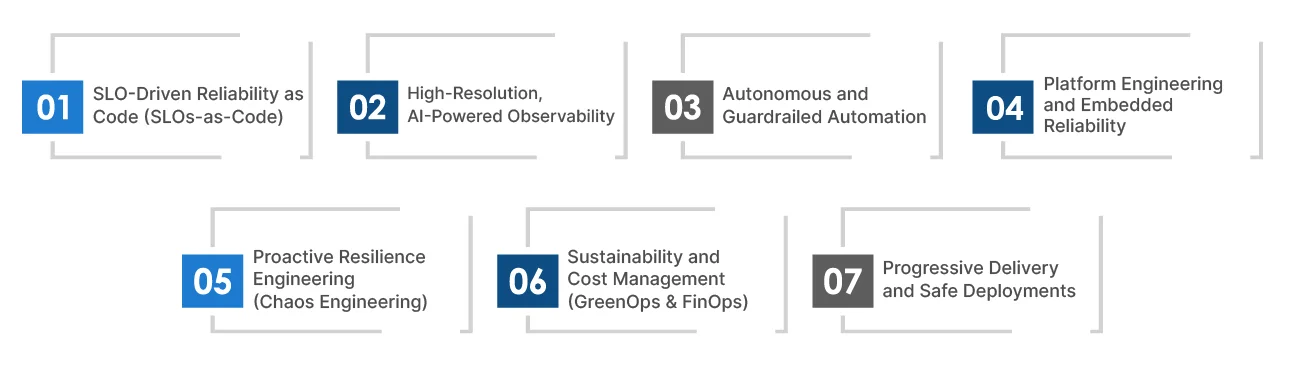
1. SLO-Driven Reliability as Code (SLOs-as-Code)
Service Level Objectives are version-controlled, peer-reviewed, and stored in Git alongside application source code.
- Declarative Definitions: Using specs like OpenSLO, SLOs live in YAML files alongside source code and not locked inside a proprietary tool that only one team can access.
- Automated Error Budgets: Error budgets automatically gate deployments and trigger canary rollbacks when burn rates breach acceptable thresholds before users feel the impact.
- Shared Ownership: Reliability metrics sit between product and engineering, forcing an honest conversation about how much unreliability the business can tolerate at any point in the release cycle.
2. High-Resolution, AI-Powered Observability
Standard monitoring asks, “is the system up?” Modern observability asks, “why is it behaving this way?” This distinction separates teams that catch issues early from teams that find out through the support queue.
- OpenTelemetry Adoption: OTel is now the baseline for centralizing traces, metrics, and logs across fragmented toolchains, removing vendor lock-in across every service.
- Tail-Based Sampling: Full trace data is retained for failed requests while the happy path is sampled, making distributed failures practical to investigate without drowning in volume.
- AIOps Anomaly Detection: AI-driven systems surface root causes and filter alert noise continuously, so on-call engineers respond to real signals rather than false positives.
3. Autonomous and Guardrailed Automation
The focus has moved from writing remediation scripts manually to building systems that resolve a defined class of problems without human involvement.
- Auto-Remediation: Pre-approved automated actions like scaling hot paths, draining unhealthy nodes, rolling back a bad canary resolve common failures without requiring a page.
- Guardrails and Safety: All automated actions are rate-limited and hard-stopped to prevent automation from masking deeper problems or triggering cascading failures.
- Toil Reduction: SREs are expected to spend at least 50% of their time on engineering work. When that ratio flips, the program is consuming itself.
4. Platform Engineering and Embedded Reliability
The centralized SRE team model does not scale. Platform engineering replaces it and gives every product team a paved road to reliability rather than asking them to build it from scratch.
- Platform as a Product: Internal Developer Platforms embed observability defaults, SLO monitoring, and runbook stubs into service templates so reliability ships with the service, not after the first incident.
- Shared Ownership: Developers own reliability from day one through platform tooling, with SREs governing standards rather than fighting fires.
- Standardized Runbooks: Service catalog metadata ensures that when something breaks in production, the owner and resolution path are immediately visible to whoever picks up the page.
5. Proactive Resilience Engineering (Chaos Engineering)
Postmortems are reactive by nature. A mature SRE program deliberately engineers failure under controlled conditions rather than waiting for production to reveal the gaps.
- Chaos Engineering as Default: Regular game days and failure injection using tools like Gremlin or LitmusChaos turn resilience from a theoretical property into a verified one.
- Blameless Culture: Post-incident reviews focused on systemic learning rather than individual fault are the only kind that produce lasting architectural improvements.
6. Sustainability and Cost Management (GreenOps & FinOps)
Reliability without cost discipline is overspending with good intentions. SRE programs in 2026 are expected to make deliberate trade-offs between reliability investment and marginal gains.
- FinOps and SRE: Cost-aware decisions ensure teams are not over-provisioning for uptime improvements that users cannot perceive or the business case does not support.
- GreenOps: Carbon-aware autoscaling schedules background workloads when the grid is cleaner, aligning infrastructure decisions with organizational sustainability commitments.
7. Progressive Delivery and Safe Deployments
Shipping fast and safely are not in conflict when the deployment model is built correctly. Progressive delivery is the standard for teams that cannot afford to bet production on a single release event.
- Argo Rollouts: Canary and blue-green strategies with automatic analysis trigger rollback without human intervention when production signals turn red.
- Kill Switch Capabilities: Feature flag platforms like LaunchDarkly turn off a faulty feature in seconds without a redeployment, which is the practical definition of a low-risk release.
Top SRE Strategies for Enterprise Apps in 2026
SRE for enterprise applications is now a shared, automated, and deeply embedded operating model built to handle the complexity of distributed systems at genuine scale.
1. Platforms as Policy and Shared Responsibility
Internal Developer Portals: SRE practices are built into service creation through platforms like Backstage, so every new service automatically inherits monitoring defaults, ownership metadata, and runbook links.
- Shared SRE: Reliability principles are automated and distributed across product and service teams, removing the bottleneck of a central operations function and improving innovation velocity.
- Ownership and Runbooks as Required Metadata: Every component in the service catalog carries an explicit owner and a documented runbook stored alongside code, so incident responders are never starting from a blank page.
2. Intelligent, AI-Driven Operations (AIOps)
- AI Agentic Systems: SRE teams are moving from AI assistants to agentic systems that monitor continuously and act on well-understood incidents without waiting for a human to pick up a page.
- Auto-Remediation with Guardrails: Pre-approved actions like restarting workloads and scaling bottlenecks execute automatically, with rate limits and hard stops built in to prevent automation from compounding the problem.
- Context-Aware Alerting: Teams are replacing CPU and RAM threshold alerts with user-impact signals like checkout failure rates and API error budgets, so on-call engineers deal with real service disruptions rather than infrastructure noise.
3. Reliability as Code
- Declarative SLOs: Service Level Objectives and indicators are stored in Git as YAML using specs like OpenSLO, making them versioned, reviewable, and auditable alongside the rest of the codebase.
- Automated Gatekeeping: SLOs trigger canary rollbacks and block deployments when burn rates breach thresholds, removing manual judgment calls from the release cycle at the point where they most often break down.
4. Standardized Observability and Cost Control
- OpenTelemetry Adoption: Instrumenting traces, metrics, and logs through OpenTelemetry gives every microservice a consistent telemetry baseline, eliminating the vendor-specific silos that make cross-service debugging painful at scale.
- FinOps for Observability: Cost controls applied to telemetry, like retention tiers, cardinality caps, and centralized sampling defaults, ensure observability spend scales with value rather than data volume.
- Carbon-Aware Scheduling: Non-critical workloads are scheduled during periods of lower grid carbon intensity, bringing sustainability into infrastructure decisions without compromising reliability on tier-1 applications.
5. Progressive Delivery and Resilience Testing
- Default Progressive Delivery: Every service ships through a staged rollout backed by tools like Argo Rollouts, with automated analysis at each stage and a proven rollback path before users see any change.
- Resilience Experiments in Production: Enterprise teams run scheduled chaos engineering experiments in live environments to verify how systems actually behave under failure, not how architecture diagrams suggest they should.
- SRE and Security Convergence: Zero-trust access controls and compliance monitoring are now embedded within the SRE function itself, because an insecure system and an unreliable system are increasingly the same problem.
How TxMinds Helps Enterprises Engineer for Resilience
At TxMinds, we work with enterprises that are ready to stop reacting to failures and start building systems that do not break in the first place. We bring together domain expertise, engineering depth, and AI-powered tooling to help organizations scale without compromising stability.
We build serverless and cloud-native applications with Kubernetes-based orchestration, high-availability strategies, and disaster recovery built in from day one. CI/CD, Infrastructure as Code, and GitOps practices keep continuous delivery reliable across distributed architectures in production, not just on paper.
Our observability practice gives enterprise teams real-time visibility into system behavior, detecting and correlating issues before they reach users and connecting technical signals directly to business outcomes. Our DevSecOps implementation work and Tx-DevSecOps framework embed security into the delivery pipeline from the start, because a system that is not secure is not reliable either.
If you are ready to build for resilience, we are ready to help. Talk to our engineering team today.


Amar Jamadhiar
VP, Delivery North America
Amar Jamadhiar is the Vice President of Delivery for TxMind's North America region, driving innovation and strategic partnerships. With over 30 years of experience, he has played a key role in forging alliances with UiPath, Tricentis, AccelQ, and others. His expertise helps Tx explore AI, ML, and data engineering advancements.
FAQs
-
SRE in 2026 is an enterprise-wide reliability model that uses automation, observability, and SLOs to keep modern cloud systems stable and scalable.
-
SRE is important because it helps enterprises reduce downtime, improve uptime, and manage the growing complexity of cloud-native and microservices-based applications.
-
A modern SRE strategy includes SLOs-as-code, AI-powered observability, auto-remediation, platform engineering, chaos engineering, and progressive delivery.
-
Enterprises can improve reliability by automating incident response, tracking error budgets, standardizing observability, and testing resilience before failures impact users.
Discover more