While over 80% of consumers trust insurers to handle their data responsibly with AI, overall trust in insurers remains relatively low at 39%, lagging banks (50%) and health companies (46%). This contrast highlights a growing divide in consumer attitudes toward data sharing and trust in the insurance industry.
This gap underscores the urgency for insurers to navigate critical challenges like macroeconomic uncertainty, proliferating risks, and technological disruptions.
Policyholders buy and renew insurance policies when they trust insurers to deliver prompt, reliable claim payouts. Yet, rapid market entry by new competitors, combined with declining trust from exits in high-risk regions and frequent claim denials amid disruptions, has turned trust into a major liability for insurers.
So, how do policy providers gain customers’ trust? By leveraging predictive claims analytics, insurers can foster transparency, enhance fairness, and expedite the claims process. This data-driven approach transforms reactive operations into proactive systems that anticipate and address policyholder needs effectively.
If you are facing similar challenges, our latest blog covers everything to guide you. Our experts explain why traditional insurance methods are failing and why it’s vital to adapt to meet the changing needs of customers.
Key Takeaways
More than 80% trust insurers with AI data, but overall trust is just 39%, behind banks and health firms.
Poor claims processes risk $170B in premiums by 2027 and caused $12.5B in US fraud losses.
Automation cuts claim costs by up to 30%, speeding up payouts and boosting satisfaction.
Predictive analytics enables fast approvals, fair pricing, better fraud detection, and stronger trust.
How Traditional Insurance Claim Methods Are Failing in the Modern Insurance World?
Traditional claims workflows are often rigid and resource intensive. It further makes it difficult to scale operations when required. During crises like floods, pandemics, and market disruptions, claim volumes spike, and manual systems often fail to cope with these surges. It results in massive backlogs, delayed payouts, and hampers the insurer’s ability to respond effectively when customers need them the most.
The stats above clearly prove how relying on traditional insurance methods causes major setbacks and loosens customer trust.
The Future of Claims is Driven by Technology
The solution to a smooth claim experience is providing services led by data but enabled by humans at moments that matter the most. Each insurance claims experience is the perfect opportunity for insurers to connect better with customers and provide unique and personalized communication.
Experts’ reports have stated that automation reduces the cost of the claims journey by up to 30%. Fulfilling this goal is a great chance for insurance enterprises to enhance profits. Improved services and faster processing times lead to higher customer satisfaction, ultimately leading to increased customer retention.
By digitizing existing insurance businesses, carriers can eliminate high costs across value chains and increase customer lifetime value.
How Predictive Analytics Insurance Claims Helps Gain Customer Trust?
Claims predictive analytics applies statistical models, AI, and ML to historical and real-time data, such as telematics, IoT, and claims information, to predict risk, detect fraud, and anticipate customer behavior. The entire process leads to better underwriting, custom pricing, and efficient claims with significant ROI.
Core methodologies and techniques of predictive analytics for insurance claims include:
Data Mining & Analysis: Extracts patterns from large datasets.
Machine Learning & AI: Powers algorithms to learn from data, including neural networks, decision trees, and regression models.
Statistical Modeling: Uses statistical methods to build predictive equations.
Deep Learning: Advanced neural networks for complex pattern recognition.
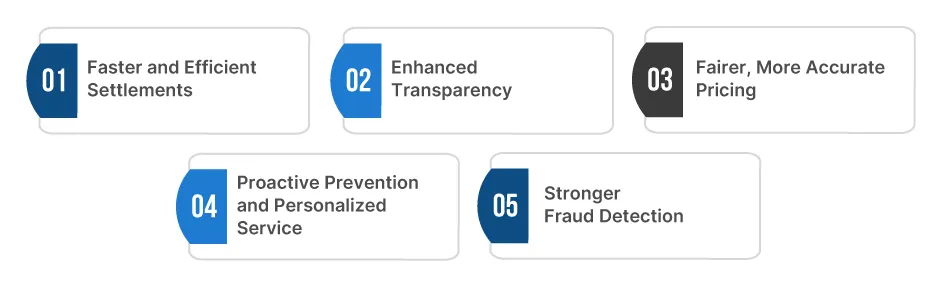
Predictive analytics in intelligent claims automation helps earn policyholders’ trust by creating a claim experience that is fast, accurate, and personalized.
It achieves this through various key mechanisms:
1. Faster and Efficient Settlements
Claims predictive analytics models automate routine tasks and prioritize claims based on complexity, which significantly reduces processing times. For simple, low-risk claims, this can mean near-instantaneous approvals and payouts, addressing a major pain point for customers and fostering trust through prompt service.
2. Enhanced Transparency
By using data-driven, objective insights and clear documentation, insurers can provide consistent, explainable decisions. Customers can track their claim status in real-time via portals and receive proactive, personalized updates, which creates a sense of transparency that builds confidence in the process and the insurer.
3. Fairer, More Accurate Pricing
Predictive analytics insurance claims enable insurers to assess risk with greater precision by analyzing vast data sets, including telematics and IoT data. This leads to more accurate and personalized premium pricing that reflects an individual’s actual risk, rather than broad demographic categories. Customers perceive this as fairer, which increases satisfaction and loyalty.
4. Proactive Prevention and Personalized Service
Insurers can use insights to offer preventative advice or services (e.g., maintenance reminders based on smart home data) that help policyholders avoid losses altogether. This shift from a reactive “pay and repair” model to a proactive “predict and prevent” model deepens the relationship and builds trust by demonstrating that the insurer genuinely cares about the customer’s well-being.
5. Stronger Fraud Detection
Insurers can save billions in losses annually by accurately and quickly identifying fraudulent claims. These help keep premiums lower for honest policyholders and protect them from the indirect costs of fraud.
The increased claim speed, accuracy, and tailored nature of the claims process enabled by predictive analytics insurance claims to culminate in a higher CX.
Earn More Customers with AI‑Driven Claims Management and Automation at TxMinds
At TxMinds, we leverage predictive analytics in insurance claims to deliver faster and more transparent claims management. Our AI‑driven insurance technology services enable insurers to streamline processing, enhance fraud detection, and deliver personalized communication that fosters trust. Our goal is to help carriers transition from reactive to proactive operations, anticipating needs and turning every claim into an opportunity for stronger customer relationships.
We partner with insurers to design tailored predictive claims analytics solutions that meet their specific business needs, making claims fairer, faster, and more efficient. Choosing TxMinds means enhancing customer satisfaction and retention by ensuring accuracy, transparency, and responsiveness throughout the claims journey.
Rakesh Pal, Vice President at Tx and Head of Insurance Vertical, brings over 19+ years of experience in the insurance industry. His experience working with organizations like Cognizant, LTIMindtree, Valuemomentum, etc., brings him deep expertise in P&C (Re)Insurance across Personal, Commercial, and Specialty lines and its operational nuances across North America, Lloyd’s of London, Middle East, APAC, and India. With a strong background in digital transformation, cloud migration, domain advisory, and client delivery, he leads strategic initiatives that drive innovation, operational efficiency, and customer delight in the insurance industry. His leadership across delivery and solutions enables insurers to modernize their technology landscape and navigate evolving business, customer, and regulatory demands with confidence.
FAQs
What is predictive claims analytics, and how does it improve the insurance claims process?
Predictive claims analytics uses AI and machine learning to analyze data and forecast risks, enabling faster, more accurate claim settlements and efficient handling of insurance claims.
How does predictive analytics insurance claims help build customer trust?
By offering transparency, fair pricing, and personalized communication through intelligent claims automation, predictive analytics in insurance claims creates a smoother and more trustworthy claims experience.
What role does AI‑driven claims management and automation play in modern insurance?
AI-driven claims management and automation streamline claims workflows, reduce costs, detect fraud more effectively, and enhance customer satisfaction through faster, data-powered decisions.
How does predictive monitoring insurance claims prevent fraud and improve outcomes?
Claims predictive analytics continuously monitor claims data to detect anomalies early, reducing fraud losses and ensuring quicker payouts, which benefits both insurers and policyholders.