In boardrooms worldwide, AI is no longer a technology discussion; it’s a business-value imperative. Yet many enterprises that invested millions in AI still face the same question: Is it paying off?
Deploying models is easy; proving their worth is not. Too often, success is measured in accuracy scores, or automation counts rather than financial impact. This blog introduces a pragmatic, outcome-driven framework for calculating the true ROI of Enterprise AI, one that connects algorithms to balance sheets and innovation pipelines.
This blog introduces a pragmatic framework for calculating the true ROI of enterprise AI and moving beyond hype to deliver a structure and actionable methodology for value assessment.
Key Takeaways
AI ROI must start with concrete business goals and KPIs, not model metrics.
A five-pillar framework keeps AI investments accountable from baseline to benefits.
True AI value combines direct gains (productivity, cost, revenue) with indirect gains (experience, decisions, agility).
AI should be managed as a live value portfolio, continuously monitored, refined, and scaled.
Beyond the Hype: Defining Tangible Business Value in AI
To derive tangible business value in AI, it is important to go beyond technical enthusiasm and adopt the outcomes that are directly relevant to the enterprise’s financial, operational, and strategic objectives. Organizations are becoming highly critical of the investments they make in AI, and they are expecting concrete results in the form of improved customer experiences, benchmarked with specific, measurable results.
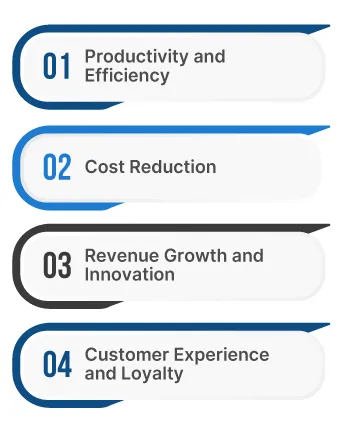
Productivity and Efficiency: The AI produces value through the elimination of manual labor, automation of repetitive processes, and faster results, such as by reducing the average call handling time, document processing time, or project life cycles. These results are clarified with business metrics, like labor hours saved or the percentage increase in tasks done.
Cost Reduction: The automation of the working process and the increased efficiency of resource distribution can assist AI in minimizing IT and operational expenses, errors, and waste. It is important to track cost reductions for the replacement of the legacy system and internal process optimization in such a way as to demonstrate ROI.
Revenue Growth and Innovation: AI can be used to personalize products and services, open new uses, and assist companies in entering new markets or upselling current clients. The financial cost is accentuated by measuring incremental sales, lower churn, or time to market new solutions.
Customer Experience and Loyalty: Customer service enhancement, 24/7 availability of assistants, faster service, and satisfaction improvement are measurable in terms of the change in customer retention or Net Promoter Score (NPS).
The Core Components of an ROI Calculation Framework
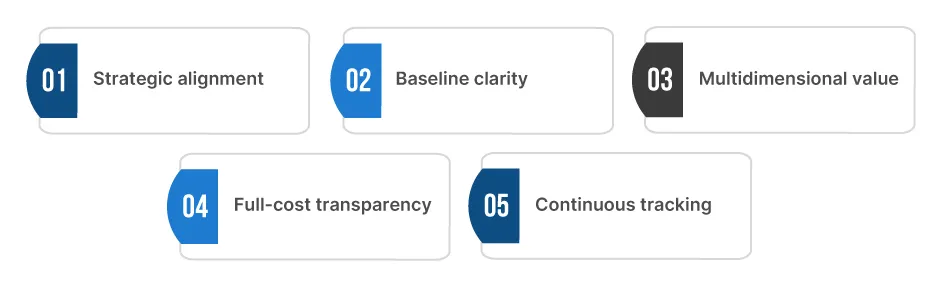
A rigorous methodology of calculating the ROI of enterprise AI consists of five key pillars:
Strategic alignment – every use case tied to a business goal.
Baseline clarity – measure the ‘before’ to validate the ‘after’.
Multidimensional value – blend hard (cost/revenue) and soft (trust, agility) returns.
Full-cost transparency – captures all lifecycle costs, not just build spending.
Continuous tracking – treat AI ROI as a live metric, not a one-time report.
1. Strategic Alignment & KPI Definition
The first step towards success is to make each AI initiative aligned to the key business goals- cost saving, customer retention, or new sources of revenue- and pin down specific KPIs prior to implementation. This will make sure AI is not implemented blindly due to technology, but rather what will have the greatest impact on leadership.
2. Use Case Modeling and Baseline Setting
Demonstrate model ROI via high-value use cases with distinct business deliverables and put a performance baseline with existing KPIs (e.g., error rates, throughput, satisfaction scores). The quantification of the before picture will allow meaningful comparison of the post-deployment and the cost of inaction.
3. Multidimensional Value Measurement
Computations should be done on benefits in the following categories:
Optimization of cost (reduction in labor, efficiency)
Turn gains into a physical expression of financial terms and recognize indirect and strategic returns -enhanced customer goodwill or speed of innovation.
4. Comprehensive Cost Accounting
Include first and continuous investments: software, integration, infrastructure, staff, cloud expenditures, maintenance, compliance, and retraining. Apply annualized or payback period calculations to inform the ROI discussions.
5. Post-Deployment Tracking and Feedback Loops
Leverage dashboards and consumption models to track real-world metrics post-implementation. It includes comparing pre- and post-AI KPIs, monitoring adoption rates, and assessing downstream impact.
A Step-by-Step Guide to Forecasting and Tracking AI Value
Forecasting and tracking AI value requires more than a structured and iterative approach. It needs strategies that align technical capabilities with business outcomes. Here are six essential steps based on authoritative frameworks and real-world implementations.
1. Define Clear Objectives and Value Drivers
Start by defining the desired business results that AI is anticipated to achieve – cost reduction, revenue growth, or enhanced customer satisfaction. Define value drivers (e.g., sharper processing, better conversion rates) and align them to the organizational KPIs to avoid accountability and strategic irrelevance.
As an example, an AI project in the customer service area must be linked to shortening average handling time or raising first-call resolution rates. This alignment will ensure that AI endeavors are not separated but that they are part of the main business strategy and can have a tangible effect.
2. Establish Performance Baselines
It is also crucial to measure current performance across several relevant metrics before AI deployment. This baseline will enable accurate attribution of improvements and help quantify the cost of inaction to strengthen the business case for investment. Without a performance baseline, ROI claims risk being speculative rather than evidence based. Hence, a solid pre-implementation benchmark enables enterprises to isolate the data attributable to AI and validate its effectiveness over time.
3. Identify and Categorize AI Investment Costs
It must include all direct and indirect expenses such as data acquisition, software development, infrastructure (cloud, storage), staff (data scientists, engineers), integration, compliance, and maintenance. A detailed cost model is used to determine a realistic ROI. As an example, the cloud inference cost of LLM, retraining cycles, and change management programs will have to be added, regarding AI as a single project and not a recurring cost of operation, resulting in a low total cost of ownership estimation and exaggerated returns on investment.
4. Forecast Net Benefits Using Realistic Scenarios
Calculate real benefits like labor savings, uptick in sales, or error reduction with conservatively supported assumptions. Isolate the influence of AI by applying the concept of scenario modeling (best-case, expected, worst-case) and such tools as A/B testing to enhance the accuracy of the forecasts. Make predictions that are more precise than traditional ones using historical data and machine learning models, including time series models or regression. This will aid in valid financial planning and trust among stakeholders.
5. Monitor, Reassess, and Scale Continuously
Deploy real-time monitoring with the help of BI tools and AIOps solutions to trace KPIs after the deployment. Calculate ROI regularly, model refinements as performance data is received, expand successful pilots throughout the enterprise, and keep the value creation going.
Ongoing observation helps to make sure that AI systems are changed and adjusted to the altered business environments and stay relevant throughout their existence. Companies that view AI as a live portfolio of projects and invest in those that perform well and deemphasize those that underperform are able to maximize long-term value.
Identifying and Quantifying Direct and Indirect AI Benefits
Benefit Category
Specific Benefit
Measurement Method
Direct Benefits
Productivity and Time Efficiency
Track time saved per task and scale across volume.
Cost Reduction
Monitor reductions in labor, overhead, and error-related costs.
Revenue Growth
Conduct A/B testing or pre/post KPI analysis.
Quality and Accuracy
Measure error rates, forecast precision, and compliance adherence.
Indirect Benefits
Customer and Employee Satisfaction
Use satisfaction scores and retention metrics.
Decision Quality and Strategic Agility
Track adoption rates and time-to-action.
Intangible Gains
Monitor engagement, brand recognition, and innovation output.
Maximizing AI Value Across the Enterprise with TxMinds
Measuring ROI is only the beginning. The real enterprise advantage comes when insights from one AI initiative fuel the next. By standardizing ROI measurement across departments, organizations turn AI into a repeatable value-creation engine.
At TxMinds, we bridge the gap between technical precision and business impact with our AI development services. Our enterprise AI solutions integrate strategic consulting, engineering, and financial modeling, ensuring that every algorithm deployed is a step toward measurable growth and sustainable advantage.
Final Thoughts
Calculating the true ROI of enterprise AI is not a mathematical exercise; it’s a leadership discipline. Organizations that treat AI as a strategic investment, supported by transparent baselines, multidimensional metrics, and continuous optimization, consistently outperform those that chase hype.
The pragmatic framework outlined here transforms AI from an experimental initiative into a proven driver of enterprise value, delivering returns you can measure, defend, and scale.
Vivek Gupta is the Vice President of Delivery at Tx with over 25 years of experience driving digital transformation. At Tx, he has built the foundation for DevOps, Digital, and Cloud practices, shaping strategies that empower businesses. Before joining Tx, Vivek held leadership roles at Infosys and Tech Mahindra. His leadership fuels innovation, strengthens delivery excellence, and enhances Tx's global impact. Vivek's commitment to driving change ensures our clients stay ahead in an evolving digital landscape.
FAQs
How to measure the ROI of AI in an enterprise setting?
Start by aligning each AI use case to specific business KPIs, setting a clear baseline, quantifying direct and indirect benefits in financial terms, include all lifecycle costs, and track results continuously rather than treating ROI as a one-time calculation.
What are the business benefits of Artificial Intelligence beyond cost savings?
In addition to productivity and cost reduction, AI can drive revenue growth through better conversion and personalization, improve decision quality, reduce risk and compliance errors, and enhance both customer and employee experience.
What is an AI project value assessment framework, and why does it matter?
An AI project value assessment framework is a structured approach that links use cases to strategic goals, defines baselines, quantifies multidimensional value (cost, revenue, risk, agility), and incorporates full-cost accounting to ensure AI investments are measurable and defensible.
How to ensure AI ROI calculations stay relevant over time with the business?
Treat AI initiatives as a live portfolio: regularly compare post-deployment KPIs with baselines, review assumptions, retire or fix underperforming use cases, and scale the ones that consistently deliver measurable value.