


Recommended Blogs

Blog
Choosing Your Cloud Path: Multi-Cloud vs. Hybrid Cloud for C-Level Leaders
Table of Content
- Need for Multi Cloud and Hybrid Cloud Strategy in Modern Enterprises
- Multi Cloud vs. Hybrid Cloud- Understanding the Differences
- When to Choose Multi Cloud Strategy
- When to Choose Hybrid Cloud Strategy
- How to Build a Successful Enterprise Cloud Strategy
- How TxMinds Helps Leaders Master Cloud Strategy
Share On


The future of your enterprise hinges on one critical question: how will you harness the cloud to outthink, outpace, and outperform competitors?
Multi-cloud and hybrid cloud are often talked about as interchangeable, whereas both offer very different paths with unique risks and rewards. For a business leader, it is not an abstract technical debate but about where to place your bets to drive innovation, reduce cost inefficiencies, and protect your brand from disruption.
In our latest blog, TxMinds cloud experts cut through the hype and delivers truths about these cloud strategies. Discover how each enterprise cloud strategy shapes your ability to scale quickly and build the agility needed in today’s volatile market.
Key Takeaways
- Gartner forecasts 90% hybrid and 80% multi-cloud adoption by 2027 for flexibility.
- 87% of enterprises use multi-provider workloads to cut costs and boost innovation.
- Multi-cloud avoids lock-in, taps best-of-breed services, and meets compliance needs.
- Hybrid balances private data control with public cloud scaling for legacy systems.
Need for Multi Cloud and Hybrid Cloud Strategy in Modern Enterprises
Modern enterprises face unprecedented IT complexity from diverse applications and high-performance expectations that no single cloud provider can fully meet. Gartner forecasts that by 2027, 90% of businesses will adopt hybrid cloud strategy and 80% will embrace multi-cloud approach. It provides essential flexibility and resilience by distributing workloads across multiple public clouds.
Companies that adopt multi-cloud or hybrid models, optimize costs and accelerate innovation using the strongest features from varied cloud ecosystems. With 87% of enterprises running workloads across multiple providers, these approaches enhance risk management and enable rapid adaptation to market shifts.
This infrastructure foundation drives growth, agility, and competitive advantage in the digital-first era.
Multi Cloud vs. Hybrid Cloud- Understanding the Differences
Multi-cloud strategy deploys workloads across several public cloud providers to avoid vendor dependency and leverage specialized services. Whereas hybrid cloud integrates public clouds with private or on-premises infrastructure for seamless data and application movement.
The table below gives a clear comparison of multi cloud vs. hybrid cloud:
| Aspect | Multi-Cloud Strategy | Hybrid Cloud Strategy |
|---|---|---|
| Infrastructure | Multiple public clouds (e.g., AWS + Azure + GCP) | Private/on-premises + at least one public cloud |
| Primary Goal | Avoid vendor lock-in, best-of-breed services | Compliance, data control, elastic scaling |
| Workload Placement | Distributed across public providers | On-premises/private for core, public for burst needs |
| Complexity | High vendor management and tool sprawl | High integration between on-prem and cloud |
| Data Flow | Typically stays within originating cloud | Seamless movement across boundaries |
For the enterprise leaders, the decision is less about labels and more about aligning these models to business priorities around control, compliance, and innovation. By understanding where each approach excels, as a leader, you can design a cloud strategy that is intentional to support current and future transformation.
When to Choose Multi Cloud Strategy
Multi-cloud strategy works well when your enterprise wants to avoid vendor lock-in, build in failover for rock-solid reliability, tackle data sovereignty rules, grab top tools from different providers like AWS for one strength and GCP for another, or fine-tune costs and speed by smartly spreading workloads across clouds.
Key Triggers for Multi-Cloud Strategy:
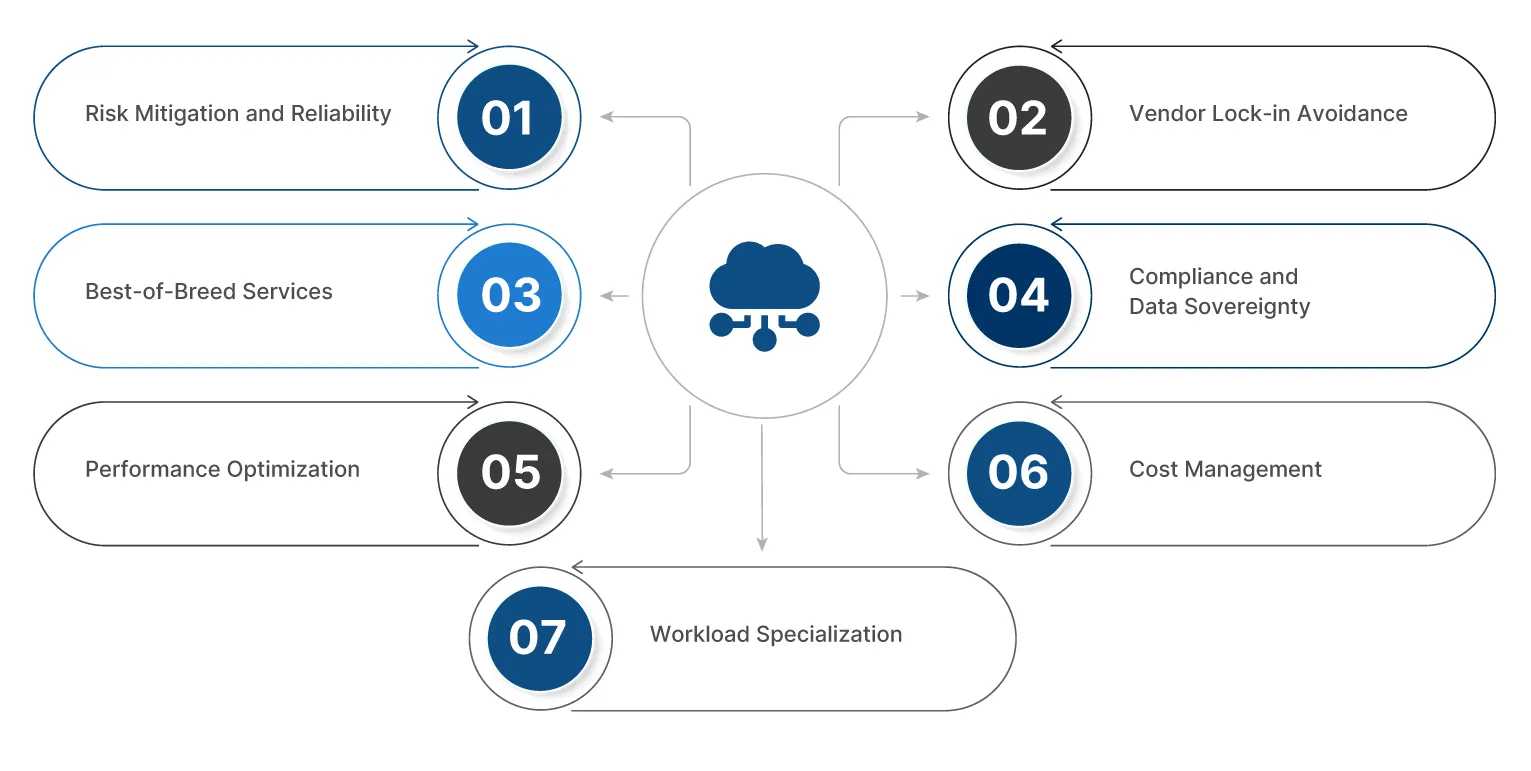
- Risk Mitigation and Reliability: Spread workloads to sidestep outages from one provider with quick failover options.
- Vendor Lock-in Avoidance: Keep leverage in negotiations and stay nimble without tying everything to a single vendor.
- Best-of-Breed Services: Pick the standout tools where each cloud leads, like specialized AI or databases.
- Compliance and Data Sovereignty: Hit geographic or regulatory needs head-on, especially in finance or healthcare.
- Performance Optimization: Cut latency by parking data and compute near users in key regions.
- Cost Management: Shop around for the cheapest services or burst to clouds during demand spikes.
- Workload Specialization: Match apps like web fronts versus heavy backend to the right cloud fit.
It is ideal for big, critical systems craving flexibility and backups, but only if you’ve got solid governance and sharp teams to handle the extra layers.
When to Choose Hybrid Cloud Strategy
Hybrid cloud fits best when your enterprise needs tight control and security from private setups alongside the scale and savings of public clouds. It’s perfect for handling sensitive info, sticking to compliance rules, easing old systems into the mix, rolling out cloud shifts step by step, or riding out demand swings like retail peaks.
Key Scenarios for Hybrid Cloud Strategy:

- Data Sovereignty and Compliance: Store sensitive data in-house to nail rules like GDPR or HIPAA, while shifting lighter tasks to public clouds.
- Legacy Systems: Link your current on-site gear with new cloud tools, skipping the expense of full tear-outs.
- Phased Cloud Migration: Shift workloads to cloud over time, cutting risks along the way.
- Workload Spikes & Elasticity: Run steady jobs on-prem and jump to public cloud for busy seasons like holidays.
- Disaster Recovery and Business Continuity: Use public cloud as a cheap backup for your main systems.
- Cost Optimization: Put steady loads on private setups and variable ones on public for the best rates.
- Control and Security: Hold firm grip on core ops while grabbing public cloud perks.
Hybrid cloud strikes the right balance between flexibility and oversight, ideal for companies seeking a secure, versatile setup that connects legacy IT with cutting-edge cloud advantages.
How to Build a Successful Enterprise Cloud Strategy
A strong enterprise cloud strategy ties right into your main business aims, like trimming costs or rolling out products quicker. Pull in folks from finance, ops, and security, not just IT, to craft a plan that sparks growth and handles risks smartly.
Core steps to build a successful enterprise cloud strategy include:
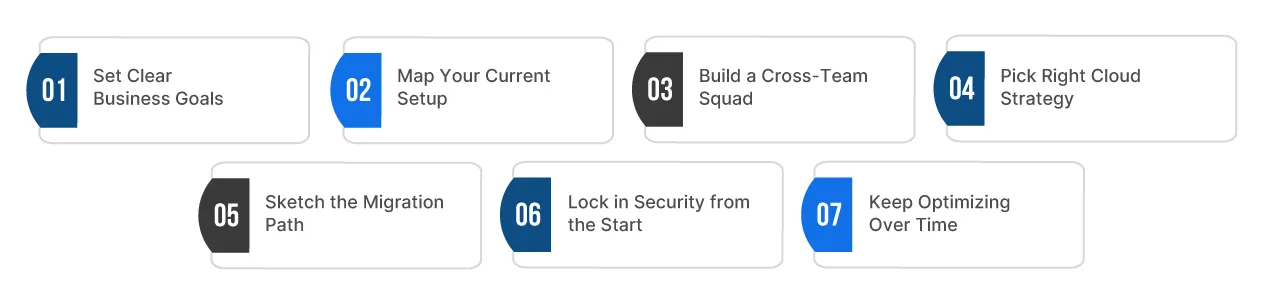
1. Set Clear Business Goals
Agree on why the organization is moving to the cloud, such as faster releases, better customer experiences, or lower long-term costs. When leaders sign off on these aims, it becomes easier to judge which cloud choices move you in the right direction.
2. Map Your Current Setup
Create a clear picture of your existing applications, data, and integrations. This helps you spot fragile legacy systems, overlaps, and performance gaps, and shows which workloads are easy to move and which need redesign.
3. Build a Cross-Team Squad
Bring together people from technology, finance, security, and the main business units. This group aligns priorities, settles trade-offs, and keeps communication open, so adoption feels shared rather than pushed by IT.
4. Pick Right Cloud Strategy
Match cloud models to workload needs, choosing between public, private, hybrid, or multi-cloud where each makes sense. Compare providers on strengths, integration, security, and pricing so each system has a clear home and purpose.
5. Sketch the Migration Path
Plan the journey in stages instead of moving everything at once. Group applications into waves based on complexity and business impact, and give each wave a simple plan for testing, release, and rollback if needed.
6. Lock in Security from the Start
Build security and compliance right into the plan from day one. Set rules for user access, data protection, and ongoing checks, so teams innovate fast without opening up risks.
7. Keep Optimizing Over Time
Regularly review usage, trim waste, tune performance, and update controls as business needs shift. This ensures your cloud setup stays lean, safe, and matched to current goals.
How TxMinds Helps Leaders Master Cloud Strategy
At TxMinds, we guide enterprise leaders through the complexities of cloud strategy with hands-on expertise in multi-cloud migrations across Azure, AWS, and Google Cloud. We start by aligning your business goals with the right platform, optimizing it for cost and performance while rebuilding applications using serverless tech, microservices, and Kubernetes for true scalability.
Our cloud consulting services handle seamless data migrations, post-go-live optimization, and ongoing monitoring to deliver continuous value, backed by our IP-led accelerators that cut timelines significantly. As a trusted Microsoft Azure Gold Partner with proven outcomes like substantial cost reductions and 99.9% accuracy, TxMinds turns cloud challenges into strategic wins for agility and growth.


Amar Jamadhiar
VP, Delivery North America
Amar Jamadhiar is the Vice President of Delivery for TxMind's North America region, driving innovation and strategic partnerships. With over 30 years of experience, he has played a key role in forging alliances with UiPath, Tricentis, AccelQ, and others. His expertise helps Tx explore AI, ML, and data engineering advancements.
FAQs
What is a multi-cloud strategy?
-
A multi-cloud strategy deploys workloads across several public cloud providers like AWS, Azure, and GCP to avoid vendor lock-in and leverage best-of-breed services.
What is a hybrid cloud strategy?
-
A hybrid cloud strategy integrates public clouds with private or on-premises infrastructure for seamless data movement, compliance, and elastic scaling.
When to choose multi-cloud vs hybrid cloud?
-
Choose multi-cloud for risk mitigation, best-of-breed services, and cost optimization across public providers; opt for hybrid cloud when balancing data control, legacy systems, and workload spikes.
What are the challenges of multi-cloud adoption?
-
Multi-cloud adoption faces high vendor management, tool sprawl, and complexity in governance, requiring sharp teams to handle distributed workloads effectively.
Discover more