

Recommended Blogs

Blog
Insurance Technology Consulting: From Legacy Friction to AI-Led Modernization

 Last Updated: July 16th, 2026
 Read Time: 5 minutes
Table of Content
- Why Insurance Modernization Needs a Different Lens
- AI Solutions for the Insurance Industry Must Be Practical
- Automation in Insurance Operations Should Reduce Drag
- Cloud Migration for Insurers Must Support Intelligence and Control
- What Enterprise Insurance Technology Consulting Should Deliver
- How TxMinds Helps Insurers Modernize with AI, Automation, Cloud, and QE
- Conclusion
Share On


Insurance systems rarely fail dramatically; they fail one workflow at a time and slow down operations. Policy teams wait for change requests, claims teams manually reconcile data, and underwriters search across systems before making decisions. Core platforms that don’t integrate seamlessly with service layers result in delays for customers. That creeping inefficiency is the real cost of legacy insurance technology.
Today, modernization is not simply about replacing platforms. It is about building the capacity for speed, accuracy, compliance, and smarter decisions. AI and automation can help, but only when the foundations are ready: business goals, system architecture, data quality, integration, cloud strategy, and quality engineering.
Key Takeaways
- Insurance system modernization is now a business performance priority, not just an IT upgrade.
- AI solutions for the insurance industry work best when tied to practical workflows like claims, underwriting, documents, and service operations.
- Cloud migration for insurers should improve scalability, integration, data accessibility, and enterprise control.
- Insurers can modernize effectively by adopting a QE-led approach that integrates AI, automation, cloud technologies, and insurance technology consulting services.
Why Insurance Modernization Needs a Different Lens
Insurance system modernization was once seen as a core platform project. The focus was often narrow, technical, and heavily IT-led. That model no longer fits the business problem.
Today’s insurers need systems that enable real-time decision-making, configurable products, faster claims processing, cleaner distribution, and better regulatory traceability. More than software replacements are needed to achieve those results.
The Problem Is Not Just Obsolete Technology
Legacy systems have years of business logic, exceptions, product rules, and workarounds. Move too quickly, and hidden dependencies can surface only after operations are disrupted. That is why careful sequencing of modernization is needed. Leaders will have to decide which systems to retain, upgrade, or retire. The goal is not disruption for its own sake. The goal is a platform environment that supports business change without constant operational friction.
Modernization Must Protect the Business
Every insurance process carries risk. A billing error affects revenue. A claims defect affects trust. An underwriting rule failure affects profitability and compliance. Modernization should improve speed without weakening control. That requires quality engineering from the beginning, not testing at the end.
AI Solutions for the Insurance Industry Must Be Practical
AI adds value when it improves insurance workflows. Adding it without governance, data readiness, or clear ownership creates risk.
For insurance industry leaders, AI solutions should begin with high-friction, high-volume processes. These are areas where improved data handling and decision support can make a difference to day-to-day execution.
How AI Can Deliver Real Value In Insurance
AI can help insurers in underwriting, claims, customer service, and operations. The largest use cases are often right next to quantifiable business pain.
Here are some common examples:
- Document Processing and Classification
- Claims Triage & Routing
- Summarization of Underwriting Evidence
- Fraud signal detection
- Customer Service Response Assistance
- Policy data validation
- Operational knowledge discovery
These use cases do not excuse humans from accountability. They help experts understand context faster before making a decision.
The Trade-off Leaders Must Manage
AI can speed up decision-making, but insurance decisions must still be explainable. We must not trade fairness, auditability, or regulatory confidence for speed. That’s why AI should support bounded workflows first. Insurers need clear escalation paths and decision logs, access controls, and model monitoring.
The practical question is not where AI can replace judgment. It is where AI can reduce manual effort while keeping humans accountable for judgment.
Automation in Insurance Operations Should Reduce Drag
Automation in insurance operations works best when it removes repetitive effort from important processes. It should not simply move bad workflows into faster tools.
Many insurers still rely on manual handoffs between policy, billing, claims, documents, CRM, and finance systems. Those handoffs create delays, rework, and inconsistent customer experiences.
Automation Should Target Workflow Friction
A strong automation roadmap starts with process discovery. Teams need to identify where delays actually occur before choosing tools.
Common opportunities include:
- Duplicate data entry
- Manual document review
- Status update workflows
- Claims assignment rules
- Renewal reminders
- Policy change validations
- Compliance evidence collection
Each automation should have a clear business outcome. Faster processing means little if accuracy declines afterward.
Automation Also Needs Quality Discipline
Automation multiplies whatever process logic it receives. If the workflow is poorly designed, automation spreads the problem faster.
That is why QE matters so much. Test automation, regression coverage, data validation, and integration testing protect the business from hidden defects.
For insurers, quality is not a technical checkpoint. It is operational risk control.
Cloud Migration for Insurers Must Support Intelligence and Control
Cloud migration for insurers is often described through scalability and cost flexibility. Those benefits matter, but they are only part of the story. The deeper value is modernization readiness. Cloud can help insurers connect data, integrate platforms, support analytics, and scale intelligent applications.
Forrester predicts US insurance technology budgets, including staff costs, to reach $173 billion in 2026, up from $160 billion in 2025, representing 7.8% year-over-year growth. That investment reflects a broader shift. Insurers are not only maintaining systems. They are funding intelligence, efficiency, and differentiation.
Cloud Decisions Should Follow Business Priorities
Insurers should not migrate every workload in the same way. Some systems need refactoring, while others may need phased migration or replacement. Leaders should assess each workload based on business value, risk, complexity, cost, and dependencies. This prevents cloud migration from becoming expensive relocation.
A strong cloud roadmap considers:
- Data sensitivity
- Application dependencies
- Integration patterns
- Disaster recovery needs
- Performance expectations
- Regulatory obligations
- Cost governance
The cloud platform matters. The migration strategy matters more.
What Enterprise Insurance Technology Consulting Should Deliver
Enterprise insurance technology consulting can’t be confined to assessment reports. Insurers need partners that can translate strategy into execution. It needs insurance domain knowledge, engineering capability, cloud architecture, AI readiness, data discipline, and quality assurance maturity.
The Right Partner Bridges Strategy And Delivery
A strong consulting partner helps insurers set the goals of modernization. The answer will depend on the realities of claims, underwriting, billing, distribution, service, compliance, and data operations.
The work should comprise:
- Current state of technology assessment
- Rationalization of applications
- Data readiness check
- Planning for Cloud Migration
- Mapping of automation opportunities
- Prioritization of AI use cases
- QE Strategy and Automated Testing
- Data governance
This approach makes modernization real. It helps leaders avoid tool-led decisions that don’t solve business problems.
QE Should Lead The Way In Modernization
Insurance systems are concerned with money, risk, customers, partners, and regulators. That puts quality engineering at the center of every modernization program.
In practice, QE-led modernization should mean stronger reliability, deeper validation, business assurance, and greater production confidence.
That’s the kind of service insurers should expect from modernization partners.
How TxMinds Helps Insurers Modernize with AI, Automation, Cloud, and QE
TxMinds helps insurers modernize their technology landscape by balancing innovation, reliability, and business outcomes. Our approach brings together AI, automation, cloud modernization, data engineering, and Quality Engineering to improve insurance operations in practical, measurable ways.
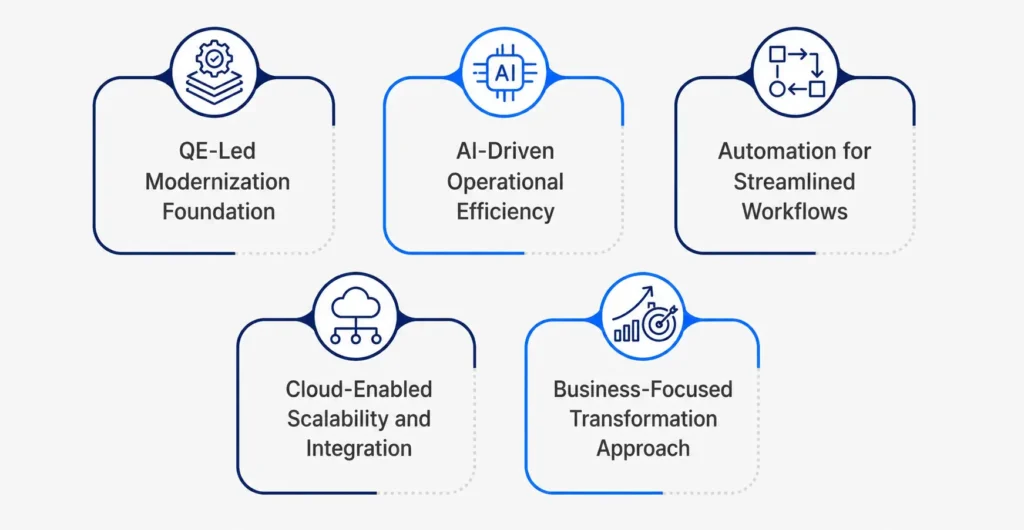
QE-Led Modernization Foundation
Quality Engineering is central to our modernization approach. It helps ensure that system changes are reliable, validated, and consistent across policy, claims, billing, underwriting, and service workflows.
AI-Driven Operational Efficiency
TxMinds applies AI to targeted insurance processes where manual effort slows decision-making. The focus is on practical use cases such as claims processing, underwriting support, document intelligence, fraud signal detection, and operational knowledge discovery.
Automation for Streamlined Workflows
Automation helps reduce repetitive tasks and operational lag. TxMinds helps insurers rethink workflows before automating them, so efficiency gains do not create new process or quality risks.
Cloud-Enabled Scalability and Integration
TxMinds supports cloud migration strategies that improve connectivity, scalability, data accessibility, and integration readiness. The aim is to create a stronger foundation for analytics, AI, and future modernization.
Business-Focused Transformation Approach
TxMinds treats modernization as operating-model improvement, not just system upgrade. This helps technology changes align with business goals, improve performance, and support long-term growth.
Conclusion
Insurance modernization is entering a sharper phase. AI and automation create value only when systems, data, cloud platforms, and quality practices can support them.
The insurers that move ahead will not chase every new tool. They will modernize core workflows, improve data trust, automate with discipline, and protect delivery quality across policy, claims, billing, underwriting, and service operations.
Insurance technology consulting should help leaders make that shift with practical roadmaps, engineering depth, and execution discipline. TxMinds helps insurers move from legacy constraints to modern insurance performance through AI, automation, cloud modernization, and QE-led delivery.
Associate Director
Yuvraj Singh is an accomplished Associate Director of Delivery, renowned for leading strategic quality assurance initiatives that consistently deliver outstanding software outcomes across global markets. With deep expertise in both Property & Casualty (P&C) and Life & Annuities (L&A) insurance domains, Yuvraj excels at bridging the gap between complex business objectives and flawless execution.
FAQs
What are insurance technology consulting services?
Insurance technology consulting services help insurers modernize legacy systems, improve workflows, adopt cloud platforms, implement automation, and apply AI across operations. These services connect business goals with technology execution across policy, claims, billing, underwriting, and customer service.
How can AI solutions for the insurance industry improve operations?
AI solutions for the insurance industry can support document processing, claims triage, underwriting assistance, fraud signal detection, customer service, and policy data validation. The goal is to reduce manual effort while keeping human experts responsible for critical decisions.
Why is insurance system modernization important for insurers?
Insurance system modernization helps insurers reduce operational delays, improve decision-making, strengthen compliance, and support faster service delivery. It also creates a stronger foundation for AI, automation, cloud integration, and data-driven insurance operations.
How does cloud migration help insurers modernize legacy systems?
Cloud migration for insurers improves scalability, system connectivity, data accessibility, and integration flexibility. When planned carefully, it helps insurers modernize core operations without losing control over security, compliance, cost, or performance.
Discover more