Software delivery is a board-level capability that shapes how quickly your enterprise can launch new products, respond to market shifts and meet regulatory demands. The question is no longer whether you release faster, but whether you can do so without increasing instability, compliance exposure, or security gaps.
A 2025 empirical study on evolving DevOps practices found that mature DevOps adoption is associated with a 45% increase in deployment frequency, a 38% reduction in lead time for changes, and a 32% decrease in change failure rates. These are not marginal gains. They represent structural improvements in how organizations design, test, and operate software at scale.
Yet as enterprises expand into Kubernetes, multi-cloud, and distributed architectures, delivery complexity grows faster than most operating models can handle. This is where the conversation moves beyond DevOps alone.
GitOps has emerged as a disciplined way to manage infrastructure and deployments with stronger control, traceability, and consistency.
This blog explores what DevOps and GitOps truly mean for modern enterprises, how they differ in practice, and how leaders can choose the right strategy to drive speed, governance, and long-term resilience.
Key Takeaways
A 2025 study cited says mature DevOps yields +45% deployment frequency, -38% change lead time, and -32% change failure rates.
DevOps improves end-to-end delivery by combining Dev and Ops with automation and shared ownership.
GitOps controls deployments by using Git-held desired state with pull-based reconciliation to prevent drift.
Enterprises should use DevOps for CI/testing speed and GitOps for Kubernetes consistency and auditability.
What is DevOps? Key Concepts for Enterprise Delivery
DevOps is a set of practices that unites software development (Dev) and IT operations (Ops) to shorten the development lifecycle and deliver high quality software faster. It moves organizations away from siloed teams and sequential handoffs, and toward collaboration, automation, and continuous improvement.
Key Aspects of DevOps
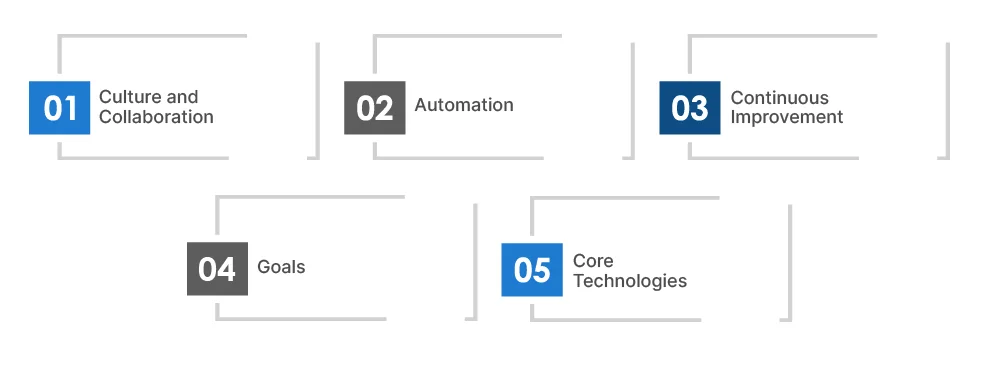
Culture and Collaboration: DevOps promotes shared responsibility between developers, who focus on building features, and operations teams, who focus on stability and performance. Both are accountable for outcomes in production.
Automation: DevOps makes extensive use of CI/CD pipelines, automated testing, configuration management, and infrastructure as code to reduce manual, error prone tasks and ensure consistent deployments.
Continuous Improvement: Delivery operates as a loop that includes planning, coding, building, testing, releasing, deploying, operating, monitoring, and gathering feedback to improve the next iteration.
Goals: The primary objectives are faster delivery, improved software quality, reliable releases, and higher customer satisfaction.
Core Technologies: DevOps environments commonly rely on cloud platforms, containerization technologies such as Docker and Kubernetes, Git for version control, and observability tools for monitoring and telemetry.
DevOps assessment & advisory services transform development into a streamlined and automated process that enables teams to deliver value quickly without compromising system stability.
What is GitOps? Git as the Operating Model
GitOps is an operating approach for managing infrastructure and application deployments where Git becomes the system of record. Instead of relying on ad-hoc scripts or manual changes in production, teams define the desired state of environments in version controlled, declarative files and let automation keep reality aligned with that definition.
GitOps is especially common in Kubernetes environments because it aligns naturally with how modern platforms are configured and reconciled.
Key Aspects of GitOps
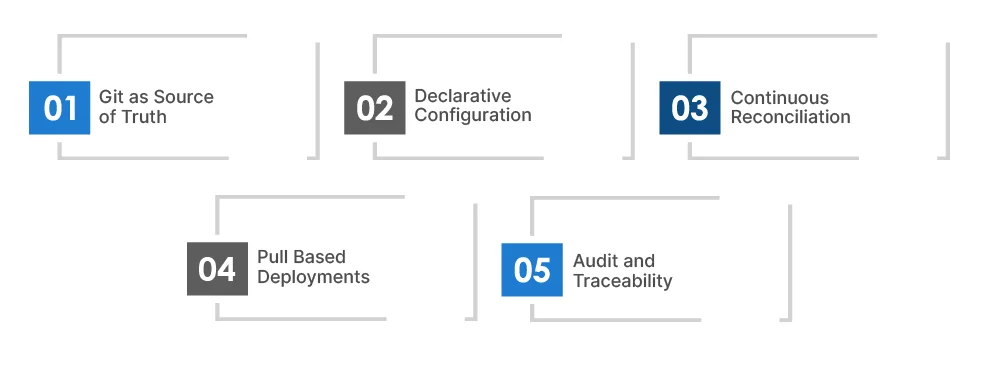
Git as Source of Truth: Configuration and deployment definitions live in Git, so the repository reflects what should be running and why it changed.
Declarative Configuration: Systems are described as a desired state rather than step by step instructions, making environments easier to recreate, scale, and audit.
Continuous Reconciliation: An agent or controller continuously compares the running state to Git and automatically corrects configuration drift to maintain consistency.
Pull Based Deployments: Changes are pulled into the environment by a controller, reducing direct production access and tightening security boundaries.
Audit and Traceability: Every change has a commit history, review context, and rollback path, strengthening governance and compliance posture.
GitOps brings discipline to cloud native operations. It ensures that what runs in production is always traceable, reviewable, and aligned with declared intent.
GitOps vs. DevOps: What’s the Difference?
DevOps and GitOps are closely related, but they operate at different levels of the delivery stack. DevOps is a broad cultural and operational model designed to improve collaboration, accelerate software delivery, and increase reliability across the entire lifecycle.
GitOps, on the other hand, is a deployment and infrastructure management approach that uses Git as the single source of truth and relies on declarative configuration and automated reconciliation. In simple terms, DevOps defines how teams work and deliver. GitOps defines how environments are controlled and kept consistent.
Key differences at a glance:
Feature
DevOps
GitOps
Scope
End to end lifecycle including development, CI/CD, testing, monitoring, and feedback.
Deployment and infrastructure state management.
Primary Focus
Culture, collaboration, speed, and reliability.
Consistency, auditability, and automated reconciliation.
Source of Truth
Code repositories, pipelines, and tooling ecosystem.
Git repository as the single source of truth.
Deployment Model
Typically push based via CI/CD pipelines.
Pull based via agents or controllers.
Drift Handling
Drift detected through monitoring or manual processes.
Continuous reconciliation and automatic correction.
Infrastructure Fit
Works across legacy, VM, cloud, and container systems.
Strong alignment with Kubernetes and declarative systems.
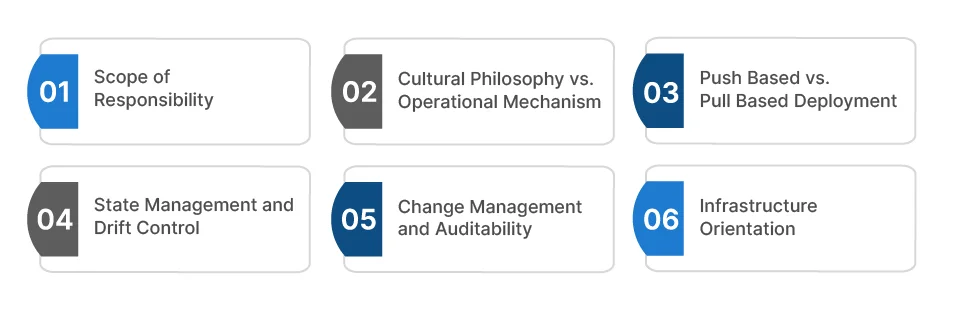
1. Scope of Responsibility
DevOps spans the entire software development lifecycle. It influences how teams plan, build, test, release, deploy, and monitor applications. It is as much about people and processes as it is about tools.
GitOps operates within a narrower boundary. It focuses specifically on how infrastructure and application deployments are defined, applied, and maintained using Git. It does not replace DevOps practices such as CI, testing, or observability, but rather governs how approved changes reach production.
2. Cultural Philosophy vs. Operational Mechanism
DevOps is fundamentally a cultural transformation. It aims to remove silos between development and operations, encourage shared accountability, and improve collaboration across functions.
GitOps is a technical implementation pattern. It formalizes deployment and infrastructure management through Git workflows, declarative configuration, and automated reconciliation. It operationalizes control rather than redefining team culture.
3. Push Based vs. Pull Based Deployment
In many DevOps environments, CI/CD pipelines push changes directly into target environments once builds and tests pass. Access controls and credentials are managed within the pipeline tooling.
GitOps reverses this direction. An agent running inside the target environment continuously monitors the Git repository and pulls approved changes. This reduces direct access to production systems and limits the blast radius of credentials, strengthening security posture.
4. State Management and Drift Control
DevOps encourages automation through infrastructure as code, but configuration drift can still occur if environments are modified outside the pipeline.
GitOps enforces a declared desired state stored in Git. Controllers constantly compare the running environment with the declared configuration and automatically reconcile differences. Drift is not just detected. It is corrected.
5. Change Management and Auditability
DevOps pipelines can include approvals, logs, and monitoring, but traceability depends on how tooling is configured.
GitOps builds governance into the workflow itself. Every infrastructure or deployment change is a Git commit reviewed through pull requests. The version history becomes an auditable record, making rollbacks straightforward and compliance easier to demonstrate.
6. Infrastructure Orientation
DevOps can be applied across a wide range of environments, including virtual machines, on premises systems, hybrid cloud, and containerized workloads.
GitOps is most effective in declarative, API driven environments, particularly Kubernetes. Its model aligns naturally with container native platforms where system state can be fully described in configuration files.
GitOps vs. DevOps: What to Choose for Your Business
For most enterprises, this is not a binary decision. The choice depends on your delivery maturity, infrastructure landscape, and governance requirements.
When DevOps alone may be sufficient
You are still building CI/CD maturity across teams
Delivery bottlenecks stem from manual testing, slow releases, or siloed ownership
Your environment includes legacy systems, VMs, or hybrid infrastructure
Standardization and automation are higher priorities than strict deployment control
Cultural alignment and shared accountability are still evolving
When GitOps adds strategic value
Kubernetes and container platforms form the core of your runtime
You manage multiple clusters or environments and need strong consistency
Audit trails, pull request approvals, and traceability are critical
Configuration drift is a recurring operational risk
You want to reduce direct production access through a pull-based deployment model
Compliance and governance expectations are increasing
In mature enterprises, the most effective approach is to combine both models deliberately. DevOps practices streamline CI, testing, and cross-team collaboration, ensuring that changes are validated quickly and consistently. GitOps then governs CD by enforcing declarative infrastructure control and making Git the single source of truth for runtime state.
This combination allows organizations to retain delivery speed while adding stronger discipline, traceability, and environment consistency at scale.
How TxMinds Help Enterprises Choose the Best Strategy
We start by assessing where you are today across process, tooling, culture, and architecture, and we benchmark your maturity using our proprietary models to pinpoint what is slowing delivery and where risk is accumulating. We then shape a practical roadmap that fits your operating reality, including toolchain rationalization and pipeline design across platforms like GitLab, Jenkins, Azure DevOps, Terraform, Ansible, Docker, and Kubernetes.
Where it matters, we add AI-powered pipeline insights to surface bottlenecks and predict release risk early. Finally, we help you decide how to combine DevOps and GitOps with the right guardrails, including security and compliance automation and cloud-native enablement.
Amar Jamadhiar is the Vice President of Delivery for TxMind's North America region, driving innovation and strategic partnerships. With over 30 years of experience, he has played a key role in forging alliances with UiPath, Tricentis, AccelQ, and others. His expertise helps Tx explore AI, ML, and data engineering advancements.
FAQs
What is DevOps in simple terms?
DevOps is a way of working that brings development and operations together using CI/CD, automation, and shared ownership to deliver software faster and more reliably.
What is GitOps and how does it work?
GitOps is a deployment approach where a Git repository stores the desired state of infrastructure and applications, and automated controllers pull and apply approved changes to keep environments consistent.
What is the difference between GitOps and DevOps?
DevOps covers the entire software delivery lifecycle, while GitOps focuses specifically on managing deployments and infrastructure using Git as the single source of truth.
When should you use GitOps with DevOps?
You should use GitOps alongside DevOps when running Kubernetes or multi-environment setups that require strong audit trails, tighter access control, and consistent, drift-free deployments.