


Recommended Blogs

Blog
Is Your Generative AI Strategy Ready to Scale Beyond Pilots?
Table of Content
- Why Digital Transformation Must Evolve into Intelligent Transformation
- What Prevents Generative AI From Scaling Beyond Pilots
- What a Generative AI Consulting Firm Brings Beyond AI Tools
- How a Generative AI Consulting Firm Builds the AI Adoption Roadmap
- Governance, Compliance, and Trust: The Controls Behind Enterprise GenAI
- From Strategy to Scale: Turning GenAI Advisory into Enterprise Execution
- How TxMinds Helps Enterprises Build Intelligent Transformation With AI
Share On


Digital transformation gave enterprises better systems, faster access, and cleaner digital channels. Yet many leaders still face the same pressure. Decisions take too long, workflows remain fragmented, and AI experiments rarely become part of core enterprise operations. A generative AI consulting firm helps close that gap by turning technology programs into intelligent operating capability.
For CIOs, CTOs, and transformation leaders, the value is practical. You get a clearer AI strategy, stronger governance, better use-case prioritization, and a phased path from experimentation to enterprise scale. The goal is not adding another tool to the stack. It is building systems that can assist decisions, improve workflows, and support measurable business outcomes.
AI adoption is not the same as AI transformation. Adoption introduces tools, while transformation changes how decisions are made, workflows are run, and accountability is managed. This blog explains how enterprise leaders can approach digital transformation with AI. It also shows where enterprise AI consulting services, AI strategy consulting, and GenAI advisory services create lasting value.
Key Takeaways
- Enterprise AI adoption is rising, with 78% of respondents using AI in at least one business function and 71% regularly using generative AI.
- Intelligent transformation goes beyond digital systems by embedding AI into decisions, workflows, governance, and enterprise execution.
- Only 34% of organizations are deeply transforming products, processes, or business models with AI, showing a clear gap between adoption and scale.
- By the end of 2026, 40% of enterprise applications are expected to include task-specific AI agents, making governance and integration critical.
Why Digital Transformation Must Evolve into Intelligent Transformation
Digital transformation often focused on digitizing processes and modernizing platforms. That work still matters. But it does not automatically create intelligence across the enterprise.
Many enterprises now have cloud platforms, workflow tools, data lakes, and automation layers. Yet business teams still depend on manual review, delayed reporting, and fragmented knowledge. The next step is not more digitization. It is intelligence embedded into the way work happens.
McKinsey’s 2025 State of AI survey found that 78% of respondents use AI in at least one business function. The same survey reported that 71% regularly use generative AI in at least one business function.
The Problem Is Not Access to AI Tools
Most enterprises can access GenAI tools today. The real question is whether AI improves business decisions and core workflows. A chatbot can summarize a document. That helps. Intelligent transformation goes further by helping teams triage claims, detect finance anomalies, reduce engineering friction, and resolve customer issues with better context.
What Intelligent Transformation Looks Like
Intelligent transformation connects AI with business processes, data foundations, applications, and governance. The strongest opportunities often include enterprise knowledge search, document understanding, decision support, AI-assisted engineering, customer service intelligence, and compliance review.
The tradeoff is clear. Faster AI adoption creates value only when ownership, controls, and accountability are equally strong.
What Prevents Generative AI From Scaling Beyond Pilots
Most enterprises do not struggle to access GenAI tools. They struggle to move from isolated experiments into repeatable business capability.
The barriers are usually practical. Data may be fragmented or difficult to govern. Use cases may not be tied to clear business outcomes. AI outputs may not be integrated into daily workflows. Ownership can remain unclear, while teams lack a consistent way to evaluate performance, manage risk, or scale adoption.
A pilot can demonstrate technical potential. Enterprise scale requires stronger data foundations, workflow integration, governance, user adoption, and accountability. Without these elements, AI programs often remain useful but limited experiments rather than becoming part of how the business operates.
What a Generative AI Consulting Firm Brings Beyond AI Tools
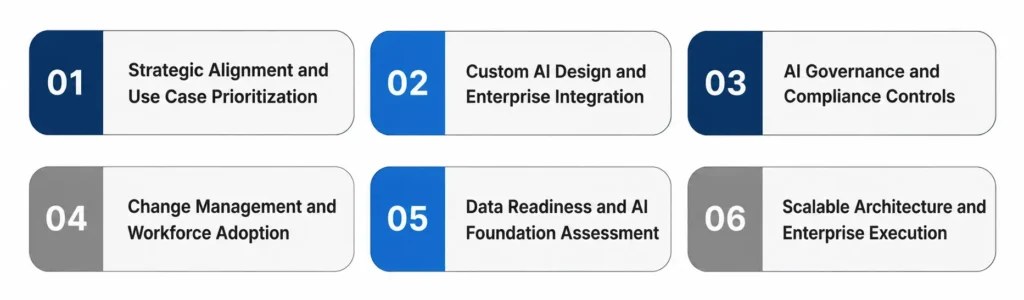
A generative AI consulting firm does more than deploy models or recommend platforms. It helps enterprises connect AI strategy, data readiness, governance, workflows, and adoption into one practical transformation path.
-
Strategic Alignment and Use Case Prioritization
GenAI should solve real enterprise problems, not create another layer of experimentation. Consultants help leaders identify high-value use cases tied to cost, speed, risk, productivity, and customer experience. They also help separate attractive ideas from practical opportunities. This keeps AI investment focused on outcomes the business can measure.
-
Custom AI Design and Enterprise Integration
Off-the-shelf tools rarely understand enterprise context, process rules, or legacy constraints. The right delivery approach should design GenAI solutions around business workflows and existing systems. This may include:
- Connecting AI models with enterprise applications and data platforms
- Building retrieval-based knowledge systems for internal information access
- Fine-tuning or configuring models for specific business needs
- Embedding AI into daily workflows, portals, and operational tools
-
AI Governance and Compliance Controls
Generative AI can create risk when data, access, and decisions are not governed. Strong AI governance and compliance practices protect the enterprise from uncontrolled usage. A consulting partner helps define review paths, access controls, audit trails, and human oversight. These controls help leaders scale AI without weakening trust or accountability.
-
Change Management and Workforce Adoption
AI transformation fails when users do not understand or trust the system. Successful adoption requires training, workflow redesign, prompt guidance, and role-specific enablement. This is especially valuable for CIOs and business leaders. Adoption improves when employees see how AI supports their work, not replaces their judgment.
-
Data Readiness and AI Foundation Assessment
GenAI is only as reliable as the data behind it. A consulting firm assesses data quality, availability, governance, security, and integration readiness before implementation begins. This step helps enterprises avoid unreliable outputs, fragmented knowledge access, and poor user confidence. It also strengthens the foundation for long-term digital transformation with AI.
-
Scalable Architecture and Enterprise Execution
A pilot may work in one team, but enterprise scale demands stronger architecture. Consultants help design scalable, secure, and maintainable AI systems. This includes performance monitoring, cost visibility, model evaluation, integration patterns, and lifecycle management. These foundations help AI evolve as business needs change.
A generative AI consulting firm brings structure, control, and execution discipline to enterprise AI. The real value is not the tool itself, but the operating capability built around it.
How a Generative AI Consulting Firm Builds the AI Adoption Roadmap
A generative AI consulting firm builds an adoption roadmap by turning AI ambition into a structured execution plan. The focus is on business outcomes first, then readiness, governance, pilots, integration, and scale.
-
Readiness and Capability Assessment
- Current-state review: Assess existing applications, data platforms, cloud maturity, security controls, and legacy dependencies.
- Data foundation check: Evaluate whether enterprise data is clean, accessible, governed, and usable for GenAI workflows.
- Adoption readiness: Identify business teams, process owners, and early champions who can support controlled AI adoption.
-
Use Case Prioritization and Definition
- Business pain points: Identify workflow bottlenecks where GenAI can improve speed, quality, cost, or decision support.
- Value versus feasibility: Rank use cases by expected impact, implementation complexity, risk, and data availability.
- Technology fit: Select the right model approach, architecture pattern, and integration method for each use case.
-
Governance and Risk Management
- Guardrail design: Define controls for hallucination risk, data exposure, access permissions, and human review.
- Compliance alignment: Ensure AI outputs follow enterprise policies, privacy requirements, and regulatory expectations.
- Ownership model: Assign clear accountability for AI performance, monitoring, escalation, and continuous improvement.
-
Rapid Prototyping and Pilot Deployment
- Proof of concept: Build focused prototypes that validate user experience, workflow fit, and technical feasibility.
- Controlled testing: Run pilots with selected teams before expanding AI into broader operations.
- Success measurement: Track adoption, quality, efficiency, user feedback, and business impact from the start.
-
Integration and Scaling
- System integration: Embed validated GenAI capabilities into enterprise applications, workflows, data platforms, and APIs.
- Change enablement: Train users, redesign workflows, and create repeatable practices for responsible AI usage.
- Scale roadmap: Expand successful pilots into reusable enterprise AI capabilities with monitoring and governance built in.
These steps help enterprises move from scattered AI experiments to a repeatable AI adoption roadmap. With the right structure, GenAI becomes easier to govern, integrate, measure, and scale across the business.
Governance, Compliance, and Trust: The Controls Behind Enterprise GenAI
Enterprise GenAI becomes useful only when leaders can trust how it behaves. Trust comes from governed data access, monitored outputs, clear ownership, and accountable decisions. Without these controls, AI can create faster workflows and faster risk at the same time.
The maturity gap is visible across enterprise AI programs. Deloitte’s 2026 State of AI in the Enterprise report found that 34% of surveyed organizations are deeply transforming products, processes, or business models with AI, while many others still use AI at a surface level. That gap shows why adoption alone is not enough. Leaders need governance models that support real transformation, not scattered experimentation.
Strong AI governance and compliance should define how data is used, who reviews AI-supported decisions, and how outputs are monitored. It should also cover audit trails, model evaluation, access control, privacy, and escalation paths. When these controls are built early, GenAI can scale with confidence instead of becoming another unmanaged enterprise risk.
Governance should also define when human review is mandatory, how model performance is evaluated, and how teams respond when AI outputs create material business risk.
From Strategy to Scale: Turning GenAI Advisory into Enterprise Execution
The value of GenAI advisory services becomes visible when the strategy reaches production. Many AI pilots fail because they sit outside daily workflows. A strong execution path connects AI with systems, users, governance, and measurable business outcomes.
A practical implementation plan should cover:
- Workflow integration across ERP, CRM, service desks, data platforms, and enterprise applications
- API design, orchestration, identity management, and role-based access
- Data quality, lineage, security, and usage controls
- Model testing, evaluation, monitoring, and continuous improvement
- Change management, user training, and adoption support
- Business metrics such as cycle time, manual effort, case resolution, and audit readiness
This is where enterprise AI consulting services create lasting value. They help leaders turn strategy into repeatable execution patterns that can scale across the enterprise.
How TxMinds Helps Enterprises Build Intelligent Transformation With AI
At TxMinds, we help enterprises move from digital transformation to intelligent transformation with practical AI strategy, engineering discipline, and governance-first execution. We work with leaders who need AI to support real workflows, not isolated experiments.
As a leading Generative AI consulting firm, we help assess AI readiness, identify high-value use cases, and define a phased AI adoption roadmap. Our teams connect AI-native engineering, trusted data foundations, application modernization, and scalable platform capabilities into one delivery approach.
We also design with enterprise realities in mind. That includes security, compliance, integration complexity, user adoption, and measurable business outcomes. We focus on GenAI solutions that improve decision speed, workflow intelligence, operational reliability, and governance confidence.
For leaders seeking an AI transformation partner, TxMinds brings advisory thinking and execution depth together. We help enterprises shape practical GenAI programs that can scale with control, trust, and business relevance.

Vivek Gupta
VP, Delivery, Digital Engineering
Vivek Gupta is the Vice President of Delivery at Tx with over 25 years of experience driving digital transformation. At Tx, he has built the foundation for DevOps, Digital, and Cloud practices, shaping strategies that empower businesses. Before joining Tx, Vivek held leadership roles at Infosys and Tech Mahindra. His leadership fuels innovation, strengthens delivery excellence, and enhances Tx's global impact. Vivek's commitment to driving change ensures our clients stay ahead in an evolving digital landscape.
FAQs
What does a generative AI consulting firm do for enterprises?
A generative AI consulting firm helps enterprises identify high-value AI use cases, build an AI adoption roadmap, design secure GenAI solutions, and integrate AI into business workflows. It also supports governance, compliance, data readiness, and enterprise-scale execution.
How are enterprise AI consulting services different from AI tools?
Enterprise AI consulting services go beyond tool selection. They help leaders align AI with business goals, modernize workflows, connect data systems, manage risk, and measure outcomes. AI tools provide capability, but consulting turns that capability into enterprise value.
Why is AI strategy consulting important for digital transformation with AI?
AI strategy consulting helps organizations move from scattered pilots to structured transformation. It defines where AI should be used, how it should be governed, what outcomes should be measured, and how teams should scale adoption responsibly.
What should CIOs look for in an AI transformation partner?
CIOs should look for an AI transformation partner with strong GenAI advisory services, enterprise architecture experience, governance expertise, integration capability, and a practical understanding of AI governance and compliance. The right partner should support strategy, execution, adoption, and long-term scale.
Discover more