Insurance underwriting has always relied on data, but not the data as it exists today. Modern carriers generate and receive thousands of real-time risk signals across their ecosystem, yet most underwriting decisions still draw from static files created at submission. The gap between what risk really is and what underwriters see has never been wider.
Contextual underwriting closes this gap by pulling in a wider, richer and more dynamic set of signals, behavioral data, telematics patterns, and even sentiment from conversations. Combined with underwriting analytics and predictive models, these signals allow insurers to move from retrospective judgments to proactive, context-aware risk assessment.
Studies say that up to 65% of underwriting working hours could be automated or augmented, yielding potential productivity gains of 30%. Yet most insurers still rely on static, limited data for pricing complex risks, further missing the opportunity to leverage rich signals from telematics, claims notes, and IoT data.
This blog is for you if you own a P&L, run an underwriting team, or shape risk strategy and are asking: How do we move from one-off file reviews to a live, contextual view of risk? How do we make better decisions, faster, without losing control or inviting regulatory trouble?
Key Takeaways
Up to 65% of underwriting work can be automated, boosting productivity by 30%, yet many still rely on static data.
Contextual underwriting uses real-time, structured, unstructured, and external data for a dynamic risk view.
A strong framework combines integrated data, predictive analytics, decision support, and governance.
Future underwriting is augmented, learning continuously from diverse signals for faster, smarter risk decisions.
From Static Files to Contextual Signals: What Contextual Underwriting Really Means
Most carriers are still making long-tail underwriting decisions on what is essentially a thin, point-in-time submission file. Contextual underwriting widens that lens and treats every credible signal as part of the risk profile, so the underwriter works with a living view of exposure rather one-off snapshots.
You can think about these signals in three broad domains, which many leading insurers already use in underwriting analytics:
Structured data: Policy and exposure schedules, claims history, financial statements, EHRs, bureau scores.
Unstructured data: Broker emails, inspection reports, adjuster notes, customer service transcripts, images and videos from surveys. NLP and computer vision are increasingly used to turn this into machine-readable features.
External and real-time data: Telematics, wearables, smart home/industrial sensors, satellite and street-level imagery, climate models, socio-economic and geospatial indicators.
In practice, this shift underwriting from one-off eligibility checks to an ongoing capability that can adjust selection, technical price, terms, and conditions as new information arrives.
Contextual Data Signals: What Underwriters Can Use Today
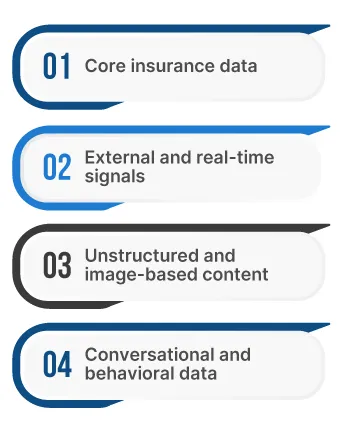
Rather than thinking in abstract terms, it helps to map the concrete data pools that can feed contextual underwriting.
1. Core insurance data
Policy, billing, and claims history across products and legal entities
Loss development patterns, sub-limits, deductibles, and recovery experience
Endorsements, mid-term adjustments, cancellations, and reinstatements
2. External and real-time signals
Telematics for usage-based motor and fleet underwriting
IoT sensor data from plants, buildings, smart homes, and wearables
Geospatial and climate data for flood, wildfire, and crime exposure
Property and vehicle attributes from third-party and public records
3. Unstructured and image-based content
Broker submissions, loss-control and engineering reports, medical narratives
Adjuster notes, survey photos, satellite, and street-level imagery
NLP, OCR, and computer vision are turning this content into clean, structured risk factors
4. Conversational and behavioral data
Contact-center calls, agent conversations, chat transcripts, and emails
Signals of non-disclosure, cancellation intent, payment stress, or potential fraud
Predictive platforms that feed these signals into underwriting and fraud models in real time
Most carriers already possess these data types. The real question is whether they are integrated into a single risk picture or left in silos.
Building a Real-Time, Data-Driven Underwriting Framework
This is the point where the work starts to feel like a consulting engagement rather than a technology wish list. Carriers that succeed usually organize contextual underwriting around four building blocks and a set of governance disciplines.
1. Data and Integration Layer
Build an underwriting data fabric that connects core policy, billing, and claims systems with external providers, telematics, IoT, and imagery, using OCR and data enrichment to clean and standardize submissions before scoring.
2. Analytics and Intelligence Layer
Deploy predictive models that estimate claim probability, severity, lapse, and fraud using portfolio data plus external and behavioral signals, with machine learning and NLP uncovering patterns that traditional actuarial approaches miss.
3. Decision and Execution Layer
Embed scores and insights into underwriting workbenches, rating engines, and referral rules so the system can triage submissions, support pre-underwriting, set technical price and line size, and keep underwriters in control of complex or high-impact cases.
4. Governance and Controls
Wrap the framework with strong governance: data quality standards, model validation, fairness and bias checks, audit trails for every recommendation, and explicit alignment with risk appetite and regulatory expectations.
The job to be done is not a single model; it is a repeatable, real-time underwriting capability that is technically robust and regulator ready.
TxMinds: Operationalizing Contextual Signals in Day-to-Day Underwriting
At TxMinds, we focus on a part of the data landscape most carriers underuse: the signals buried in conversations and free-form text. By connecting to policy, claims platforms, chat, and email systems, we turn disclosures, hesitation, negotiation patterns, and cancellation intent into structured inputs. That translates into cleaner submissions, sharper triage, more accurate technical pricing, and earlier detection of adverse selection and fraud through insurance technology services for underwriting and claims.
The future of underwriting isn’t algorithmic, and it isn’t manual; it is augmented. Contextual underwriting defines the blueprint for underwriting organizations that can scale their expertise, reduce volatility, and strengthen governance without slowing down decision-making.
The carriers that thrive will be the ones that build architectures capable of continuously learning from their own claims, conversations, behaviors, and environments, turning real-time signals into proactive action.
Rakesh Pal, Vice President at Tx and Head of Insurance Vertical, brings over 19+ years of experience in the insurance industry. His experience working with organizations like Cognizant, LTIMindtree, Valuemomentum, etc., brings him deep expertise in P&C (Re)Insurance across Personal, Commercial, and Specialty lines and its operational nuances across North America, Lloyd’s of London, Middle East, APAC, and India. With a strong background in digital transformation, cloud migration, domain advisory, and client delivery, he leads strategic initiatives that drive innovation, operational efficiency, and customer delight in the insurance industry. His leadership across delivery and solutions enables insurers to modernize their technology landscape and navigate evolving business, customer, and regulatory demands with confidence.
FAQs
How does contextual underwriting use data signals to anticipate risk?
Contextual underwriting integrates a wide range of real-time, structured, unstructured, and behavioral data signals to create a dynamic risk profile, enabling insurers to predict and address risk before it fully emerges.
What are the best practices for implementing data-driven contextual underwriting?
Key best practices include building a unified data infrastructure, deploying predictive analytics and machine learning models, embedding decision support into underwriting workflows, and maintaining strong governance to ensure model accuracy and compliance.
How can using behavioral and alternative data improve underwriting accuracy?
Behavioral and alternative data such as conversation transcripts, payment patterns, and telematics provide deeper insights into risk characteristics, enabling more precise pricing, early fraud detection, and better risk selection than traditional static data alone.
How are insurers shifting from traditional to real-time contextual underwriting in insurance?
Insurers are moving from point-in-time, static file reviews to continuously updated risk assessments that incorporate real-time external signals and advanced analytics, allowing faster and more proactive underwriting decisions.