


Recommended Blogs

Blog
Is Your Cloud Data Modernization Building Trust, Agility, and AI Readiness?
Table of Content
- Why Cloud Data Modernization Must Move Beyond Migration
- The Business Value Gap After Cloud Migration
- Cloud Data Modernization and the Enterprise Data Strategy Leaders Need
- Turning Post-Migration Modernization into Data Trust, Agility, and Cloud Optimization
- The TxMinds Approach to Cloud Data Modernization That Delivers Business Value
Share On


A cloud migration can move data without changing how the business uses it. That is where many modernization programs lose executive confidence. The platform changes, but decision speed, data trust, and business value remain uneven. Moving data to the cloud does not automatically create trusted data, usable governance, or a foundation that AI initiatives can rely on.
Cloud data modernization should answer a sharper leadership question. Has the enterprise simply moved data to the cloud, or has it built a data foundation that leaders can trust, teams can use faster, and AI initiatives can rely on?
For C-level technology leaders, the value is practical. Better data platforms should reduce friction between business teams, data teams, and technology operations. They should improve reporting confidence, support governed AI, and create stronger cloud optimization.
This blog looks beyond migration as a technical milestone. It explains where post-migration modernization creates value, why enterprise data strategy matters, and how leaders can connect data agility with measurable business outcomes.
Key Takeaways
- Cloud data modernization must go beyond migration, because 51% of enterprises already have data in public cloud while cost and security remain top challenges at 85% and 82%.
- AI readiness depends on data readiness, as Gartner says organizations will abandon 60% of AI projects unsupported by AI-ready data through 2026.
- Enterprise data quality remains a major gap, with only 29% of technology leaders strongly agreeing their data meets the standards needed to scale generative AI.
- AI adoption has moved ahead of AI scale, with 88% of organizations using AI regularly, while only about one-third are scaling AI programs.
Why Cloud Data Modernization Must Move Beyond Migration
Cloud migration changes where enterprise data lives across platforms, pipelines, and storage environments. Cloud data modernization determines whether that data can be trusted, governed, reused, and made ready for AI. That difference matters after the move is complete. A migrated estate can still carry duplicate datasets, unclear ownership, inconsistent definitions, and slow reporting. The cloud platform may be modern, while the data operating model remains fragmented.
Flexera’s 2026 State of the Cloud Report found that 51% of enterprises currently have data in public cloud, while cost and security remain leading cloud challenges at 85% and 82%.
For C-level leaders, migration is the foundation, not the finish line. Post-migration modernization turns cloud data into governed assets, stronger business value, better data agility, and reliable AI readiness.
The Business Value Gap After Cloud Migration
The business value gap appears after the move is complete. Dashboards load, pipelines run, and cloud services become available. Yet business teams may still question report accuracy, finance may see rising consumption, and data teams may keep fixing inherited pipeline issues. The issue is rarely the cloud platform alone. It is whether data ownership, quality, cost control, and access models changed with it.
Executives should measure cloud data modernization through business outcomes, not migration volume. Terabytes moved and pipelines rebuilt are delivery indicators, but they do not prove business value. Stronger measures include faster executive reporting, fewer conflicting definitions, better cloud optimization, trusted AI-ready datasets, and clearer spend visibility by domain or function. Business value improves when enterprise data becomes easier to trust, govern, and reuse.
Cloud Data Modernization and the Enterprise Data Strategy Leaders Need
Cloud data modernization goes beyond moving legacy databases into cloud environments. Leaders need an enterprise data strategy that creates a real-time, governed, and scalable foundation for analytics, automation, and AI consumption.
A successful modernization roadmap should connect architecture decisions with business value. That means improving data trust, increasing data agility, and making cloud optimization part of everyday operating discipline.
The Strategic Pillars Leaders Need
A strong cloud data modernization framework should rest on four core pillars:
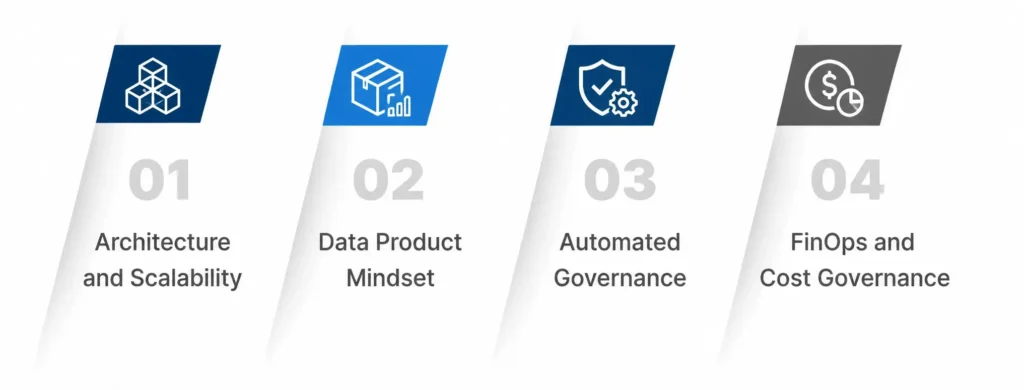
- Architecture and Scalability: Shift from rigid, legacy data storage to cloud-native data platforms that support growth, performance, and changing business demand. The architecture should support structured, semi-structured, and unstructured data without creating new silos.
- Data Product Mindset: Treat enterprise data as a reusable business asset, not a byproduct of applications. Each critical dataset should have an owner, quality expectations, usage context, and a clear purpose for business teams.
- Automated Governance: Build governance into pipelines, catalogs, access policies, and data quality checks. This gives leaders better visibility into lineage, usage, ownership, and compliance without slowing delivery.
- FinOps and Cost Governance: Move beyond lift-and-shift economics by linking cloud data spend to business priorities. Leaders should monitor consumption, retire unused assets, optimize workloads, and align platform investment with measurable value.
When these pillars work together, cloud data becomes easier to trust, scale, and use. That is where modernization starts creating measurable business value beyond migration.
Turning Post-Migration Modernization into Data Trust, Agility, and Cloud Optimization
Turning post-migration modernization into business value requires more than moving workloads into cloud environments. Leaders need to refine data pipelines, improve governance, optimize consumption, and make cloud data easier to use across business functions.
The goal is not only a cleaner platform. It is a stronger operating model where data trust, data agility, and cloud optimization work together.
-
Cloud Optimization
Cloud migration does not automatically reduce cost or improve efficiency. After migration, enterprises must continuously tune their cloud data environment to prevent waste and improve performance.
- Right-Sizing: Adjust storage, compute, and processing capacity based on actual workload demand and usage patterns.
- Workload Efficiency: Review pipelines, queries, and transformation jobs to reduce unnecessary processing and improve response times.
- Cost Visibility: Map cloud data spend to business domains, products, and functions so leaders can track value clearly.
- Usage Governance: Retire unused datasets, duplicate tables, idle environments, and low-value workloads that consume budget without impact.
-
Data Trust
Modernization is only valuable when business users trust the data. Migrated data can still carry duplication, inconsistent definitions, missing lineage, and unclear ownership.
- Cleansing and Standardization: Remove duplicate records, improve data quality, and align definitions across business-critical datasets.
- Unified Governance: Build governance into data catalogs, access policies, lineage tracking, and quality monitoring workflows.
- Ownership Clarity: Assign accountable owners for key datasets so business teams know which sources are reliable.
- AI-Ready Controls: Ensure data used for analytics and AI is discoverable, governed, secure, and contextually accurate.
-
Data Agility
Data agility means business teams can access trusted data faster without creating uncontrolled complexity. It allows enterprises to respond quickly while maintaining governance and control.
- Reusable Data Products: Package high-value datasets with ownership, quality rules, metadata, and business context.
- Modern Integration: Connect applications, platforms, and analytics environments through scalable data pipelines and governed APIs.
- Continuous Delivery: Automate testing, validation, and deployment for data changes across cloud environments.
- Faster Experimentation: Enable teams to build analytics, reporting, and AI use cases without repeatedly rebuilding foundations.
When these three areas mature together, post-migration modernization becomes a business capability. It turns cloud data into a trusted, agile, and optimized foundation for enterprise growth.
The TxMinds Approach to Cloud Data Modernization That Delivers Business Value
At TxMinds, we approach cloud data modernization as a value-led program that helps enterprises move from migrated data estates to trusted, governed, AI-ready data foundations. We begin by understanding business goals, current infrastructure, workloads, and long-term data priorities.
Then we shape the right cloud path across platform selection, architecture, migration, governance, and optimization. TxMinds’ cloud modernization work focuses on building for cloud, not merely moving systems.
We combine cloud-native architecture, secure data migration, integration, performance tuning, and post-migration support. Our teams work across structured and unstructured data, hybrid environments, and cloud ecosystems with business continuity in focus.
We also keep optimization active after go-live through cost monitoring, performance improvement, and proactive management. That matters because cloud data modernization should keep improving after migration. The goal is trusted data, stronger agility, controlled spend, and AI-ready foundations that create measurable business value.

Rajiv Diwan
VP and Global Head Data & AI Practice
Results-oriented Data Analytics & AI Specialist with 24+ years of experience in multiple roles, including Practice Leader with P&L ownership. Expert in building Data Analytics practices, defining market strategies, and leading large-scale transformation initiatives. Skilled in Business Intelligence, Data Engineering, Cloud platforms (Azure, AWS, GCP), AI/ML, and Data Governance, with a strong focus on customer-centric solutions and strategic alliances.
FAQs
What is cloud data modernization?
Cloud data modernization is the process of improving enterprise data platforms, pipelines, governance, and architecture after or during cloud adoption. It goes beyond migration by making data more trusted, scalable, secure, AI-ready, and useful for business decisions.
Why is post-migration modernization important?
Post-migration modernization is important because moving data to the cloud does not automatically improve business value. Enterprises still need cleaner data, stronger governance, better cost control, and faster access to reliable insights.
How does cloud data modernization support enterprise data strategy?
Cloud data modernization supports enterprise data strategy by creating governed, reusable, and scalable data foundations. It helps leaders align data ownership, quality, lineage, security, cloud optimization, and analytics priorities with business outcomes.
How does cloud data modernization improve data agility and cloud optimization?
Cloud data modernization improves data agility by giving teams faster access to trusted data for reporting, analytics, and AI use cases. It improves cloud optimization by reducing waste, improving workload efficiency, and linking cloud data spend to measurable business value.
Discover more