


Recommended Blogs

Blog
10 Best ETL Tools for Data Warehousing in 2026: A Blueprint for Modern Data Teams
Table of Content
- What are ETL Tools and Why They Matter in Modern Data Warehousing
- Importance of ETL Tools for Data Warehousing in 2026
- Top 10 ETL Tools for Data Warehousing in 2026
- Key Considerations When Choosing the Best ETL Tools
- How TxMinds Helps Enterprises Choose and Implement the Best ETL Tools
Share On


Data is generated across every industry, but insights remain limited. Research shows that 79% of enterprises still operate with fragmented data systems, where information is scattered across disconnected platforms instead of being unified for analysis.
As data volumes grow and sources multiply across cloud applications, databases, and real-time systems, this fragmentation becomes a significant barrier to reliable analytics and decision-making.
This is where ETL (Extract, Transform, Load) tools play a critical role. By extracting data from diverse sources, transforming it into a consistent format, and loading it into a centralized data warehouse, ETL tools help enterprises build a trusted foundation for reporting, analytics, and AI initiatives.
In 2026, ETL is no longer just about data movement. It is about enabling scalable, real-time, and intelligence-driven data warehousing. This blog explores what ETL tools are, why they matter, and the top ETL tools shaping modern data warehouses today.
Key Takeaways
- 79% of enterprises still struggle with siloed data, so standardization is urgent.
- ETL in 2026 is about building a trusted warehouse layer for analytics and AI, not just moving data.
- The right ETL tool is the one that reliably plugs into your databases, SaaS apps, APIs, and warehouse with minimal custom work.
- Choose tools that handle growing volumes and higher refresh rates without constant tuning.
What are ETL Tools and Why They Matter in Modern Data Warehousing
ETL tools (Extract, Transform, Load) are software applications that automate the process of collecting data from several sources, cleaning and reformatting it, and loading it into a centralized repository like a data warehouse.
ETL tools consist of three components:
- Extract: Pulls data from diverse, disparate sources such as CRM systems, databases, APIs, or files.
- Transform: Cleans, filters, validates, restructures, and converts raw data into a consistent, usable format based on business rules.
- Load: Inserts the processed data into a destination target system (e.g., cloud data warehouse, data lake) for analysis.
These tools are designed to enable enterprises to move data efficiently for analytics, reporting, and machine learning. The next section explores why ETL tools are critical in modern data warehousing.
Importance of ETL Tools for Data Warehousing in 2026
In 2026, ETL (Extract, Transform, Load) tools play a critical role in data warehousing by enabling the integration of large, disparate, and real-time data sources into a unified, high-quality repository. These tools further ensure that data is accurate, scalable, and supports AI-driven analytics to transform raw data into actionable business intelligence.
Some major benefits of ETL tools include:
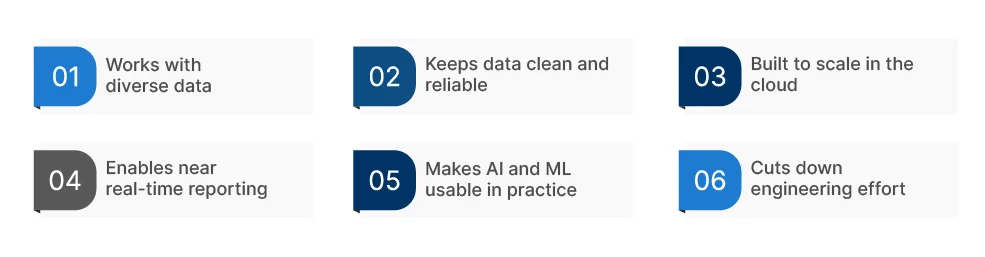
- Works with diverse data: ETL tools integrate data from databases, spreadsheets, APIs, applications, logs, flat files, and even unstructured text, allowing organizations to break down silos and gain a complete view of their operations.
- Keeps data clean and reliable: ETL tools remove duplicates, fix formatting issues, validate fields, and apply consistent rules, ensuring that reporting and decision-making are not based on messy inputs.
- Built to scale in the cloud: Most modern ETL platforms are designed for cloud warehouses, handling high data volumes and heavy workloads without constant tuning or rework.
- Enables near real-time reporting: Many ETL tools support streaming or high-frequency data ingestion, ensuring dashboards reflect what’s happening now.
- Makes AI and ML usable in practice: High-performing AI models depend on high-quality data. ETL tools prepare and deliver well-structured, high-quality datasets that teams can use for ML pipelines and AI projects.
- Cuts down engineering effort: With automation, reusable connectors, and visual pipeline builders, teams spend less time maintaining hand-coded pipelines and more time focusing on innovation and insights.
ETL tools are gaining traction with cloud data warehouses, and there are various types of them. Our next section talks about the top ETL tools in data warehousing and how each plays a crucial role.
Top 10 ETL Tools for Data Warehousing in 2026
Choosing the right ETL tool is a critical decision in building a scalable, reliable data warehouse. In 2026, the tools listed below stand out for their ability to support modern data warehousing needs.
1. Fivetran (Best for Automated ELT)
Fivetran is widely recognized for its fully managed, automated ELT approach. It offers an extensive library of pre-built connectors that continuously sync data from applications, databases, and SaaS platforms into cloud data warehouses. By automatically handling schema changes and incremental updates, Fivetran significantly reduces operational overhead and pipeline maintenance.
Where Fivetran fits best: Fivetran is ideal for organizations that prioritize speed, reliability, and minimal manual intervention in data ingestion. Since it primarily focuses on extraction and loading, most teams pair it with a transformation tool to handle business logic and modeling inside the warehouse.
2. Matillion (Best for Cloud Data Warehouses)
Matillion is a cloud-native ETL/ELT platform built specifically for modern data warehouses such as Snowflake, Amazon Redshift, and Google BigQuery. It provides a visual interface for designing pipelines while leveraging the warehouse’s compute engine for transformations, resulting in high performance and scalability.
Key consideration: Matillion works especially well for analytics-driven teams comfortable with SQL and cloud-native architectures. As data volumes and transformations grow, thoughtful pipeline design becomes essential to maintain performance and manageability.
3. dbt (data build tool) (Best for Transformation)
dbt has become the industry standard for transforming data directly within the data warehouse using SQL. It allows teams to build modular, tested, and documented data models, improving trust and consistency across analytics and reporting.
How it’s typically used: dbt is not an end-to-end ETL tool but a powerful transformation layer. It is most effective when combined with an ingestion tool, forming a modern ELT stack that separates data movement from transformation logic.
4. Informatica PowerCenter / Informatica Cloud (Best for Enterprise)
Informatica is a long-established enterprise data integration platform known for handling complex, large-scale data environments. It supports advanced transformations, metadata management, and strong governance controls, making it suitable for mission-critical workloads.
Best suited for: Large organizations with hybrid or multi-cloud environments, legacy system integrations, and strict compliance requirements. Informatica delivers the most value in mature data ecosystems with formal governance practices.
5. Azure Data Factory (Best for Microsoft Ecosystems)
Azure Data Factory is a fully managed integration service designed to orchestrate data movement and transformation within Azure and hybrid environments. It integrates seamlessly with other Azure services, making it a natural choice for organizations invested in the Microsoft stack.
Architectural note: Azure Data Factory excels at workflow orchestration and data movement. For advanced transformations, it is often used alongside Azure Synapse, Databricks, or SQL-based processing engines.
6. Airbyte (Best Open-Source Alternative)
Airbyte is an open-source, ELT-focused platform that emphasizes flexibility and extensibility. It provides a growing catalog of connectors and allows teams to customize or build their own, offering greater control over data pipelines.
Important trade-off: Airbyte’s flexibility makes it attractive for engineering-led teams, but it also requires more hands-on management, especially when deploying and maintaining custom connectors at scale.
7. Talend (Best for Data Governance)
Talend combines data integration with strong data quality and governance capabilities. It supports profiling, cleansing, and validation as part of ETL workflows, helping organizations maintain consistent and trustworthy data.
Where Talend stands out: Talend is particularly valuable in regulated industries or large enterprises where data accuracy, compliance, and stewardship are as important as performance.
8. AWS Glue (Best for AWS Environments)
AWS Glue is a serverless ETL service designed for data integration within the AWS ecosystem. It supports both batch and event-driven workloads and includes a centralized data catalog to simplify schema discovery and metadata management.
Best use case: AWS Glue works best for teams already operating in AWS, especially when integrating services like Amazon S3, Redshift, and Athena into a unified data warehouse strategy.
9. Hevo Data (Best for Real-Time Pipelines)
Hevo Data focuses on near real-time data ingestion with built-in automation, monitoring, and error handling. It enables teams to move data quickly from multiple sources into cloud warehouses with minimal operational effort.
Ideal scenario: Hevo is well-suited for analytics use cases that require fresh data and reliable ingestion, rather than highly complex, transformation-heavy pipelines.
10. Astera (Best for No-Code and AI-Driven ETL)
Astera offers a no-code ETL platform designed to simplify the creation of end-to-end data pipelines. Its visual interface enables both technical and non-technical users to design, deploy, and manage ETL processes efficiently.
Why teams choose Astera: Astera is often selected by organizations aiming to accelerate ETL delivery, reduce dependency on custom coding, and enable faster collaboration between business and technical teams.
Choosing between the best ETL tools is always a hard decision. The section below talks in detail about factors to consider when picking the ETL tool.
Key Considerations When Choosing the Best ETL Tools
Choosing the best ETL tool requires balancing data connectivity, scalability, and cost to match enterprises’ needs. You must prioritize tools that handle large, growing data volumes and comply with standards like SOC 2 Type II.
Here are the most important factors to evaluate:
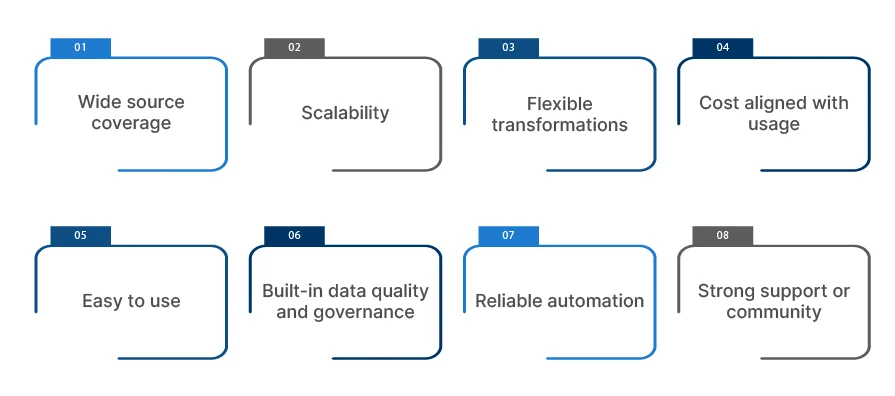
- Wide source coverage: Choose a tool that easily connects to your databases, SaaS applications, APIs, and data warehouse. Strong connectivity reduces custom development and speeds up integration.
- Scalability: Your ETL tool should handle increasing data volumes and higher refresh rates without performance issues.
- Flexible transformations: Look for tools that support SQL, advanced logic, or low-code options to clean and shape data effectively.
- Cost aligned with usage: Make sure the cost model fits your data volume and pipeline complexity as you scale.
- Easy to use: A clear interface and simple workflows reduce setup time and ongoing maintenance.
- Built-in data quality and governance: Features such as validation, monitoring, and lineage tracking help keep data accurate and secure.
- Reliable automation: Scheduling, alerts, logging, and automatic retries are essential to ensure pipelines run smoothly with minimal manual effort.
- Strong support or community: Good vendor support or an active user community can make implementation and troubleshooting much easier.
How TxMinds Helps Enterprises Choose and Implement the Best ETL Tools
At TxMinds, we help enterprises cut through the noise and choose ETL tools that genuinely align with their data strategy. We start by understanding your data sources, existing systems, and business priorities, then align them with tools that support scalability, performance, and long-term growth. Our ETL and data warehouse services are driven by real-world use cases, not trends, ensuring the ETL stack you choose can evolve with your analytics and data warehousing needs.
We also take ownership of implementation, designing, and building reliable data pipelines that deliver clean, trusted data to your warehouse. From setting up transformations and governance to optimizing performance, we ensure your ETL environment is built to last. With TxMinds, enterprises gain a partner focused on turning data integration into a strong foundation for insight and decision-making.


Amar Jamadhiar
VP, Delivery North America
Amar Jamadhiar is the Vice President of Delivery for TxMind's North America region, driving innovation and strategic partnerships. With over 30 years of experience, he has played a key role in forging alliances with UiPath, Tricentis, AccelQ, and others. His expertise helps Tx explore AI, ML, and data engineering advancements.
Discover more