


Recommended Blogs

Blog
The Autonomous Enterprise: Scaling Operational Efficiency with Agentic AI
Table of Content
- Key Capabilities of Agentic AI in the Enterprise
- Core Capabilities That Drive Scaling Operational Efficiency
- Operational Domains Where the Enterprise Automation Thrives
- The Journey to Business Process Automation
- Challenges, Risks & Governance Considerations for Agentic AI Systems
- Looking Ahead: The Future of the Autonomous Enterprise
- Why TxMinds is Your Partner for Autonomous Enterprise Transformation
Share On


Business operations are evolving rapidly, with agentic AI leading the charge. Unlike traditional enterprise automation, which simply executes repetitive tasks, agentic AI solutions empower intelligent agents to make decisions, adapt to new situations, and optimize workflows autonomously. This shift is unlocking new levels of operational efficiency and agility, enabling businesses to scale faster and more effectively.
As organizations strive to stay competitive, the need for more adaptable and efficient systems becomes clear. During a survey, 93% enterprises believed that those who scaled AI agents into their business operations would achieve a competitive advantage.
In this blog, we will explore how AI agents for business are transforming enterprises, driving autonomous enterprise operations, and creating a foundation for end-to-end process automation. Get ready to discover how agentic AI is reshaping the future of work.
Key Takeaways
- Automation is now an economic lever in insurance, targeting loss, expense, and combined ratios and not just “efficiency.”
- AI-powered claims automation cuts processing time by up to 70% and saves about $6.5B annually.
- A solid ROI model tracks baseline unit costs, cost–risk–growth impact, and full TCO (process, tech, change).
- Lasting value comes from treating automation as an operating-model shift, with clear ownership and experts refocused on judgment work.
Key Capabilities of Agentic AI in the Enterprise
Traditional automation and even earlier forms of Artificial Intelligence, autonomous applications still depend heavily on human‑defined triggers and tightly constrained workflows.
In contrast, agentic AI systems exhibit four defining qualities:
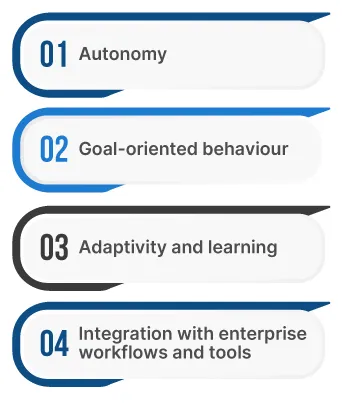
- Autonomy: They can decide on actions, plan steps, and execute without detailed human instruction each time.
- Goal-oriented behaviour: These systems aren’t just reactive; they accept objectives and break them down into subtasks.
- Adaptivity and learning: They monitor outcomes, modify their approach based on experience, and improve performance.
- Integration with enterprise workflows and tools: They don’t operate in isolation, but rather connect to business systems (such as ERP, CRM, and supply chain) and tools.
To remain competitive, customer service operations must deliver instant, multilingual responses across every touchpoint. Deploying AI agents enables organizations to automate high-volume, routine tasks effectively. The result is a dual benefit: enhanced customer satisfaction scores (CSAT) through faster resolution times, and a substantial reduction in cost-per-ticket.
Core Capabilities That Drive Scaling Operational Efficiency
Let’s look at specific capabilities of agentic AI that support the autonomous enterprise in scaling operational efficiency:
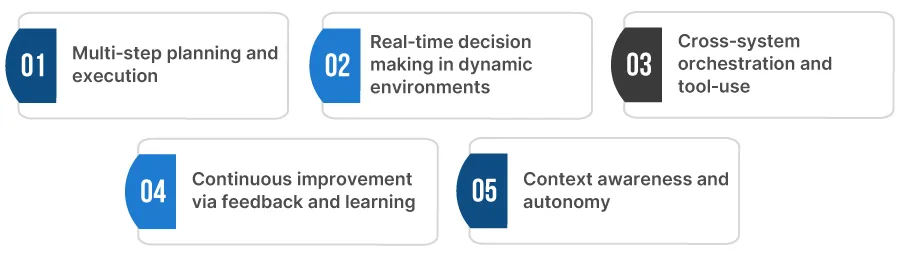
1. Multi‑step planning and execution
A business goal (e.g., reducing supply chain lead time by 15%) can be broken down into subtasks by agentic systems. Further, its task dependencies can be mapped and business execution coordinated by connected systems and AI agents.
2. Real‑time decision making in dynamic environments
They are dynamic in response to different conditions, e.g., when an unforeseen shortage of raw material occurs, production is rerouted, and logistics and procurement are automatically synchronized.
3. Cross‑system orchestration and tool‑use
These agents relate to a variety of systems (CRM, ERP, data lakes, external APIs) in a synchronous manner; essential to more high-scale enterprise processes.
4. Continuous improvement via feedback and learning
With time, the agent gets to understand which decisions have been successful, how to change strategies, perfect process steps, and thereby becomes more efficient.
5. Context awareness and autonomy
They have a business context, environmental cues, and can run without clear instructions involving all the actions and therefore aid autonomous automation.
Operational Domains Where the Enterprise Automation Thrives
With the integration of agentic AI as a primary component of the modern enterprise, its effects can be found in different spheres of operation. These business AI agents are causing a change in the way tasks are performed, and business processes are optimized. Let’s take a closer look at how agentic AI solutions are reshaping key areas of business operations.
1. Supply Chain and Logistics
Supply chains are dynamic, and agentic AI makes them simpler by adapting to changes. These intelligent systems can anticipate demand, optimize routing, and respond to disruptions without any human intervention.
- How it works: Agentic AI solutions predict demand and autonomously adjust routes and procurement.
- Key benefits: Include Shorter lead times, improved demand forecasting, and proactive issue resolution.
- Real-world example: Companies like Walmart and Amazon use AI to adjust their supply chain operations in real time.
2. Customer Service and Support
Customer care is being improved by utilizing AI agents to process complex queries and interactions. These systems offer 24/7 support, troubleshooting, and customer forecasting.
- How it works: AI agents respond to customer inquiries, troubleshoot issues, and escalate when necessary.
- Key benefits: Faster responses, personalized service, and reduced wait times.
- Real-world example: H&M utilizes AI assistants to manage customer inquiries, enhancing both speed and customer satisfaction.
3. Human Resources and Talent Management
Agentic is a recruiting, onboarding, and performance review automation solution in HR, providing highly personalized experiences and optimizing operations.
- How it works: AI agents assess resumes, schedule interviews, and manage employee performance.
- Key benefits: Faster recruitment, better candidate matching, and improved employee retention.
- Real-world example: Unilever utilizes AI to evaluate early-stage talent and enhance employee engagement.
4. Finance and Accounting
In the finance sector, agentic AI decreases manual labor, automates invoicing, detects fraud, and promotes compliance to make financial activities more accurate and quicker.
- How it works: AI agents handle transactions, reconcile accounts, and generate reports automatically.
- Key benefits: Reduced errors, faster reporting, and improved compliance.
- Real-world example: JP Morgan uses AI for document review, automating processes that once took days.
5. IT and DevOps
In IT, autonomous enterprise automation ensures system health and stability. AI agents for business diagnose issues, make fixes, and streamline deployment processes in DevOps.
- How it works: Agentic AI monitors systems, predicts potential failures, and autonomously corrects issues.
- Key benefits: Reduced downtime, faster software delivery, and improved reliability.
- Real-world example: Netflix utilizes AI to identify and resolve streaming issues, ensuring a seamless service experience.
The Journey to Business Process Automation
The autonomous AI is a strategic, step-by-step process for building an autonomous enterprise. It relates to the incremental process of automation to autonomy, a continuous process where a smooth and coordinated system is developed across the organization. This change requires businesses to have a solid foundation, establish the necessary infrastructure, and manage change effectively.
- Augmentation: At the initial level, agentic AI tends to enhance human abilities by automating time-consuming and repetitive tasks. It enables employees to perform more productive tasks, as AI handles monotonous tasks such as data entry, scheduling, or responding to customers.
- Automation: With increased functionalities of the AI system, the whole workflow is automated. It implies that the work of departments such as HR, finance, and supply chain can be performed through AI with minimal human input, resulting in enhanced efficiency and reduced errors.
- Reinvention: At this level, companies begin to re-examine and rationalize their old-fashioned ways of doing business. Agentic AI is not merely robots doing all the things that people can do; it brings about innovation and discovers how operations can be improved, customer experiences can be enhanced, and how to keep up with changing market conditions.
- Transformation: Full AI integration in the organization is the last stage. Systems gain complete autonomy, making decisions, optimizing their processes, and learning continuously from the results. Human supervision becomes more strategic, with high-level decision-making being handled, whereas AI takes care of normal day-to-day operations.
Challenges, Risks & Governance Considerations for Agentic AI Systems
Although the advantages of agentic AI are obvious, several issues and threats must be considered to implement the technology successfully. It may not be easy to integrate with existing systems, particularly when it’s legacy software. Further, agentic AI requires high-quality and consistent data; therefore, data quality and availability are essential conditions. There are also security and privacy risks associated with AI systems handling sensitive business data. Companies should take all necessary measures to ensure that this data does not fall into the hands of cybercriminals.
Another significant risk is that human oversight is lost as AI takes on more decisions independently, potentially leading to unintended outcomes should systems malfunction or provide inaccurate results. The solution to these risks entails strong integration policies, data governance policies, and security policies to safeguard systems and sensitive data.
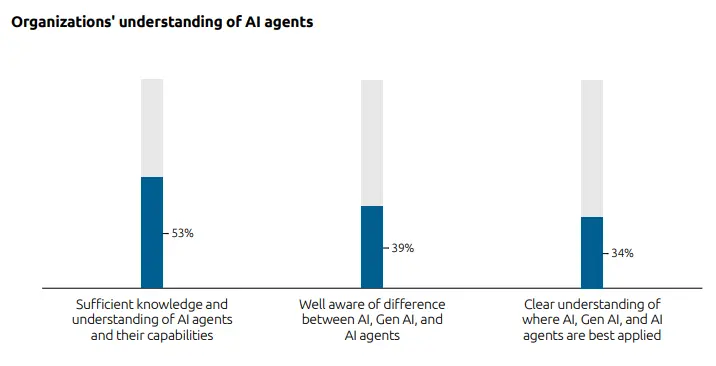
In addition to the technical issues, ethical and governance factors must also be addressed to ensure the responsible use of AI. Businesses play a crucial role in developing ethical AI systems that are both transparent and accountable in their AI decision-making processes. Another area of concern is bias in AI models, where biased training data may lead to discriminatory practices.
Additionally, it is crucial to comply with evolving regulations, such as GDPR or CCPA, to avoid legal pitfalls and ensure that AI systems are utilized responsibly. To mitigate risks, organizations must establish clear AI governance frameworks, conduct regular monitoring and auditing of AI performance, and collaborate with regulators to ensure compliance with relevant laws and regulations.
Looking Ahead: The Future of the Autonomous Enterprise
The future of the autonomous enterprise is poised for a significant transformation with the advancement of agentic AI. The AI systems will not only optimize current processes but also facilitate cross-functional collaboration, providing innovation and uncovering new growth opportunities. As edge computing and IoT continue to rise, AI will enable real-time, on-site decision-making, making businesses more responsive and agile.
Additionally, AI will become more self-optimizing, learning, and evolving to become more efficient. To stay ahead, businesses must adopt agentic AI solutions, invest in the necessary technology, and modify their workflow to leverage AI to its fullest potential, thereby achieving growth and success in a constantly evolving environment.
Why TxMinds is Your Partner for Autonomous Enterprise Transformation
TxMinds is a reliable partner for companies that are interested in adopting agentic AI. With comprehensive expertise in agentic AI solutions, we enable businesses to thoroughly integrate AI agents into their operations, optimize business processes, enhance decision-making, and drive scalable efficiency. The solutions created by our team will be tailored to your specific business requirements, enabling you to fully leverage the capabilities of autonomous automation and achieve a competitive advantage in today’s highly dynamic digital environment.
Work with TxMinds and accelerate your journey to an intelligent, self-optimizing enterprise. Let’s transform your business and shape the future of autonomous operations.


Vivek Gupta
VP, Delivery, Digital Engineering
Vivek Gupta is the Vice President of Delivery at Tx with over 25 years of experience driving digital transformation. At Tx, he has built the foundation for DevOps, Digital, and Cloud practices, shaping strategies that empower businesses. Before joining Tx, Vivek held leadership roles at Infosys and Tech Mahindra. His leadership fuels innovation, strengthens delivery excellence, and enhances Tx's global impact. Vivek's commitment to driving change ensures our clients stay ahead in an evolving digital landscape.
FAQs
How agentic AI drives autonomous enterprise operations?
-
Agentic AI drives autonomous enterprise operations by turning high-level goals into multi-step actions, coordinating across systems like CRM, ERP, and supply chain tools. It allows real-time decisions, fewer manual handoffs, and scaling operational efficiency using agentic AI across departments.
What are the benefits of an autonomous enterprise with AI agents?
-
The key benefits of autonomous enterprise with AI agents include faster response times, shorter lead times in supply chains, reduced errors in finance, and always-on customer support. These capabilities contribute to enhancing business outcomes with autonomous AI through higher productivity and better customer satisfaction.
How does optimizing business processes with agentic AI work in practice?
-
Optimizing business processes with agentic AI means delegating routine, rule-based, and multi-step work to agents that can learn from feedback and improve over time. By integrating agentic AI into enterprise workflows, companies can streamline processes.
What are effective autonomous enterprise transformation strategies?
-
Effective autonomous enterprise transformation strategies follow a staged path: starting with task augmentation, moving to end-to-end automation, then rethinking processes, and finally reaching full autonomy.
Discover more