


Recommended Blogs

Blog
AI vs Machine Learning vs Deep Learning: Navigating the Future of Intelligent Technology
Table of Content
- Understanding Intelligent Technologies- AI vs Machine Learning vs Deep Learning
- Artificial Intelligence: Concept, Scope, and Real-World Impact
- Traditional Machine Learning: Learning Patterns from Structured Data
- Deep Learning: Advancing Intelligence Through Neural Networks
- Core Differences Between Rule-Based AI vs Traditional ML vs Deep Learning
- From Strategy to Execution: Choosing the Right Approach and How TxMinds Delivers Value
Share On


78% of enterprises now use AI in at least one business function, reflecting its rapid shift from a buzzword to a critical driver of business strategy.
Yet, despite its widespread adoption, many leaders still grapple with a common challenge when it comes to decision-making. The terms Artificial Intelligence, Machine Learning, and Deep Learning are often used interchangeably, even though they represent distinct technologies.
For executives and decision-makers, this is not just a technical nuance. It directly impacts how you evaluate vendor claims, prioritize initiatives, and set realistic expectations across teams and boards.
This blog clarifies the distinctions between AI vs machine learning vs deep learning and how these approaches help you make informed, business-first decisions about where each fit into your company’s strategy.
Key Takeaways
- AI is now standard practice, with 78% of enterprises using it in at least one business function.
- AI, ML, and Deep Learning serve different purposes, from rules-based automation to data-driven prediction and complex pattern recognition.
- The best technology is the one that fits business goals, balanced value, cost, speed, and governance.
- More advanced models require more data and oversight, especially as organizations move from AI to ML to Deep Learning.
Understanding Intelligent Technologies- AI vs Machine Learning vs Deep Learning
Think of Artificial Intelligence (AI) as the broad category: technology that enables machines to perform tasks that usually require human judgment, like decision-making, language understanding, or recognizing patterns. Within AI, Machine Learning (ML) is the approach where systems learn from historical data rather than being programmed with every rule.
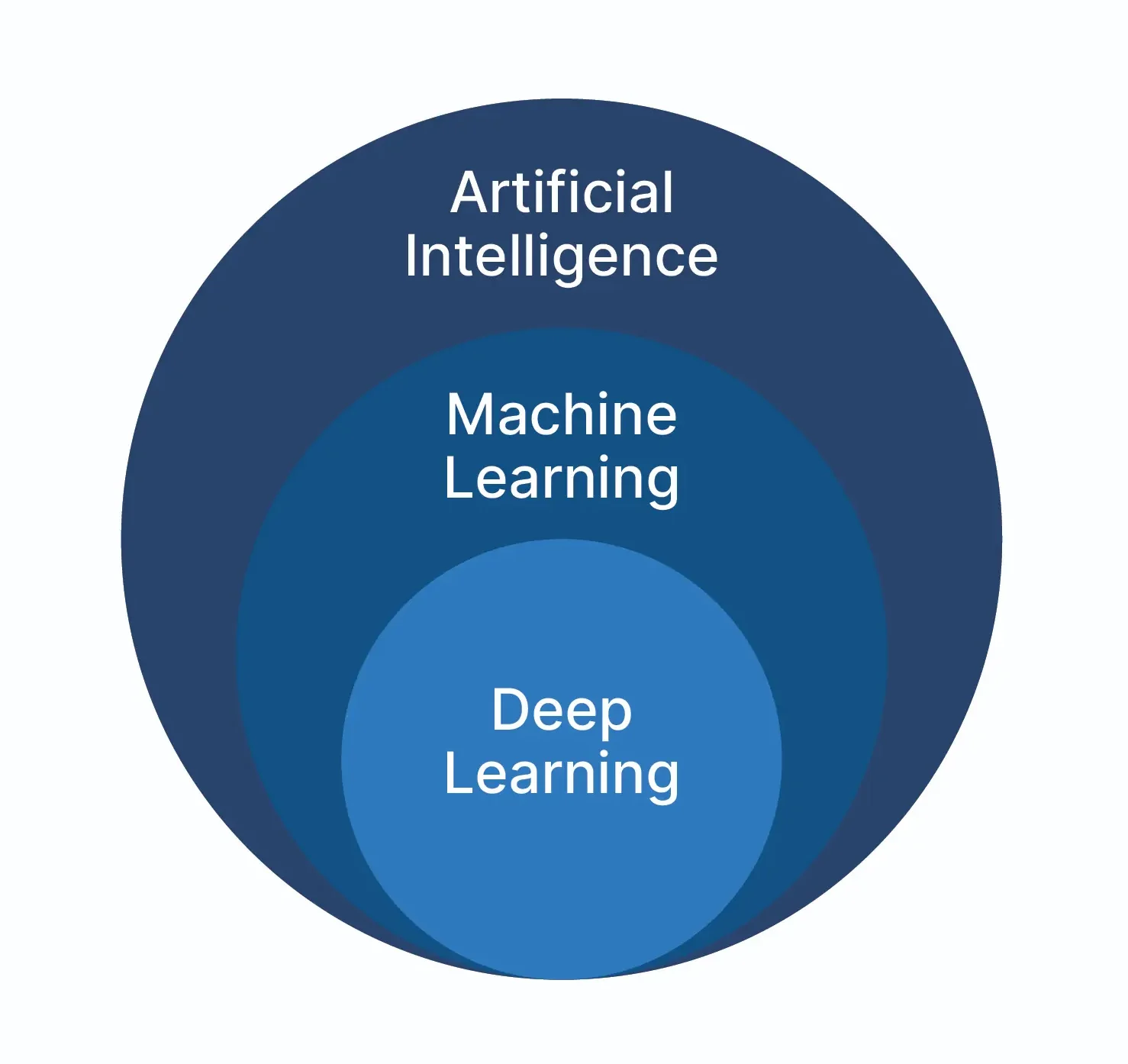
Why does AI vs machine learning vs deep learning concept matter in a business context? Because the “right” approach depends on what you are trying to achieve. Many successful digital transformation programs use a mix of AI, ML, and Deep Learning across different functions. The goal is not to adopt the most advanced technology; it is to choose what delivers value with the right level of cost, speed, and governance.
Artificial Intelligence: Concept, Scope, and Real-World Impact
Artificial Intelligence is a broad concept that encompasses technologies that enable machines to perform tasks that typically require human intelligence, such as reasoning, decision-making, language understanding, and pattern recognition. In practice, it includes everything from rules-based automation and decision workflows to machine learning and deep learning models that learn from data to predict outcomes and interpret unstructured inputs like text, images, and speech.
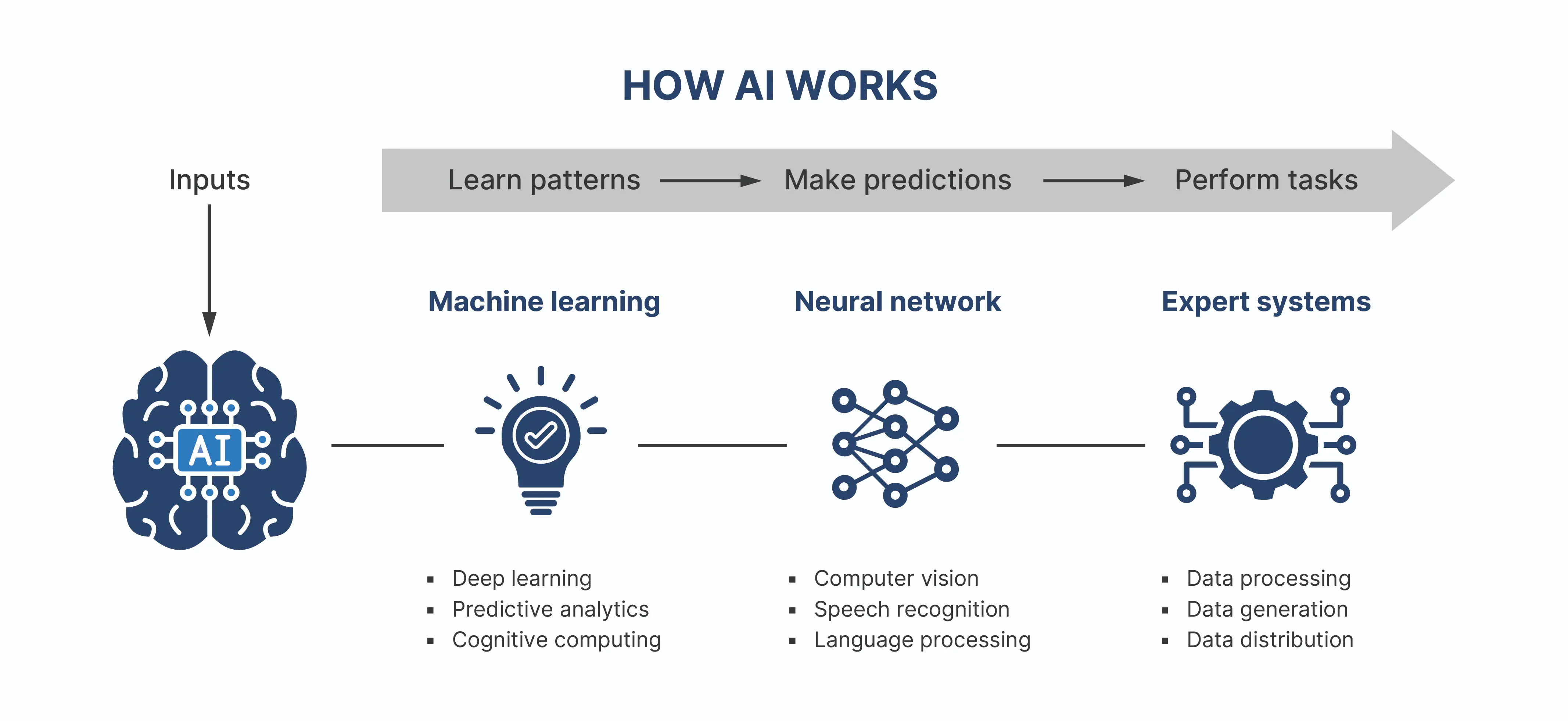
For businesses, the real value of AI lies in selecting the right approach based on the goal, data readiness, and governance needs, ensuring the solution delivers measurable impact.
In practical terms, AI is widely used to
- Automate repetitive work that follows clear rules (approvals, routing, validation checks).
- Increase speed and consistency in decision-making across teams and locations.
- Reduce manual effort and errors, especially in operational workflows.
- Support employees with intelligent assistance (triage, guided actions, standard responses).
Examples include chatbots for common customer queries, rule-based compliance checks, workflow automation in finance and HR, and intelligent routing in customer support. AI delivers strong results when the process is clear, the environment is predictable, and leaders want fast time-to-value.
Traditional Machine Learning: Learning Patterns from Structured Data
Traditional Machine Learning takes the next step: instead of relying only on predefined rules, it uses historical data to learn patterns and make predictions. This is why ML is at the center of many “AI in business” projects because it can improve decision-making in dynamic environments where behavior changes over time.
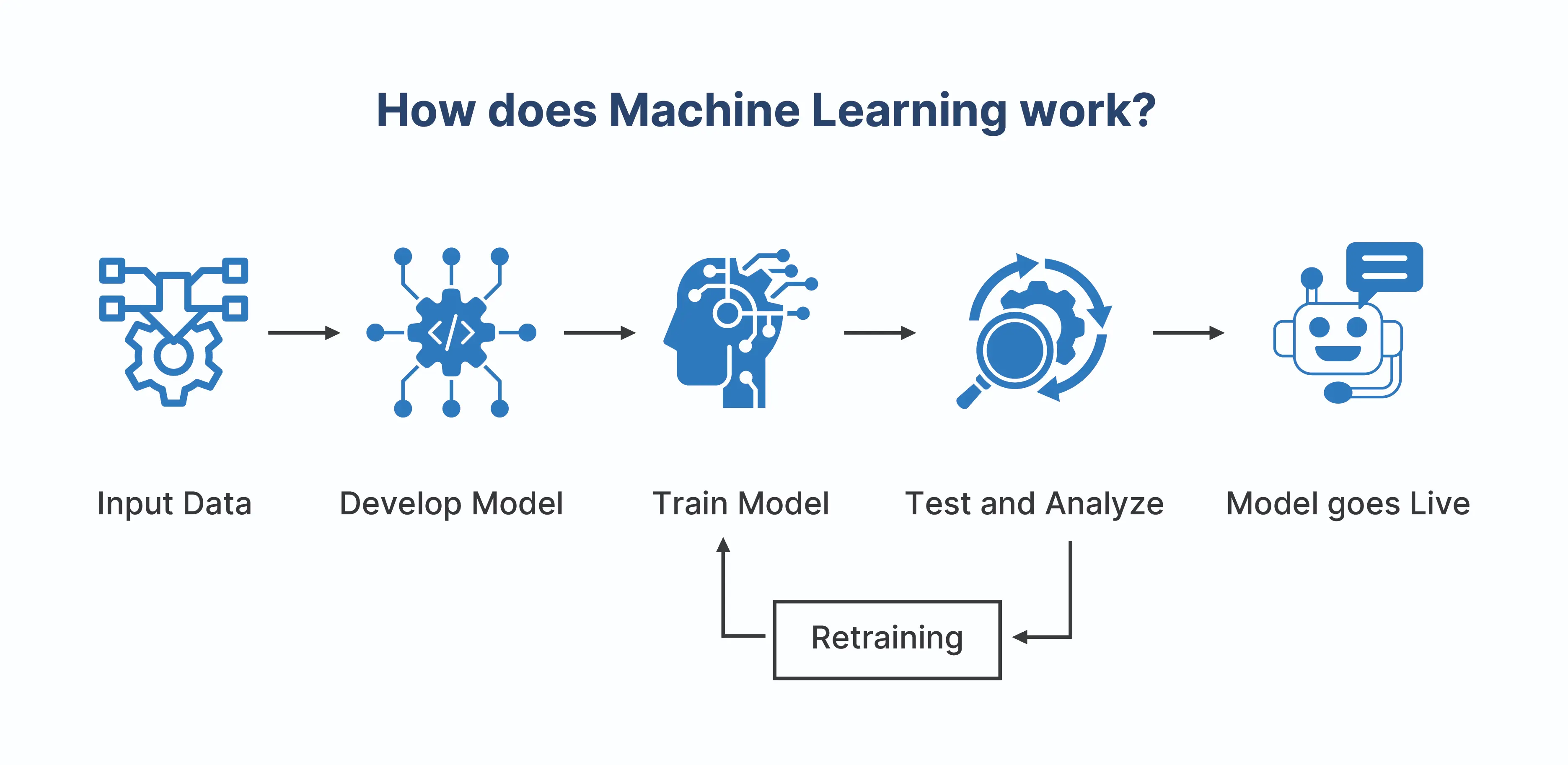
Organizations typically use traditional Machine Learning to:
- Predict outcomes such as demand, churn, fraud likelihood, or equipment failure.
- Personalize experiences (recommendations, offers, content, next-best-action).
- Detect anomalies that humans might miss in large datasets.
- Optimize decisions such as pricing, inventory, staffing, and marketing spend.
Machine Learning creates an advantage when your organization has usable data and clear success metrics. The key executive consideration is that ML is not a one-time build. Models need monitoring, retraining, and governance to maintain accuracy as patterns drift.
Deep Learning: Advancing Intelligence Through Neural Networks
Deep Learning is a specialized form of Machine Learning that uses neural networks with many layers to identify complex relationships in data. It is particularly effective when the input data is unstructured, such as text, documents, images, video, and audio, where traditional approaches struggle.
Deep Learning is commonly applied to:
- Computer vision (classification and segmentation of images and videos, defect detection in areas like manufacturing and diagnosis of medical problems in areas like medical domain where normal human eyes can’t detect, safety monitoring in autonomous driving and surveillance).
- Document intelligence (extracting key fields from invoices, contracts, forms, identifying fake documents and information).
- Speech and audio analytics (call insights giving sentiment analysis, compliance monitoring, and bringing security).
- Advanced natural language processing (summaries, intent detection, classification at scale).
For leaders, Deep Learning can unlock value from information that previously sat unused. But it also requires more data, more computing power, and more effort to validate and govern. It is best used when the business case is strong and simpler models cannot deliver the outcome.
Core Differences Between Rule-Based AI vs Traditional ML vs Deep Learning
These three terms are related, but they represent different levels of capability and complexity. The comparison below is designed for decision-making and how each approach behaves, what it takes to deliver, and where it fits best in real enterprise settings.
Core Purpose: What Each Approach Is Designed to Do
How AI is used
AI is designed to deliver consistent, repeatable intelligence, often through decision logic that people can define and control. In many business systems, AI acts like a strong operational assistant: it applies rules, routes work, and supports decisions where the “right answer” can be described clearly.
How Machine Learning is used
Machine Learning is designed to improve decisions using evidence from data. It is used when the organization wants better forecasting, prioritization, or recommendations, especially when rules alone cannot keep up with changing customer behavior, market shifts, or operational variability.
How Deep Learning is used
Deep Learning is designed to handle high complexity and nuance, particularly with unstructured inputs. It is the right choice when you need machines to interpret language, images, or audio at scale, tasks that cannot be captured well with simple rules or traditional models.
Data Dependency: What Each One Needs to Work Well
How AI uses data
AI solutions that rely on rules-based logic and predefined workflows typically require limited data. The system depends more on well-defined rules and structured inputs than on large datasets. While data still plays a role, especially clean and accurate data, many AI systems can operate with smaller, well-defined datasets and can be implemented quickly with low data dependency.
How Machine Learning uses data
Machine Learning requires historical, structured data that is linked to known outcomes. For example, if a business wants to predict customer churn, it needs data on past customer behaviors and the associated outcomes. The performance of ML models is often heavily dependent on the quality and consistency of the data provided. Unlike rules-based AI, ML systems improve over time as they are exposed to more data, and they require continuous monitoring and updating to maintain performance.
How Deep Learning uses data
Deep Learning, a more advanced subset of ML, needs large amounts of data, often unstructured (text, images, audio, etc.). Deep Learning models excel at recognizing complex patterns within this type of data, but they require significant computational power for training. To achieve high accuracy, these models need extensive, high-quality data that is representative of the real-world environment they will operate in. Data preparation and labeling are also crucial, as they ensure the models learn from the right signals.
Adaptability: How Each Approach Responds to Change
How AI adapts
Traditional AI systems are not inherently adaptive. These systems rely on rules and logic that must be manually updated if there is a change in the environment, such as a shift in business policies or customer behavior. This can be advantageous in environments where stability and control are critical. However, it can become a limitation when there is frequent or unpredictable change, as the system requires continuous manual intervention to stay relevant.
How Machine Learning adapts
Machine Learning is designed to adapt over time. As new data becomes available, ML models can be retrained to capture changing patterns and behaviors. This is particularly useful in dynamic environments where trends, customer preferences, or market conditions evolve. The ability of ML to adapt to new data means that, with proper monitoring, models can continue to provide valuable insights and accurate predictions as the underlying data shifts.
How Deep Learning adapts
Deep Learning models can adapt to complex changes, but this comes with higher operational effort. While deep learning models can handle more nuanced shifts in data, such as changes in language use or image patterns, retraining deep models requires substantial computational resources and careful validation. Deep Learning models also need to be monitored closely to ensure they remain accurate and effective as they scale.
Explainability and Control: How Transparent Are the Decisions
How AI decisions are explained
AI systems that rely on rules and predefined logic are typically the easiest to explain. Since decisions are based on clear, defined rules, it is straightforward to trace how and why a decision was made. This is particularly important in regulated industries or when governance and compliance are priorities.
The transparency of AI decision-making provides a high level of control, allowing organizations to understand the reasoning behind each action.
How Machine Learning decisions are explained
Machine Learning models can vary in their level of explainability. Some models, like decision trees, are relatively transparent, making it easier to trace how decisions are made. However, more complex models, such as ensemble methods or neural networks, may require interpretability tools to provide insight into how the model arrived at a specific outcome.
While ML models are generally more explainable than Deep Learning, achieving a balance between model performance and explainability is important, especially when dealing with sensitive business decisions.
How Deep Learning decisions are explained
Deep Learning models, particularly those based on neural networks, are often considered the least transparent. These models can process large, complex datasets to identify patterns, but understanding exactly why a Deep Learning model made a particular decision can be challenging. To mitigate this, organizations rely on performance testing, continuous monitoring, and validation processes.
While this approach doesn’t make Deep Learning unsafe, it does require a stronger governance framework to ensure that models are making reliable and ethical decisions over time.
Real-World Business Use Cases: Where Each Creates the Most Value
How AI is used in practice
AI is most valuable for workflow automation and structured decisioning, such as approvals, routing, compliance rules, and operational triggers. It often delivers quick ROI by reducing manual work and improving consistency.
How Machine Learning is used in practice
Machine Learning fits best where leaders need prediction and prioritization, demand forecasting, churn prediction, fraud detection, credit risk scoring, and personalization. It supports growth and efficiency by improving the quality and timing of decisions.
How Deep Learning is used in practice
Deep Learning creates value when the problem involves language, vision, or complex pattern recognition, such as document processing, computer vision for quality inspection, speech analytics, and advanced NLP for customer insights. It is particularly useful when unstructured information is a major bottleneck.
From Strategy to Execution: Choosing the Right Approach and How TxMinds Delivers Value
Strong outcomes with AI vs machine learning vs deep learning start with business clarity: the problem to solve, the KPI to improve, and the operational process that will adopt the solution. TxMinds helps enterprises select the appropriate approach based on data readiness, governance expectations, and time-to-value with its AI development services so teams build what will work in production, not just in a demo.
By combining strategy, engineering, and scalable deployment practices, we support enterprises in embedding intelligent systems into core operations, improving decision-making, streamlining workflows, and turning AI initiatives into measurable business value.


Vivek Gupta
VP, Delivery, Digital Engineering
Vivek Gupta is the Vice President of Delivery at Tx with over 25 years of experience driving digital transformation. At Tx, he has built the foundation for DevOps, Digital, and Cloud practices, shaping strategies that empower businesses. Before joining Tx, Vivek held leadership roles at Infosys and Tech Mahindra. His leadership fuels innovation, strengthens delivery excellence, and enhances Tx's global impact. Vivek's commitment to driving change ensures our clients stay ahead in an evolving digital landscape.
FAQs
What is the difference between AI, Machine Learning, and Deep Learning?
-
AI is the broad umbrella for systems that mimic human intelligence, Machine Learning enables systems to learn from structured data, and Deep Learning is a subset of ML that uses neural networks to analyze complex, unstructured data like text, images, and audio.
How should enterprises decide which intelligent technology to implement first?
-
As a business, you should start with a clear business problem and KPI, then assess data readiness, complexity, and governance needs—often beginning with rules-based AI or traditional Machine Learning before moving to Deep Learning only when the use case demands it.
When should an organization use machine learning instead of rules-based AI?
-
Traditional machine learning is best suited for dynamic environments where outcomes change over time, such as demand forecasting, churn prediction, or fraud detection, especially when historical data is available.
Is ML the same as deep learning?
-
No. Machine learning and deep learning are related but not the same. Deep learning is a subset of ML that uses multi-layer neural networks to learn complex patterns, especially from unstructured data like text, images, and audio. Traditional machine learning typically works best with structured data, requires less data and compute, and is easier to explain and govern than Deep Learning.
Discover more