


From Manual Reviews to Intelligent Decisions in Insurance Claims and Underwriting


Table of Content
- Why Manual Claims and Underwriting Reviews Are Reaching Their Limits
- How AI Solutions for the Insurance Industry Turn Reviews into Intelligent Decisions
- Claims Automation Using AI: Faster Triage, Better Routing, Stronger Accuracy
- Underwriting Automation with AI: Sharper Risk Assessment and Faster Decisions
- What Insurers Must Control Before Scaling AI in Claims and Underwriting
- How TxMinds Helps Insurance Enterprises Build Intelligent Claims and Underwriting Systems


Insurance leaders are under pressure to make faster decisions without weakening risk discipline. Claims teams face rising document volume, fraud complexity, and customer expectations. Underwriters face incomplete submissions, scattered data, and pressure to quote faster. Manual review still has value, but it can no longer carry the full operating burden.
AI solutions for the insurance industry are changing that equation. They help insurers read documents faster, detect risk signals earlier, route work smarter, and support better decisions. The gain is not judgment replacement. It is stronger judgment supported by clearer evidence.
For C-level technology leaders, the value is practical. AI solutions for the insurance industry can reduce operational friction, improve service responsiveness, and strengthen decision consistency. This blog explains where AI creates value across claims and underwriting, and what leaders must get right before scaling it.
Key Takeaways
- AI is now a leadership priority in insurance. KPMG’s 2025 Global Insurance CEO Outlook found that 73% of insurance CEOs are prioritizing AI investments to streamline underwriting, claims, and customer experience.
- Claims automation using AI improves claims flow. It supports FNOL intake, claim routing, document review, fraud detection, and customer sentiment analysis.
- Underwriting automation with AI sharpens risk decisions. It helps underwriters review submissions, find missing data, and assess risk signals faster.
- Enterprise AI adoption in insurance needs control. AI-powered insurance software works best with human oversight, trusted data, and clear governance.
Why Manual Claims and Underwriting Reviews Are Reaching Their Limits
Claims teams must review policy documents, loss details, repair estimates, medical records, images, fraud indicators, and customer communications. Underwriters must evaluate submissions, exposure data, loss history, broker notes, financial documents, and risk appetite rules. Much of this information still arrives in unstructured formats and across disconnected systems.
The Work Has Outgrown the Old Model
Many teams still validate this information across disconnected systems and manual handoffs. That slows decisions and creates inconsistent outcomes across reviewers, regions, and business lines.
KPMG’s 2025 Insurance CEO Outlook, based on 110 insurance CEOs, found that 73% are prioritizing AI investments to streamline underwriting, claims, and customer experience.
The Risk Is Bigger Than Delay
Slow claims weaken customer trust. Slow underwriting creates missed opportunities. Poor data quality affects pricing, reserving, and risk confidence.
How AI Solutions for the Insurance Industry Turn Reviews into Intelligent Decisions
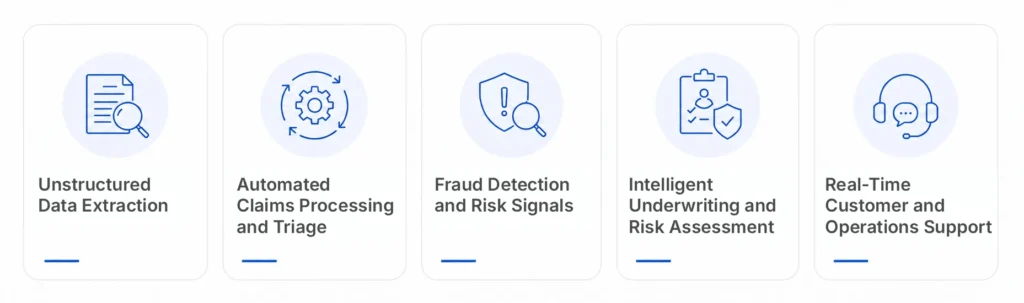
AI solutions for the insurance industry help insurers move from document-heavy reviews to decision-ready workflows. They connect data, documents, rules, and risk signals so teams can act with more confidence.
-
Unstructured Data Extraction
- The Problem: Claims and underwriting teams review emails, PDFs, forms, images, notes, and customer documents manually.
- The AI Solution: Generative AI in insurance can summarize documents and extract relevant information for faster review. AI-powered insurance software then turns scattered inputs into structured, searchable, and usable decision context.
-
Automated Claims Processing and Triage
- The Problem: Adjusters spend valuable time sorting claims, checking documents, and identifying missing information.
- The AI Solution: Claims automation using AI can classify claims, assess complexity, and route work to the right handler. Simple claims can move faster, while complex cases receive earlier expert attention.
-
Fraud Detection and Risk Signals
- The Problem: Fraud indicators are often hidden across claim history, documents, payments, and behavioral patterns.
- The AI Solution: Predictive analytics for insurers can compare new claims against historical patterns and unusual activity. This helps teams flag suspicious cases earlier without slowing every claim review.
-
Intelligent Underwriting and Risk Assessment
- The Problem: Underwriters often work with incomplete submissions, fragmented data, and inconsistent risk indicators.
- The AI Solution: Underwriting automation with AI can prefill data, identify gaps, and support AI risk assessment in insurance. It gives underwriters clearer evidence before pricing, referral, or acceptance decisions.
-
Real-Time Customer and Operations Support
- The Problem: Customers and internal teams often wait for basic updates, document requests, or status clarification.
- The AI Solution: AI chatbots for insurance operations can support routine queries, claim status updates, and document guidance. Human teams can then focus on sensitive conversations, exceptions, and judgment-heavy work.
AI does not remove the need for experienced insurance professionals. It gives them cleaner information, better signals, and faster paths to action. The real shift is from manual effort to intelligent decision support. That is where enterprise AI adoption in insurance starts creating durable operational value.
Claims Automation Using AI: Faster Triage, Better Routing, Stronger Accuracy
Claims automation using AI helps insurers move claims forward with better speed, structure, and control. It reduces repetitive review work while giving adjusters clearer evidence earlier in the process. The three core pillars driving this shift include:
-
Faster Triage
- Instant FNOL Intake: AI-powered insurance software captures claim details, documents, images, and customer inputs at the first notice of loss.
- Automated Claim Classification: Intelligent systems categorize claims by type, complexity, severity, and required level of review.
- Document Intelligence: Generative AI in insurance extracts key details from emails, forms, repair estimates, medical notes, and policy records.
-
Better Routing
- Complexity-Based Assignment: AI routes simple claims to automated workflows and complex claims to experienced handlers.
- Specialist Matching: Predictive analytics for insurers help assign claims based on expertise, workload, urgency, and risk indicators.
- Customer Sentiment Signals: AI chatbots for insurance operations can detect frustration, confusion, or escalation needs from customer interactions.
-
Stronger Accuracy
- Data Consistency Checks: AI compares claim information against policy terms, prior records, and predefined validation rules.
- Damage Review Support: Computer vision can analyze submitted photos or videos to support property and auto damage assessment.
- Fraud Signal Detection: AI models identify unusual patterns across claims history, documents, payment behavior, and external data points.
The strongest claims models combine intelligent automation with human accountability. That balance gives insurers faster resolution, cleaner control, and more trusted claim outcomes.
Underwriting Automation with AI: Sharper Risk Assessment and Faster Decisions
Underwriting automation with AI helps insurers review submissions faster without weakening risk discipline. AI-powered insurance software can read broker emails, ACORD forms, loss runs, inspection reports, and financial documents. It can extract key details, identify missing information, and prepare cleaner submission summaries.
AI risk assessment in insurance gives underwriters better context before they make decisions. Predictive analytics for insurers can connect loss history, exposure data, underwriting guidelines, and external risk signals. This helps teams identify risk drivers earlier and reduce time spent on manual document review.
Enterprise AI adoption in insurance works best when automation supports judgment rather than replacing it. Underwriters need explainable recommendations, visible data sources, and clear approval paths. Intelligent automation for insurance should help teams quote faster, assess risk better, and stay accountable for every decision.
What Insurers Must Control Before Scaling AI in Claims and Underwriting
The value of AI in claims and underwriting depends on the controls around it. Insurers need trusted data, explainable recommendations, workflow integration, model validation, audit trails, and clear human accountability.
Without these controls, AI may accelerate decisions without making them more reliable.
Before scaling AI across claims or underwriting, leaders should validate five areas:
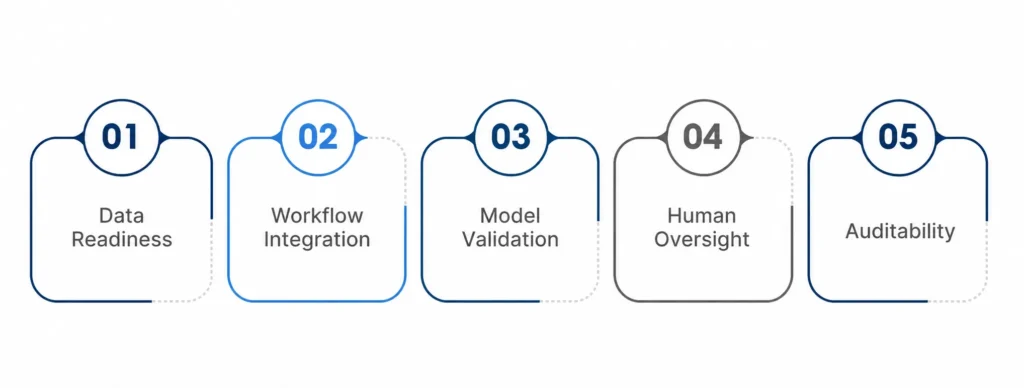
- Data Readiness: Claims, policy, customer, broker, exposure, and loss data must be accurate, accessible, and governed.
- Workflow Integration: AI must fit into existing claims, policy, billing, CRM, document, and reporting systems without creating parallel processes.
- Model Validation: Recommendations should be tested for accuracy, bias, drift, exception handling, and business-rule alignment.
- Human Oversight: Claims handlers and underwriters must understand when to accept, challenge, override, or escalate AI-supported recommendations.
- Auditability: Every AI-supported decision should leave a clear trail of data inputs, rules, recommendations, human actions, and final outcomes.
How TxMinds Helps Insurance Enterprises Build Intelligent Claims and Underwriting Systems
At TxMinds, we help insurance enterprises move from manual review models to intelligent decision systems. We work with leaders who need AI to fit real claims, underwriting, data, compliance, and integration environments.
Our teams connect AI-native engineering, data engineering, legacy modernization, and insurance domain knowledge into one delivery approach. As an insurance technology consulting services, we help insurers design AI-powered insurance software that supports claims automation, underwriting automation, intelligent routing, document intelligence, risk signal detection, and operational support.
We also focus on integration with policy, claims, billing, CRM, document, and reporting systems, because AI value depends on how well it fits the insurance operating model.
Our role is to help insurers scale AI with control. We bring clarity to data readiness, workflow design, model validation, human oversight, and operational support. For leaders rethinking claims and underwriting, we help turn AI ambition into dependable business capability.

Yuvraj Singh
Associate Director
Yuvraj Singh is an accomplished Associate Director of Delivery, renowned for leading strategic quality assurance initiatives that consistently deliver outstanding software outcomes across global markets. With deep expertise in both Property & Casualty (P&C) and Life & Annuities (L&A) insurance domains, Yuvraj excels at bridging the gap between complex business objectives and flawless execution.
FAQs
AI solutions for the insurance industry are tools and systems that help insurers improve claims, underwriting, risk assessment, customer service, and operations. They include AI-powered insurance software, predictive analytics for insurers, AI chatbots for insurance operations, and generative AI in insurance.
Claims automation using AI helps insurers classify claims, extract document details, detect fraud signals, and route cases faster. It reduces manual effort while giving adjusters better information for accurate decisions.
Underwriting automation with AI helps underwriters review submissions faster and identify missing data. It also supports AI risk assessment in insurance by connecting loss history, exposure data, guidelines, and risk signals.
Insurers should focus on trusted data, system integration, governance, and human oversight. Intelligent automation for insurance works best when AI supports decisions instead of replacing accountability.
Discover more