


Why Dashboard Sprawl Requires a Governed BI Modernization Strategy


Table of Content
- Why Dashboard Sprawl is Becoming an Enterprise Decision-Making Risk
- Why BI Modernization Is More Than an Enterprise BI Upgrade
- A Governed BI Modernization Strategy for Safe Dashboard Consolidation
- How to Sustain BI Platform Modernization After Consolidation
- How TxMinds Helps Enterprises Modernize BI Without Losing Reporting Trust


The real danger of dashboard sprawl arises when leadership meetings turn into arguments over which number deserves to be believed. What began as helpful reporting often becomes an estate of duplicated metrics, aging reports, and unanswered ownership questions. For enterprise leaders, the cost is delayed decisions, weaker accountability, and less confidence in every executive dashboard.
The issue is not simply the number of dashboards. It is whether the business can trust the decisions they support. BI modernization should create decision clarity while protecting the reporting people depend upon. That requires shared metrics, governed data products, and phased dashboard consolidation guided by business priorities.
The practical benefit is fewer reporting disputes, safer change, and faster decisions across critical operations. With the right BI modernization services, teams can simplify analytics without interrupting the reports that keep business moving.
Key Takeaways
- BI modernization reduces dashboard sprawl by aligning reports with trusted metrics and business decisions.
- A structured dashboard consolidation strategy protects critical reporting while retiring duplicated or low-value assets.
- Shared semantic models and clear ownership prevent conflicting KPIs from returning after modernization.
- Effective BI modernization services help analysts spend less time maintaining reports and more time improving decisions.
Why Dashboard Sprawl is Becoming an Enterprise Decision-Making Risk
Dashboard sprawl begins when reports multiply faster than shared definitions, ownership, and governance can keep up. Teams may gain faster access to information, but leaders lose confidence in the numbers.
Inconsistent Definitions Create Competing Answers
Different teams often calculate the same KPI using different sources, filters, or refresh schedules. Leaders then spend time reconciling reports instead of acting on them. Business intelligence modernization should standardize metric logic before conflicting versions of the same KPI become embedded across teams.
Reporting Overload Slows Decision Cycles
Too many dashboards create uncertainty when several reports appear equally credible. Leaders may delay decisions while teams manually validate data. A focused BI modernization strategy consolidates reporting around priority business decisions rather than departmental preferences.
Unmanaged Dashboards Raise Cost and Control Risk
Every dashboard requires maintenance, storage, access management, and periodic troubleshooting. Older reports can remain active long after their owners or business purpose disappear, creating unnecessary cost and control risk. BI platform modernization introduces lifecycle controls, accountable ownership, and consistent access standards.
Analysts Lose Time That Should Improve Decisions
Analysts often spend time fixing refresh failures, resolving permissions, and rebuilding similar reports. That work takes time away from forecasting, planning, and performance analysis. BI modernization services reduce this maintenance burden through reusable data products and governed reporting experiences.
Why BI Modernization Is More Than an Enterprise BI Upgrade
An enterprise BI upgrade can improve speed, usability, and administration across the reporting estate. However, it cannot create shared KPI definitions or accountable business ownership by itself. That requires changes to data models, governance, and the way teams build reports.
Preserve Decisions Before Reports
Legacy BI migration should begin with the decisions each report actually supports. Some dashboards remain essential for close cycles, operational oversight, or regulated reporting. Others duplicate content, serve narrow audiences, or have outlived their original purpose.
Modernize the Foundations Behind Reporting
Dashboards only reflect the quality of their underlying data, logic, security, and refresh processes. BI modernization should strengthen these foundations before users move to a new reporting platform.
A Governed BI Modernization Strategy for Safe Dashboard Consolidation
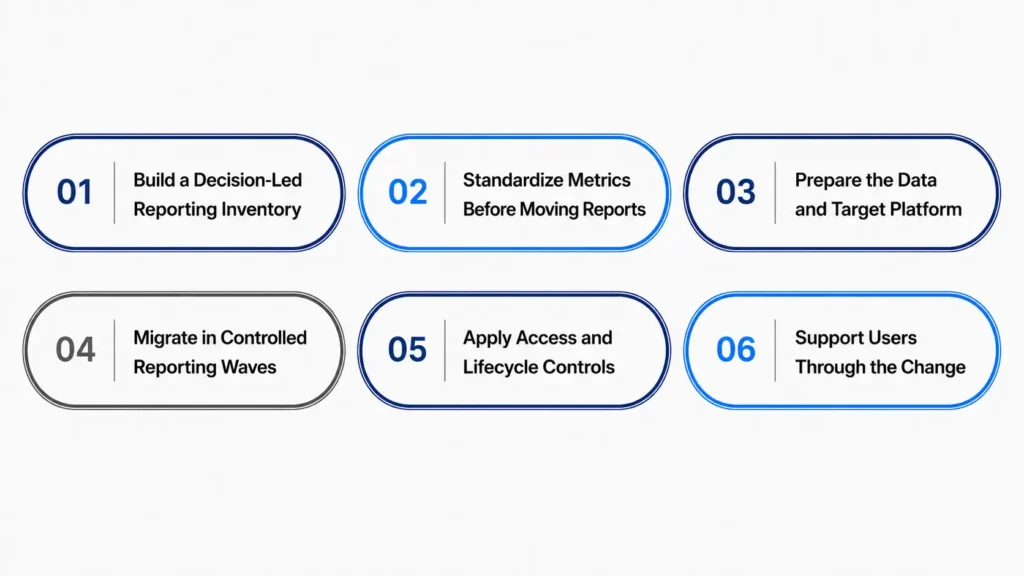
A governed BI modernization strategy reduces dashboard sprawl while preserving reports that support critical operations. It replaces scattered reporting with a governed, decision-led environment without forcing abrupt business change.
-
Build a Decision-Led Reporting Inventory
- Map dashboards to their users, source data, business decisions, owners, and operational dependencies.
- Classify assets as retain, redesign, consolidate, archive, or retire after business validation.
- Identify high-value reports that require additional safeguards during legacy BI migration.
-
Standardize Metrics Before Moving Reports
- Define enterprise measures with approved formulas, owners, refresh rules, and clear business context.
- Create a shared semantic layer that prevents conflicting KPI calculations across reporting teams.
- Use governed definitions to support consistent business intelligence modernization across departments.
-
Prepare the Data and Target Platform
- Resolve duplicate data, outdated transformations, and quality issues before dashboard migration begins.
- Align data models with enterprise reporting needs, not isolated departmental reporting preferences.
- Design the target environment to support scalable BI platform modernization over time.
-
Migrate in Controlled Reporting Waves
- Start with lower-risk dashboards to test migration methods, reconciliation processes, and user adoption.
- Run critical reports in parallel until users confirm outputs meet agreed business expectations.
- Use each migration wave to refine the wider dashboard consolidation strategy.
-
Apply Access and Lifecycle Controls
- Define access rules based on roles, data sensitivity, and the reporting responsibilities of each user.
- Assign clear ownership for dashboards, data products, and business-critical metric definitions.
- Retire unused content only after archive requirements and stakeholder approvals are complete.
-
Support Users Through the Change
- Explain why reports are changing and how consolidated dashboards improve decision confidence.
- Provide focused training for users moving from fragmented reporting to shared enterprise views.
- Monitor adoption and feedback after the enterprise BI upgrade goes live.
A successful enterprise BI modernization program does not simply reduce dashboard numbers. It gives leaders fewer places to look, stronger reasons to trust the numbers, and clearer paths to action.
How to Sustain BI Platform Modernization After Consolidation
BI platform modernization does not end when the last dashboard is published. It becomes durable when reporting has clear rules for ownership, change, quality, and reuse. Microsoft distinguishes business-led, managed self-service, and enterprise content models because each needs different governance responsibilities.
Govern Shared Data Products, Not Every Individual Report Request
The objective is not to remove self-service access for capable business users. It is to provide trusted data products, approved metric definitions, and safe room for exploration. Teams should understand when local analysis is appropriate within agreed reporting boundaries. They should also know when certified assets require reuse or new enterprise reports need review.
A workable operating model establishes three practical controls for shared enterprise reporting.
- Named owners for critical dashboards, semantic models, and business definitions across shared reporting domains.
- Certification routes for enterprise reporting assets and high-impact changes to established KPI calculations.
- Routine monitoring of usage, duplicate content, refresh failures, access patterns, and unresolved data-quality issues.
These controls make BI platform modernization practical for a growing enterprise across departments. Governance becomes a visible service protecting decision quality, rather than a central barrier to delivery. The best model creates standards that users can understand and follow without constant intervention.
How TxMinds Helps Enterprises Modernize BI Without Losing Reporting Trust
BI modernization is not successful because an enterprise has fewer dashboards. It is successful when leaders have a clearer, more reliable view of performance and can act without debating the numbers.
Dashboard consolidation, shared KPI definitions, governed semantic models, and clear ownership reduce reporting noise while protecting the continuity business teams need during change.
For enterprises, the goal is not simply a modern BI platform. It is trusted reporting that supports faster, better decisions at scale.
TxMinds helps enterprises turn fragmented reporting into a governed, decision-led BI environment built for clarity, control, and long-term reporting trust.

Rajiv Diwan
VP and Global Head Data & AI Practice
Results-oriented Data Analytics & AI Specialist with 24+ years of experience in multiple roles, including Practice Leader with P&L ownership. Expert in building Data Analytics practices, defining market strategies, and leading large-scale transformation initiatives. Skilled in Business Intelligence, Data Engineering, Cloud platforms (Azure, AWS, GCP), AI/ML, and Data Governance, with a strong focus on customer-centric solutions and strategic alliances.
FAQs
A strong BI modernization strategy starts by identifying duplicate, low-value, and unused dashboards. It then consolidates reporting around priority business decisions, shared KPI definitions, and governed data sources.
During legacy BI migration, enterprises should assess report dependencies, data quality, business ownership, security requirements, and critical reporting timelines. Running essential reports in parallel helps teams validate outputs before retiring older assets.
An enterprise BI upgrade often focuses on moving to a newer reporting tool or improving existing capabilities. BI platform modernization is broader because it also includes governance, reusable data models, access controls, lifecycle management, and scalable self-service analytics.
Discover more