


Recommended Blogs

Blog
AI in Insurance Underwriting: How Leading Insurers Are Transforming Risk Decisions
Table of Content
- Key Takeaways
- Why AI for Insurance Underwriting is Becoming a Competitive Mandate
- Where Insurance AI Use Cases Are Creating Real Underwriting Value
- Underwriting Automation AI: Freeing Underwriters for High-Stakes Judgment
- The Governance Imperative: Scaling AI Without Losing Trust, Control, or Explainability
- How TxMinds Helps Insurers Build Intelligent, Scalable Underwriting Systems
Share On


Insurance underwriting is facing a structural reset. Risk is moving faster than traditional review cycles, submission data is scattered, and customers expect decisions in days, not weeks. Hence, for insurance providers, it is mandate to make underwriting faster, more consistent, and more defensible without weaking risk discipline.
Underwriting research found that insurers expect AI and GenAI adoption in underwriting to rise from 14% 2025 to 70% within three years, based on a survey of 430 senior underwriting executives across life, commercial P&C, and personal P&C.
AI for insurance in underwriting enables enterprises to improve risk selection, reduce operational drag, and create a more scalable underwriting operational model.
Explore this blog to understand how leading insurers are using AI to transform underwriting decisions, where the highest-value insurance AI use cases are emerging, and what enterprise leaders must get right to scale underwriting automation AI with confidence.
Key Takeaways
- AI adoption in underwriting is expected to rise sharply, from 14% in 2025 to 70% within three years.
- Insurers are using AI to improve submission intake, data prefill, risk scoring, pricing support, and referral routing.
- Ineffective systems remain a major barrier, with 65% of executives identifying them as a top underwriting challenge.
- In one 2025 rollout, AI helped process 80% of submissions and saved about 60 minutes per submission.
Why AI for Insurance Underwriting is Becoming a Competitive Mandate
Underwriting still depends on actuarial models, underwriter judgment, historical loss data, and risk rules. But these foundations are under pressure. Risk data is more dynamic, underwriting teams are stretched, and enterprise growth increasingly depends on faster, more consistent decisions.
In many insurers, submission intake, appetite checks, pricing support, referral routing, and renewal reviews still involve manual steps across disconnected systems. This slows quote-to-bind cycles, creates decision inconsistency, and limits portfolio visibility.
Research on underwriting transformation found that 65% of executives identified ineffective systems as a top challenge.
For C-level leaders, this is not just an efficiency gap. It is a growth, profitability, and governance challenge. The table below show where AI creates a strategic advantage:
| Underwriting Challenge | AI-Enabled Advantage |
| Manual data intake | Faster submission ingestion and document extraction |
| Static rules | Adaptive risk models and decision support |
| Siloed systems | Connected underwriting intelligence |
| Slow broker response | Faster triage and quote readiness |
| Inconsistent reviews | Standardized appetite and referral logic |
| Limited profile view | Real-time exposure and profitability insights |
The strongest insurers will not use AI for insurance underwriting only to reduce cost. They will use it to create a risk intelligence layer across underwriting operations, actuarial collaboration, broker engagement, and portfolio steering.
Where Insurance AI Use Cases Are Creating Real Underwriting Value
The most valuable insurance AI use cases are already changing how insurers assess applications, evaluate risk, route submissions, price policies, and support underwriter judgment.
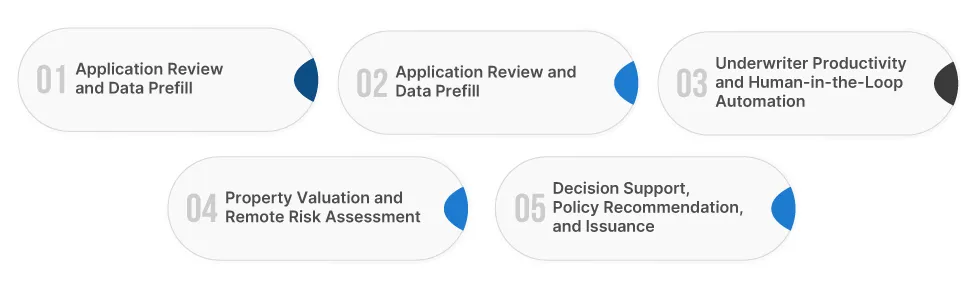
1. Application Review and Data Prefill
AI can review applications, extract missing fields, validate information, and prefill data using internal and third-party sources such as public records, historical claims, property databases, medical sources, and customer records. This reduces rekeying, improves data quality, and accelerates first-pass review.
Example: In life underwriting, agentic AI is being used to fetch applicant information, validate inputs, and trigger underwriting workflows through real-time data exchange, reducing manual intervention and operational bottlenecks.
2. Risk Scoring and Predictive Analytics
AI models can analyze historical claims, customer behavior, environmental data, financial indicators, telematics, and other exposure signals to generate dynamic risk scores. These scores help underwriters identify risk drivers earlier and support more accurate pricing, referral, and acceptance decisions.
Example: In life and health underwriting, AI-based “similar case” functionality can analyze prior underwriting decisions and compare them with a new referred case, helping underwriters make decisions faster and with greater confidence.
3. Underwriter Productivity and Human-in-the-Loop Automation
One of the most important uses of underwriting automation AI is not full automation. It is decision support. AI can summarize evidence, surface risk drivers, retrieve underwriting guidelines, highlight inconsistencies, and prepare referral notes. The underwriter remains accountable for the decision, but the review becomes faster, more structured, and more evidence led.
Example: A 2025 rollout for middle-market underwriters used generative AI to create underwriting narratives in minutes by distilling exposure data, loss runs, and risk reports into concise summaries. During the initial rollout, 80% of submissions handled by 16 underwriters were processed with AI assistance, saving an estimated average of 60 minutes per submission.
4. Property Valuation and Remote Risk Assessment
For property underwriting, AI can evaluate aerial imagery, satellite data, drone footage, geospatial data, and computer vision outputs to assess property condition and exposure. This helps insurers understand roof quality, structural risk, vegetation proximity, weather exposure, and other property-level risk indicators without relying only on physical inspections.
Example: In property underwriting, insurers are using AI to monitor changes in property conditions and external risk factors, then recommend renewal adjustments based on updated risk signals. This brings underwriting closer to continuous risk evaluation rather than one-time assessment.
5. Decision Support, Policy Recommendation, and Issuance
AI can support recommendations on coverage, limits, deductibles, exclusions, pricing bands, and referral decisions based on risk profile and underwriting appetite. For simpler risks, this can enable straight-through processing. For more complex cases, it can give underwriters a decision-ready view of the account.
Example: AI-driven underwriting workflows are using retrieval-augmented generation to retrieve underwriting guideline knowledge and machine learning to identify comparable historical insurance cases. This helps underwriters align new submissions with internal guidelines and prior decisions.
Underwriting Automation AI: Freeing Underwriters for High-Stakes Judgment
Underwriting automation AI is not about taking underwriting authority away from experienced professionals. It is about giving them a stronger operating model. In large insurance enterprises, underwriters still spend a significant amount of time on intake, data entry, document review, evidence collection, referral preparation, and administrative follow-ups.
This is where automation changes the equation. By automating repetitive and data-heavy activities, insurers can separate routine processing from strategic risk judgment. Low-complexity submissions can move faster through predefined underwriting rules and appetite checks, while complex commercial, life, health, specialty, or catastrophe-exposed risks can be routed to expert underwriters with better context, cleaner data, and stronger decision support.
In practice, underwriting automation AI helps insurers:
- Accelerate submission intake by reading broker emails, ACORD forms, PDFs, spreadsheets, loss runs, inspection reports, medical records, and financial documents.
- Reduce redundant data entry by extracting, validating, and pre-filling underwriting data across connected systems.
- Improve appetite alignment by checking submissions against underwriting guidelines, risk appetite, authority limits, exclusions, and referral rules.
- Enable smarter triage by classifying submissions based on risk complexity, completeness, premium potential, historical loss patterns, and required underwriter intervention.
- Support straight-through processing for low-risk or rules-based cases where the data is complete, the risk fits appetite, and confidence thresholds are met.
- Strengthen underwriter decision support by summarizing exposure details, identifying missing information, flagging inconsistencies, and preparing referral notes.
- Improve pricing discipline by surfacing relevant risk factors, comparable cases, claims history, and exposure indicators before quote generation.
- Create audit-ready records by documenting the data used, rules applied, recommendations generated, and human approvals captured during the underwriting process.
- Enable agentic workflows where AI can fetch applicant information, validate inputs, trigger underwriting steps, and reduce operational bottlenecks through real-time data exchange.
The goal is a more precise division of work where automation handles the repetitive, rules-based, and data-intensive tasks, while underwriters focus on complex judgment, portfolio quality, broker negotiation, pricing nuance, and risk selection.
The Governance Imperative: Scaling AI Without Losing Trust, Control, or Explainability
AI in underwriting will only scale when it can be completely trusted. Trust is an operating requirement across compliance, actuarial, underwriting, legal, security, broker management, and customer experience.
What C-level leaders must get right:
- Data readiness: AI needs clean, connected, governed data. Insurers must modernize data pipelines, standardize risk taxonomies, and resolve fragmentation across policy administration, claims, CRM, rating engines, document repositories, and external data providers.
- Explainability: Underwriters, regulators, brokers, and internal audit teams need to understand why a model flagged a risk, recommended a price, or escalated a case. Explainable AI is essential for defensible underwriting.
- Human-in-the-loop control: AI should support core decision-making, not remove accountability. Human oversight is especially important for high-value commercial accounts, adverse decisions, sensitive personal data, and regulated product lines.
- Bias and fairness monitoring: Models must be tested for unintended discrimination, proxy variables, historical bias, and adverse customer outcomes. Insurers need model validation, continuous monitoring, and clear escalation policies.
- Legacy integration: Large insurers cannot build AI in isolation from core systems. AI must connect with rating engines, policy administration, claims platforms, underwriting workbenches, data lakes, CRM systems, broker portals, and compliance systems.
- Security and privacy: Underwriting data may include medical records, financial information, property data, identity details, commercial records, and sensitive customer disclosures. AI architecture must address encryption, access control, data minimization, retention, and regulatory obligations.
AI success in underwriting depends more on enterprise readiness. The insurers that scale responsibly will build governance into the operating model from day one.
How TxMinds Helps Insurers Build Intelligent, Scalable Underwriting Systems
At TxMinds, we help insurers lead the next era of underwriting with AI-enabled automation, risk analytics, platform modernization, and compliance-ready delivery. We bring deep insurance technology expertise across Property & Casualty, Life & Annuity, Health, and General Insurance, helping enterprises modernize workflows, streamline operations, and improve underwriting precision.
We build AI for insurance underwriting solutions that strengthen risk assessment, automate submission workflows, improve pricing support, and create audit-ready decision trails. Our capabilities span underwriting automation AI, data engineering, cloud migration, legacy system modernization, quality engineering, governance, and ecosystem support.
TxMinds as a leader in insurance digital transformation, we focus on outcomes like faster decisions, lower leakage, stronger traceability, improved compliance, and scalable underwriting operations. We help insurers move from fragmented underwriting processes to intelligent, connected systems built for speed, control, and confident risk selection.

Yuvraj Singh
Associate Director
Yuvraj Singh is an accomplished Associate Director of Delivery, renowned for leading strategic quality assurance initiatives that consistently deliver outstanding software outcomes across global markets. With deep expertise in both Property & Casualty (P&C) and Life & Annuities (L&A) insurance domains, Yuvraj excels at bridging the gap between complex business objectives and flawless execution.
FAQs
What is AI for insurance underwriting?
AI for insurance underwriting uses machine learning, automation, and data analytics to help insurers assess risk, review submissions, support pricing decisions, and improve underwriting speed and consistency.
What are the top insurance AI use cases in underwriting?
Key insurance AI use cases include:
- Application review
- Data prefill
- Risk scoring
- Predictive analytics
- Referral routing
- Policy recommendations
- Remote property risk assessment.
How does underwriting automation AI help underwriters?
Underwriting automation AI reduces manual work by extracting data, checking appetite rules, summarizing risk details, and preparing referral notes so underwriters can focus on complex decisions.
Does AI replace human underwriters?
No. AI supports underwriters by improving speed, accuracy, and decision readiness, while human experts remain responsible for high-value, complex, and judgment-based underwriting decisions.
Discover more