Recommended Blogs

Blog
AI-Augmented Development: How Enterprises Can Build Software Faster Without Losing Control
Table of Content
- Key Takeaways
- What is Agentic AI? The Shift from Assistance to Action
- Why AI-Augmented Development is Now a C-Suite Priority
- Agentic AI Enterprise Use Cases Across the Software Development Lifecycle
- Building Faster Without Losing Control: The Enterprise AI Governance Framework
- How TxMinds Helps Enterprises Scale AI-Augmented Development with Confidence
Share On


Enterprise leaders are under pressure to deliver software at the speed of digital-native competitors while protecting governance, security, compliance, and shareholder trust. That tension is now reaching a breaking point. A MIT NANDA research report found that only 5% of enterprise generative AI initiatives achieve marked and sustained productivity or P&L impact, while most remain trapped in pilots that do not adapt to real workflows.
For C-level leaders, the question is no longer whether AI can accelerate development. The sharper question is: Can your enterprise move faster without creating new operational risk?
AI-augmented development offers that path. It brings intelligence into planning, coding, testing, deployment, and maintenance. But the real advantage comes when enterprises combine AI speed with human judgment, architectural discipline, and governance by design.
This is where the conversation moves from experimentation to enterprise transformation.
This blog explores what is agentic AI, its enterprise use cases, and how an AI agent for business automation can help enterprises build faster, while staying secure, governed, and in control.
Key Takeaways
- Only 5% of enterprise GenAI initiatives achieve sustained productivity or P&L impact.
- Agentic AI can plan, act, and support multi-step enterprise workflows.
- AI-augmented development accelerates requirements, coding, testing, DevSecOps, and modernization.
- Faster software delivery needs human oversight, auditability, security, and governance.
What is Agentic AI? The Shift from Assistance to Action
To understand AI-augmented development, leaders must first answer a foundational question: what is agentic AI?
Agentic AI refers to AI systems that can pursue goals, make decisions, plan tasks, use tools, and act with limited human supervision. Agentic AI is a system that accomplishes specific goals with limited supervision, often through coordinated AI agents performing subtasks.
In simple terms:
| Traditional Automation | Generative AI Assistant | Agentic AI |
| Follows fixed rules | Responds to prompts | Pursues goals |
| Works in predefined workflows | Generates content or code | Plans and executes multi-step tasks |
| Breaks when conditions change | Needs frequent human direction | Can adapt within guardrails |
| Best for repetitive tasks | Best for knowledge work support | Best for complex workflow orchestration |
For software development, this shift is significant. A coding assistant may suggest a function. An agentic AI system may review a backlog item, clarify requirements, generate code, create test cases, check dependencies, open a pull request, and flag compliance risks.
This does not remove human responsibility. It changes where human judgment is applied. Engineers move from writing every line manually to supervising systems, validating decisions, designing architectures, and handling exceptions.
Why AI-Augmented Development is Now a C-Suite Priority
AI-augmented development has moved beyond engineering experimentation. For enterprise leaders, it is now a strategic lever for speed, resilience, and operational control. The priority is not simply to generate more code. It is to redesign how software moves from business needs to production value.
Here is why AI-augmented development is becoming a C-suite priority:
1. Faster Software Delivery Without Expanding Complexity
- Shorter development cycles: AI can support teams in requirements analysis, code generation, testing, documentation, and release preparation, helping enterprises reduce delays across the software development lifecycle.
- Less manual engineering drag: Repetitive tasks such as test creation, code review support, documentation updates, and backlog refinement can be accelerated, allowing senior engineers to focus on architecture, risk, and innovation.
- Better use of existing talent: Instead of relying only on headcount growth, enterprises can improve engineering throughput by augmenting current teams with intelligent development workflows.
2. Stronger Competitive Positioning
- Faster response to market change: Enterprises can move from idea to implementation more quickly, helping leadership respond to customer needs, regulatory changes, and competitive pressure with greater confidence.
- More room for innovation: When AI reduces repetitive delivery work, technology teams can spend more time building differentiated digital products and less time maintaining slow, manual processes.
- Enterprise-wide acceleration: AI-augmented development not only benefits IT. It can improve how business, product, compliance, security, and engineering teams collaborate around software outcomes.
3. Modernization of Legacy Systems
- Reduced dependency on institutional knowledge: AI can help analyze legacy code, summarize business logic, map dependencies, and support documentation where knowledge is fragmented or outdated.
- Lower modernization friction: Enterprises can use AI to support refactoring, migration planning, API creation, and technical debt analysis without pausing critical business operations.
- Continuous modernization: Instead of treating modernization as a large, disruptive program, AI-augmented development allows enterprises to modernize incrementally and with stronger visibility.
4. Better Governance, Risk, and Control
- Earlier risk detection: AI can help identify security, compliance, performance, and quality issues earlier in the development lifecycle, before they become expensive production problems.
- Improved auditability: With the right controls, AI-assisted workflows can create clearer records of decisions, code changes, approvals, and testing activity.
- Controlled adoption of agentic AI: As enterprises explore agentic AI enterprise use cases, C-level leaders must ensure that AI agents operate within defined permissions, approval flows, and enterprise policies.
5. A Shift from Coding Support to Intelligent Orchestration
- Beyond developer copilots: AI-augmented development is not limited to code suggestions. It can coordinate tasks across planning, development, testing, DevOps, documentation, and business workflows.
- Connected software operations: An AI agent for business automation can help link business requirements, engineering tickets, compliance checks, release workflows, and reporting into a more unified operating model.
- Strategic technology leadership: For the C-suite, the opportunity is to build an enterprise where AI does not just assist teams, but helps orchestrate software delivery with speed, discipline, and control.
Agentic AI Enterprise Use Cases Across the Software Development Lifecycle
The strongest agentic AI enterprise use cases emerge where software delivery depends on repeated decisions, cross-functional coordination, and large volumes of technical and business context. This is where agentic AI moves beyond simple code assistance and begins to support the full software development lifecycle.
For executives asking what is agentic AI in practical enterprise terms, the answer is: it is AI that can plan, act, check outcomes, and move work forward across connected systems, under defined human and governance controls.
Key Agentic AI Use Cases Across the SDLC:
1. Planning and Requirements Analysis:
AI agents can review business requirements, customer feedback, product documents, compliance inputs, and historical tickets to create clearer user stories, acceptance criteria, risk flags, and project plans. This helps reduce ambiguity before engineering work begins.
2. Architecture and Solution Design:
Agentic AI can support architects by comparing design options, identifying system dependencies, mapping integration risks, and generating early architecture documentation. It can also help evaluate whether a proposed solution aligns with enterprise standards, security rules, and scalability needs.
3. Code Generation and Development:
AI agents can assist developers with boilerplate code, feature implementation, code refactoring, API creation, and framework upgrades. In mature environments, agents can work within approved repositories and coding standards, while human engineers review and approve critical changes.
4. Automated Testing and Quality Engineering:
Agentic AI can generate test cases from requirements, create regression suites, prioritize high-risk test areas, analyze failed builds, and suggest probable defect causes. This makes quality engineering more proactive and helps enterprises release software with greater confidence.
5. DevSecOps and Deployment Readiness:
AI agents can monitor CI/CD pipelines, review security scan results, check release dependencies, summarize deployment risks, and recommend whether a release is ready, blocked, or needs human intervention. This supports faster delivery without weakening control.
6. Legacy Modernization and Maintenance:
Many enterprises still depend on complex legacy systems. Agentic AI can analyze old codebases, infer business logic, detect dependencies, create documentation, support refactoring, and help teams plan modernization in smaller, safer increments.
7. AI Agent for Business Automation:
An AI agent for business automation can connect software delivery with enterprise operations. For example, it can turn a new regulatory requirement into impact analysis, engineering tickets, test scenarios, approval workflows, and progress reports. This helps business, technology, compliance, and operations teams work from the same source of truth.
Agentic AI allows enterprises to connect planning, development, testing, deployment, and business workflows into a faster and more controlled operating model.
Building Faster Without Losing Control: The Enterprise AI Governance Framework
Building faster with AI does not mean giving AI unrestricted access to enterprise code, data, or decisions. For large organizations, speed must sit inside a clear control model. Without it, AI-augmented development can create shadow workflows, weak accountability, compliance gaps, and quality risks.
Core Pillars of an Enterprise AI Governance Framework:
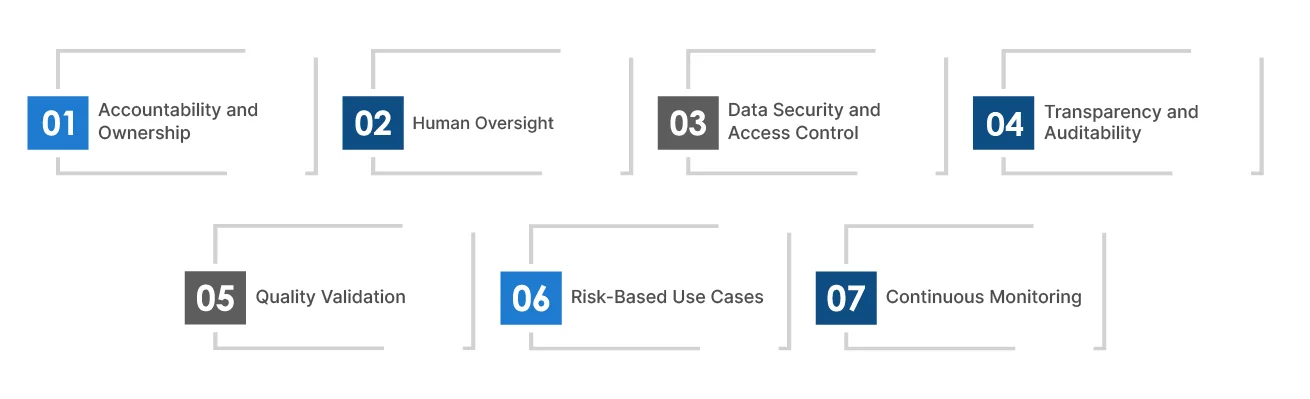
- Accountability and Ownership:
Define who owns AI-assisted workflows, who approves outputs, and who is responsible when an AI agent takes action.
- Human Oversight:
Keep expert review for high-impact decisions such as production deployments, architecture changes, security exceptions, and major refactoring.
- Data Security and Access Control:
Limit what AI agents can read, write, modify, or share through role-based permissions and approved data sources.
- Transparency and Auditability:
Track every AI-assisted action, including what the agent did, what data it used, and who approved the final outcome.
- Quality Validation:
Apply the same engineering standards to AI-generated outputs, including code review, automated testing, security scans, and architecture checks.
- Risk-Based Use Cases:
Classify AI use cases by business impact, data sensitivity, and operational risk before scaling them.
- Continuous Monitoring:
Monitor AI agents for errors, drift, misuse, and unexpected behavior as adoption grows.
How TxMinds Helps Enterprises Scale AI-Augmented Development with Confidence
At TxMinds, we help enterprises move from AI experimentation to production-ready transformation. We design and build generative AI solutions that support real business workflows, from custom Gen AI development and agentic AI systems to AI-powered automation, RAG pipelines, enterprise data integration, and responsible AI governance.
We build autonomous, multi-agent systems with tools, memory, and goals, enabling workflows that can think, adapt, and act within defined enterprise guardrails. We also help teams automate code generation, documentation, reporting, test automation, and legacy system modernization, so software delivery becomes faster, smarter, and more scalable.
Our approach combines innovation with control. We embed monitoring, governance, compliance, and transparency from the start, helping enterprises adopt AI-augmented development without compromising trust. With TxMinds, organizations can turn agentic AI into measurable business value while keeping software delivery secure, governed, and enterprise-ready.

Amar Jamadhiar
VP, Delivery North America
Amar Jamadhiar is the Vice President of Delivery for TxMind's North America region, driving innovation and strategic partnerships. With over 30 years of experience, he has played a key role in forging alliances with UiPath, Tricentis, AccelQ, and others. His expertise helps Tx explore AI, ML, and data engineering advancements.
FAQs
What is agentic AI in enterprise software development?
-
Agentic AI is an AI system that can plan, act, use tools, and complete multi-step tasks with limited human supervision. In software development, it can support requirements analysis, coding, testing, documentation, and deployment workflows.
What are common agentic AI enterprise use cases?
-
Common agentic AI enterprise use cases include code generation, test automation, legacy modernization, DevSecOps support, requirements analysis, compliance checks, and release readiness reviews.
How can an AI agent for business automation help enterprises?
-
An AI agent for business automation can connect business and technology workflows by turning requests, compliance updates, or operational needs into tasks, approvals, reports, and follow-ups across enterprise systems.
How can enterprises adopt agentic AI without losing control?
-
Enterprises should use clear governance, human oversight, role-based access, audit trails, quality validation, and continuous monitoring to ensure agentic AI works within approved business and security boundaries.
Discover more