Every enterprise has a version of the same story. Workflows automated years ago now feel fragile. Bots break the moment an exception appears. Decisions that should take seconds still wait on a human. The gap between the promise of digital transformation and daily operational reality keeps widening.
Agentic AI goes beyond automation. It is systems that think, decide, and act on their own to get things done powered by Gen AI Development that enables real reasoning, not just rule execution.
This blog will explore why traditional automation is breaking down, how Agentic AI works, the use cases delivering real results, a practical implementation roadmap, and how TxMinds helps enterprises make this transformation happen.
Key Takeaways
AI agents in enterprise apps are expected to jump from <5% in 2025 to 40% by 2026.
Traditional automation breaks when workflows need context, judgment, or exception handling.
Agentic AI can plan, decide, and act across enterprise systems with limited human input.
Key use cases include support, supply chain, IT, finance, sales, and marketing.
The Automation Ceiling: Why Traditional Workflows Are Breaking Down
Enterprise automation has delivered significant gains over the past decade, helping organizations reduce manual effort, standardize processes, and improve operational speed. However, many traditional automation models are now reaching their limits. Rule-based workflows, robotic process automation, and scripted process flows work well when tasks are predictable, inputs are structured, and exceptions are minimal. But modern enterprise operations are rarely that simple.
Business teams now operate across multiple systems, handle large volumes of unstructured data, respond to changing customer expectations, and make decisions that depend on context, judgment, and real-time information. As a result, many workflows that appear automated still require constant human intervention to manage exceptions, validate outputs, transfer data between systems, or make decisions that rigid automation cannot handle.
Key reasons traditional automation is breaking down include:
1. Rigid rule-based logic: Traditional workflows follow fixed instructions and often fail when scenarios deviate from predefined rules.
2. Limited contextual understanding: Legacy automation can process data, but it cannot always interpret intent, business context, or changing priorities.
3. Dependence on structured data: Many enterprise processes involve emails, documents, tickets, chat messages, contracts, and reports that do not fit neatly into fixed formats.
4. High exception handling effort: When workflows encounter missing information, unusual requests, or process variations, human teams must step in.
5. Fragmented system execution: Employees still spend time moving information across ERP, CRM, HRMS, ITSM, finance, and customer support platforms.
6. Limited decision-making capability: Traditional automation can execute tasks, but it cannot reason, plan, prioritize, or adapt independently.
7.Difficulty scaling end-to-end automation: Enterprises often automate isolated steps, but struggle to connect them into seamless, intelligent business processes.
The next phase of enterprise automation must move beyond task execution and toward systems that can understand, decide, act, and improve continuously. This is where agentic AI becomes a critical enabler of intelligent workflow transformation.
What is Agentic AI? How it Works in Enterprise Environments
Agentic AI refers to a new class of intelligent systems that can pursue business goals, interpret context, plan actions, and execute multi-step tasks across enterprise applications with limited human intervention. Unlike traditional automation, which follows predefined rules, or generative AI, which usually responds to a prompt, agentic AI is designed to act. Enterprises investing in Agentic AI Services today are building the operational foundation for the next decade of intelligent workflow management.
It can understand a request, break it into smaller tasks, choose the right tools, interact with APIs or databases, complete actions in business systems, and adjust its approach based on outcomes. In an enterprise environment, this makes agentic AI especially valuable for complex workflows that span CRM, ERP, ITSM, HRMS, finance, supply chain, customer service, and knowledge management platforms.
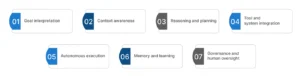
In enterprise workflows, agentic AI typically works through the following capabilities:
Goal interpretation: The system understands the business objective behind a user request, event, or trigger rather than treating it as a single isolated command.
Context awareness: Agents gather relevant information from enterprise systems, documents, databases, emails, tickets, and previous interactions to understand the situation before acting.
Reasoning and planning: Instead of executing one fixed rule, the agent determines the sequence of steps required to complete the task, including dependencies, approvals, and exception paths.
Tool and system integration: Agentic AI connects with APIs, workflow engines, SaaS platforms, databases, and internal applications to retrieve information, update records, trigger actions, or complete transactions.
Autonomous execution: Once the plan is defined, agents can carry out approved steps across systems, such as creating tickets, sending notifications, generating reports, checking order status, or escalating unresolved issues.
Memory and learning: Agents can use short-term context and historical data to maintain continuity, personalize responses, avoid repeated errors, and improve workflow performance over time.
Governance and human oversight: Enterprise-grade agentic AI operates within role-based access, approval workflows, audit trails, compliance controls, and human-in-the-loop checkpoints for high-risk decisions.
This is what makes agentic AI different from traditional automation: it can understand context, plan actions, execute tasks, and adapt within governed enterprise workflows. It acts as an intelligent layer connecting people, systems, and processes.
Top Enterprise Use Cases for Agentic AI Automation (With Real-World Examples)
Agentic AI is most valuable in enterprise environments where work is repetitive but not always predictable. These systems can manage multi-step workflows, gather context from different applications, take approved actions, and involve employees only when judgment or escalation is required. Instead of automating one task at a time, enterprises can use agentic systems to connect decisions, data, and execution across departments.
1. Customer Service and Support Automation
Customer support teams often deal with high ticket volumes, repeated queries, refund requests, order updates, complaint handling, and service escalations. Agentic AI can analyze the customer’s issue, check order history, retrieve policy information, update CRM records, generate responses, and route complex cases to the right team.
Example: in telecom, banking, insurance, and eCommerce, agentic workflows can help resolve billing questions, service requests, and account updates faster. This reduces average resolution time while allowing human agents to focus on sensitive or high-value conversations.
2. Supply Chain and Inventory Management
Supply chain operations depend on constant coordination between demand forecasts, warehouse stock, supplier timelines, procurement systems, and logistics platforms. Traditional automation can send alerts, but agentic AI can go further by monitoring demand signals, identifying inventory risks, recommending replenishment, checking supplier availability, and initiating purchase workflows.
Example: For enterprises in retail, manufacturing, and distribution, this can help prevent stockouts, reduce overstocking, improve vendor coordination, and respond faster to disruptions. The value lies in moving from reactive supply chain management to proactive, context-aware operations.
3. IT Operations and Service Management
IT teams manage password resets, access requests, incident tickets, system alerts, device issues, software approvals, and infrastructure monitoring. Many of these workflows require checking multiple systems before taking action. Agentic AI can classify incidents, diagnose recurring issues, run approved remediation steps, update ITSM tickets, notify affected users, and escalate unresolved problems.
Example: This is especially useful for enterprises managing hybrid infrastructure, cloud platforms, internal applications, and large employee bases. It helps reduce ticket backlog, shorten downtime, and improve employee experience without overloading IT support teams.
4. Finance and Back-Office Process Automation
Finance teams handle invoice validation, expense approvals, payment follow-ups, reconciliation, procurement requests, and compliance documentation. These processes are often slowed down by missing information, manual checks, and cross-system dependencies. Agentic AI can review invoices, match them with purchase orders, flag anomalies, extract data from documents, update ERP systems, and route approvals based on business rules.
Example: In large enterprises, this can improve cash flow visibility, reduce processing delays, and lower the risk of manual errors. It also gives finance teams more time for analysis, forecasting, and strategic decision-making.
5. Sales and Marketing Workflow Optimization
Sales and marketing teams work across CRM platforms, campaign tools, lead databases, email systems, analytics dashboards, and customer engagement platforms. Agentic AI can qualify leads, enrich account data, recommend next-best actions, personalize outreach, schedule follow-ups, update CRM records, and analyze campaign performance.
Example: For B2B enterprises, this creates a more connected revenue workflow. Sales teams can spend less time on administrative updates and more time building relationships, while marketing teams can respond faster to customer behavior and market signals.
Together, these use cases show how agentic AI can move enterprise automation beyond simple task completion. It enables intelligent workflows that sense what is happening, decide the next best step, and act across systems with the right level of human oversight.
How to Implement Agentic AI in Your Enterprise: A Practical Roadmap
Implementing agentic AI requires a structured roadmap, not a plug-and-play approach. Enterprises should begin with focused, low-risk workflows, ensure data and system readiness, define governance controls, and measure results before scaling across departments.
1. Identify the Right Workflow
Start by selecting processes that are repetitive, high-volume, and dependent on multiple systems, but not too risky for an initial rollout. Good starting points include customer support triage, IT ticket handling, invoice validation, employee onboarding, procurement requests, report generation, and CRM updates.
The ideal first use case should have:
Clear business impact
Defined inputs and outputs
Measurable success metrics
Frequent manual intervention
Low compliance or financial risk
Existing digital systems and process documentation
Avoid starting with workflows that involve sensitive decisions, unclear ownership, poor data quality, or heavy regulatory exposure.
2. Map the Workflow and Define Decision Boundaries
Before building agents, document how the process currently works. Identify every step, system, decision point, approval requirement, escalation path, and exception scenario. This helps define what the agent can do independently and where human review is required.
For example, an agent may be allowed to classify a support ticket, retrieve customer details, suggest a response, and update the ticket status. But refund approval, contract changes, or legal escalations may still require a human decision.
3. Prepare Enterprise Data and System Access
Agentic AI performs best when it can access reliable enterprise data. This may include CRM records, ERP data, ticket history, product documentation, policies, invoices, knowledge bases, emails, and internal SOPs.
Enterprises should focus on:
Cleaning and organizing key data sources
Creating secure API access to business systems
Connecting knowledge bases and document repositories
Defining user permissions and role-based access
Ensuring data privacy and compliance controls
Without strong data and integration foundations, agentic workflows will remain limited.
4. Build Governance from Day One
Governance should not be added after deployment. It should be part of the design. Enterprises need clear policies for access control, audit trails, approval workflows, performance monitoring, exception handling, and accountability.
A practical governance model should answer:
What actions can the agent take?
Which systems can it access?
When does it need human approval?
Who owns the workflow outcome?
How are decisions logged and reviewed?
What happens when the agent fails or produces an incorrect result?
This ensures agentic automation remains secure, explainable, and aligned with business rules.
5. Run a Controlled Pilot
Start with a sandbox or limited production environment. Choose one department, one workflow, and one measurable goal. For example, reduce support ticket resolution time, improve invoice processing speed, or cut manual CRM updates.
Track metrics such as accuracy, completion rate, escalation rate, processing time, user adoption, cost savings, and error reduction. The pilot should validate both business value and operational reliability.
6. Scale Gradually Across Teams and Systems
Once the pilot is stable, expand to adjacent workflows. A support agent may connect with a billing agent. An IT ticketing agent may connect with identity management tools. A procurement agent may connect with finance approvals and supplier systems.
At this stage, enterprises can move from single-agent workflows to multi-agent orchestration, where specialized agents coordinate across departments to complete larger processes.
7. Train Teams for the New Operating Model
Successful implementation also depends on people. Employees need to understand how to supervise agents, review exceptions, interpret outputs, and improve workflows over time. The goal is not to remove human expertise, but to shift teams from manual execution to higher-value oversight, decision-making, and process improvement.
Why TxMinds is the Enterprise Partner Built for Agentic AI Transformation
At TxMinds, we help enterprises move beyond isolated automation and build intelligent, scalable systems that are ready for real-world business environments. Agentic AI requires more than model development. It needs the right strategy, secure architecture, enterprise data readiness, workflow integration, governance, testing, and long-term operational support.
We bring these capabilities together through our end-to-end AI development services, covering AI advisory, AI model development, generative AI, Agentic AI Service, Gen AI Development, AI testing, QA, MLOps, and lifecycle management alongside Application Modernization to ensure legacy systems are ready to support intelligent, agent-driven workflows.
Using technologies such as LLMs, RAG, MCPs, and agent-to-agent frameworks, we help enterprises create goal-oriented systems that can adapt to changing business needs. With responsible AI practices and agile delivery, we enable organizations to transform static workflows into intelligent, governed automation ecosystems.
Amar Jamadhiar is the Vice President of Delivery for TxMind's North America region, driving innovation and strategic partnerships. With over 30 years of experience, he has played a key role in forging alliances with UiPath, Tricentis, AccelQ, and others. His expertise helps Tx explore AI, ML, and data engineering advancements.
FAQs
What is agentic AI in enterprise automation?
Agentic AI refers to AI systems that can understand goals, plan actions, make decisions, and execute tasks across enterprise workflows with limited human intervention.
How is agentic AI different from traditional automation?
Traditional automation follows fixed rules, while agentic AI can understand context, handle exceptions, adapt to changing inputs, and complete multi-step workflows.
What are the top enterprise use cases for agentic AI?
Key use cases include customer support automation, IT service management, finance process automation, supply chain management, and sales workflow optimization.
How can enterprises implement agentic AI successfully?
Enterprises should start with a low-risk, high-volume workflow, prepare reliable data and system access, define governance controls, run a pilot, and scale gradually.