Recommended Blogs

Blog
Infrastructure as Code (IaC): The Blueprint for Resilient, Cost-Effective IT
Table of Content
- What Is Infrastructure as Code (IaC) and Why it Matters for Modern IT
- How IaC Builds Resilient, Consistent, and Scalable Infrastructure
- IaC for Cost Optimization and Faster IT Operations
- Infrastructure as Code Best Practices for Security, Compliance, and Control
- How TxMinds Helps Enterprises Adopt Infrastructure as Code with Confidence
Share On


Modern IT infrastructure must do more than keep systems running. It needs to support growth, respond quickly to change, and do all of that without driving up costs or increasing operational risk. Yet many enterprises still depend on manual provisioning and disconnected processes that make infrastructure harder to manage, scale, and recover. As environments become more distributed and business demands keep rising, that approach becomes difficult to sustain.
A report found that cost issues are the top management concern, with 38% of business leaders saying they are very concerned and another 38% somewhat concerned. The same report also shows that forecasting future data center capacity requirements is also a growing concern, highlighting how difficult it has become to balance resilience, efficiency, and scale in today’s IT landscape.
This is where Infrastructure as Code (IaC) plays a key role. By managing infrastructure through code, organizations can bring greater consistency, scalability, resilience, and cost control to their IT operations. Instead of relying on repetitive manual effort, teams can standardize provisioning, reduce configuration drift, and build a stronger foundation for long-term growth.
This blog explores how IaC helps enterprises create resilient, cost-effective IT environments and why it has become a critical part of modern infrastructure strategy.
Key Takeaways
- IaC replaces manual setup with code to improve consistency, scalability, resilience, and cost control.
- Cost is a major concern, with 38% of leaders very concerned and another 38% somewhat concerned.
- The IaC market is expected to grow from USD 0.8 billion in 2022 to USD 2.3 billion by 2027.
- IaC reduces drift, speeds provisioning, lowers error costs, and makes infrastructure easier to scale.
What Is Infrastructure as Code (IaC) and Why it Matters for Modern IT
Infrastructure as Code, or IaC, is a way of managing IT infrastructure through code instead of setting everything up manually. In practice, that means servers, networks, storage, and other infrastructure components can be defined in configuration files and deployed in a consistent, repeatable way. Instead of depending on manual setup, ticket-based requests, or one-off console changes, teams can automate how infrastructure is created and maintained.
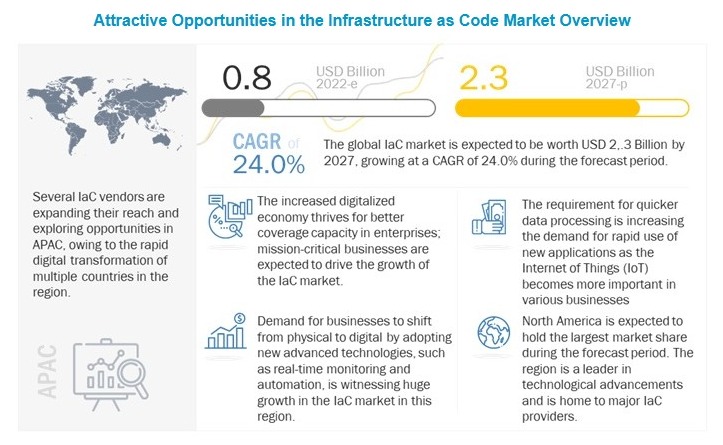
According to MarketsandMarkets, the global Infrastructure as Code market was valued at USD 0.8 billion in 2022 and is expected to reach USD 2.3 billion by 2027, growing at a CAGR of 24.0%.
Why it Matters for Modern IT
- It helps teams maintain consistency across environments, so development, testing, and production are less likely to drift apart.
- It reduces manual work, which saves time and lowers the chances of avoidable errors.
- It makes provisioning faster, allowing teams to respond more quickly to changing business and application needs.
- It improves operational efficiency by replacing repetitive setup tasks with automated, repeatable processes.
- It gives organizations a stronger base for cloud adoption and modernization, especially as infrastructure becomes more complex.
- It makes infrastructure easier to scale, manage, and control as business demands grow.
How IaC Builds Resilient, Consistent, and Scalable Infrastructure
As IT environments grow more complex, maintaining resilience and consistency becomes harder through manual processes alone. Infrastructure as Code (IaC) helps bring structure, repeatability, and control to infrastructure management.

1. Reduces Configuration Drift
One of the most common infrastructure issues is configuration drift. This happens when environments start to differ over time because of manual changes, quick fixes, or inconsistent updates.
Infrastructure as Code (IaC) helps avoid that by defining infrastructure in code and deploying it in the same way each time. This keeps environments better aligned and reduces the chances of issues showing up later during testing or production.
2. Improves IT Resilience
A resilient IT setup is one that can handle change and recover quickly when something goes wrong. IaC supports that by making infrastructure easier to rebuild, restore, and manage.
When systems are defined in code, teams do not have to rely on scattered documentation or manual steps to recreate an environment. This can make recovery more straightforward during outages, migrations, or other unexpected events.
3. Brings Consistency Across Environments
As businesses work across cloud, hybrid, and on-premises environments, keeping everything consistent becomes more difficult. Even small differences between environments can lead to larger operational problems.
IaC brings more consistency by standardizing how infrastructure is provisioned and maintained. This helps teams work with a setup that is more predictable, easier to manage, and less likely to create avoidable issues.
4. Makes Infrastructure Easier to Scale
Manual provisioning may be manageable in smaller setups, but it becomes harder to handle as infrastructure grows. Adding more applications, services, and environments can quickly increase complexity.
IaC makes scaling easier by using reusable templates and automated workflows. Instead of building everything from scratch, teams can roll out infrastructure faster and in a more controlled way.
5. Supports Better Change Management
Infrastructure changes often create problems when they are made without enough visibility or review. A manual change that seems minor can have a much bigger impact later.
With IaC, changes can be written, reviewed, tested, and tracked before they are applied. This gives teams more control over updates and makes it easier to understand what changed and why.
IaC for Cost Optimization and Faster IT Operations
Managing infrastructure manually often costs more than it seems. It takes time, creates extra work for teams, and increases the chances of mistakes that lead to delays or rework. Infrastructure as Code (IaC) helps simplify that by making infrastructure setup and management more structured, repeatable, and efficient.
1. Reduces Manual Work
A lot of infrastructure work is repetitive by nature. Setting up environments, making routine changes, and fixing inconsistencies can take up valuable time for IT and engineering teams.
IaC helps reduce that workload by automating how infrastructure is provisioned and managed. Once the right templates and configurations are in place, teams can spend less time on manual tasks and more time on work that adds real value.
2. Speeds Up Provisioning
Infrastructure delays can slow down everything around them, from development and testing to deployment and release planning. When teams have to wait for environments to be created manually, momentum is often lost.
With IaC, environments can be provisioned much faster because the setup is already defined in code. This helps teams move more quickly and keeps projects from getting held up by avoidable operational delays.
3. Lowers the Cost of Errors
Manual processes leave more room for small mistakes, and those mistakes can become expensive. A wrong setting, a missed step, or an inconsistent environment can easily lead to troubleshooting, rollback work, or downtime.
IaC helps reduce those risks by making deployments more consistent. When infrastructure is created the same way each time, teams are less likely to deal with avoidable errors and the extra cost that comes with fixing them.
4. Brings More Standardization
As infrastructure grows, it can become difficult to keep everything organized. Different teams may follow different practices, which often leads to duplication, unused resources, and unnecessary complexity.
IaC brings more order to the process by using standard templates and approved configurations. This makes infrastructure easier to manage and helps avoid waste caused by scattered or inconsistent setups.
5. Improves Day-to-Day Efficiency
When infrastructure is easier to create, update, and maintain, operations run more smoothly. Teams can respond faster, work more consistently, and spend less time dealing with repetitive issues.
Over time, that creates a more efficient operating model. Instead of constantly reacting to infrastructure problems, teams can focus on improving systems and supporting the broader goals of the business.
Infrastructure as Code Best Practices for Security, Compliance, and Control
As organizations adopt Infrastructure as Code (IaC) at scale, speed alone is not enough. The real value comes from using it in a way that keeps infrastructure secure, consistent, and easy to govern. That is where a few core practices make a real difference.
| Best Practices | Why it Matters |
| Use version control for infrastructure code | Infrastructure changes should be tracked properly, just like application code. This makes it easier to review updates, understand what changed, and go back to a stable version if needed. |
| Review and test changes before deployment | Even a small infrastructure change can create unexpected issues. A proper review and testing process helps teams catch problems early and avoid unnecessary disruption later. |
| Keep secrets out of code files | Passwords, access keys, and tokens should not be stored directly in infrastructure code. Using secure secret management practices helps reduce exposure and strengthens overall security. |
| Standardize templates and configurations | Reusable templates bring more consistency to the environment. They help teams avoid ad hoc setups and make infrastructure easier to manage across projects and teams. |
| Set clear policies and access controls | As environments grow, governance becomes harder to manage informally. Defined policies and controlled access help ensure that infrastructure changes follow the right standards. |
| Maintain a clear record of changes | A visible history of infrastructure updates is useful for both compliance and day-to-day operations. It makes troubleshooting easier and helps teams stay accountable. |
A visible history of infrastructure updates is useful for both compliance and day-to-day operations. It makes troubleshooting easier and helps teams stay accountable.
How TxMinds Helps Enterprises Adopt Infrastructure as Code with Confidence
At TxMinds, we help enterprises turn Infrastructure as Code (IaC) into a practical, secure, and scalable part of their delivery model. Our focus is not only on automating infrastructure provisioning, but on building a stronger DevSecOps foundation around it. We implement IaC using tools such as Terraform, AWS CloudFormation, and Ansible to improve environment consistency, speed up setup, and support rollback when changes need to be reversed.
We also connect IaC with the broader practices that make it effective at scale. That includes CI/CD automation, GitOps, continuous monitoring, vulnerability assessment, and policy-driven governance. Our DevSecOps implementation services are designed to reduce manual dependencies, improve visibility across delivery pipelines, and bring better control to multi-cloud infrastructure, compliance, and disaster recovery readiness.
In short, we help enterprises adopt infrastructure automation in a way that strengthens security, supports faster delivery, and keeps operations easier to manage as the business grows.


Amar Jamadhiar
VP, Delivery North America
Amar Jamadhiar is the Vice President of Delivery for TxMind's North America region, driving innovation and strategic partnerships. With over 30 years of experience, he has played a key role in forging alliances with UiPath, Tricentis, AccelQ, and others. His expertise helps Tx explore AI, ML, and data engineering advancements.
FAQs
What is Infrastructure as Code (IaC)?
-
IaC is the practice of managing and provisioning infrastructure such as servers, networks, and storage through code instead of manual setup.
How does IaC improve infrastructure consistency and resilience?
-
IaC reduces configuration drift, standardizes environments, and makes infrastructure easier to rebuild and recover during outages or changes.
How does IaC help with cost optimization and operational efficiency?
-
IaC lowers manual effort, speeds up provisioning, reduces costly errors, and improves day-to-day infrastructure efficiency.
What are the best practices for secure and compliant IaC adoption?
-
Key practices include version control, testing changes before deployment, keeping secrets out of code, standardizing templates, and enforcing policies and access controls.
Discover more