


Recommended Blogs

Blog
DevSecOps in 2026: The Strategic Path to Building and Scaling Security Maturity
Table of Content
- DevSecOps in 2026: From Practice to Strategic Imperative
- The Core Pillars of Modern DevSecOps
- Understanding DevSecOps Maturity: The 5-Level Evolution
- How to Build a Scalable DevSecOps Maturity Roadmap
- How TxMinds Enables DevSecOps Maturity at Scale
Share On


Are you still treating DevSecOps as just a way of embedding security checks into an existing pipeline? If yes, it can severely harm your business growth.
DevSecOps has become a strategic capability that determines how fast enterprises can safely ship AI-native and cloud-first software at scale. Industry data shows why this is critical in 2026. The global market DevSecOps market is expected to reach more than 37 billion by 2035.
It will be driven by the twin pressure of escalating cyberattacks and the need to secure increasingly complex cloud-native architectures.
This blog explores the core pillars of modern DevSecOps and how enterprises can build a scalable maturity roadmap.
Key Takeaways
- DevSecOps has evolved into a strategic business capability in 2026, with the global market projected to exceed $37 billion by 2035.
- Modern DevSecOps shifts security left by enforcing real-time controls like policy-as-code, helping teams keep MTTR under 7 days and block 95% of critical vulnerabilities before production.
- Strong DevSecOps runs on six pillars: culture, shift-left security, automation, compliance, secure coding, and monitoring.
- DevSecOps maturity grows across 5 levels and 4 phases, from reactive fixes to secure-by-design delivery.
DevSecOps in 2026: From Practice to Strategic Imperative
Security integration starts early in code commit and not on deployment day. Modern enterprises ship AI-native apps across Kubernetes clusters, serverless functions, and multi-cloud GitOps pipelines where every layer expose risk.
Three critical shifts define DevSecOps in 2026:
- Risk moves continuous: Policy-as-code engines like Open Policy Agent (OPA) score PRs and Terraform plans in real time, blocking non-compliant changes before they hit CI.
- Ownership goes shared: Development, security, and platform teams align on unified KPIs. Mean Time to Remediate (MTTR) stays under 7 days. They block 95% critical vulnerabilities for pre-production.
- Design turns proactive: Secure-by-default templates, signed OCI images via Cosign, and SLSA Level 3 supply chain controls let squads innovate without accumulating tech debt.
DevSecOps isn’t tooling. It is engineering discipline that turns security into a velocity multiplier. Boards now track it alongside revenue growth.
The Core Pillars of Modern DevSecOps
DevSecOps pillars interlock tooling, process, and culture. Even when the business skip one, gaps appear at scale.
Here are the six key pillars of modern DevSecOps:
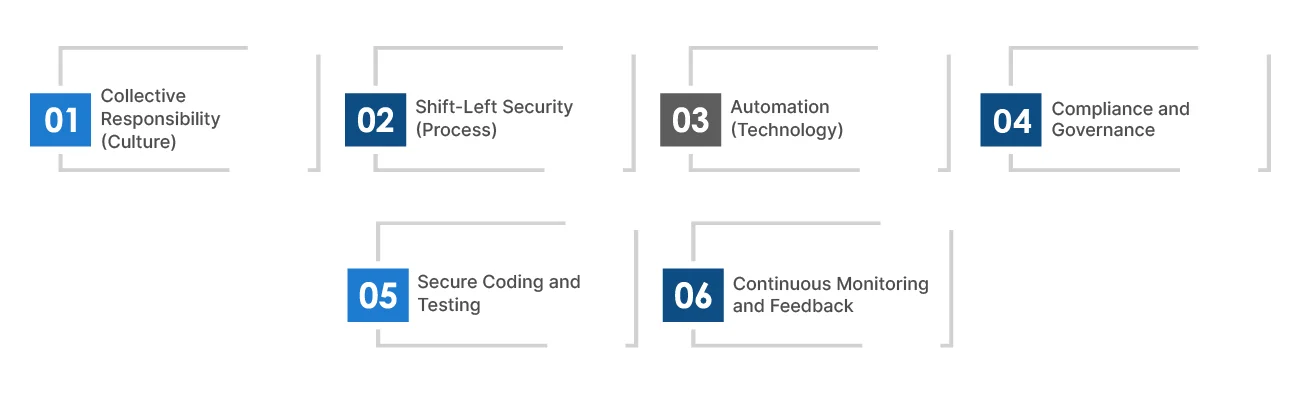
1. Collective Responsibility (Culture)
In DevSecOps, security is not left to one specialist team. It becomes part of everyone’s job, including developers, operations teams, and security staff.
- This means teams are expected to think about security as they work, not only when something goes wrong. Problems should be spotted early, discussed openly, and fixed before they grow into larger issues.
- Support from leadership matters too. When management takes security seriously, it is easier to build good habits, provide proper training, and make secure practices part of day-to-day work.
- A healthy culture also avoids blame. When incidents happen, the focus should be on understanding the cause, fixing it quickly, and learning from it rather than pointing fingers.
2. Shift-Left Security (Process)
A key idea in DevSecOps is that security should be included from the beginning of development, not added at the end.
- For example, developers can use pre-commit checks on their own machines before code is pushed. These checks can catch things like exposed secrets, weak code patterns, or other basic issues early.
- Security should also be considered during planning and design. Threat modelling helps teams think through what could go wrong before the system is built, which makes it easier to avoid mistakes later.
3. Automation (Technology)
Automation plays a big part in DevSecOps because it helps teams apply security checks in a consistent way without slowing everything down.
- Security testing can be added directly into CI/CD pipelines so code is scanned automatically whenever changes are made. This helps teams catch issues sooner and reduces the chance of risky code moving forward unnoticed.
- Infrastructure as Code supports this approach as well. When infrastructure is defined in code, it can be reviewed, tested, versioned, and deployed in a more controlled and secure way.
4. Compliance and Governance
DevSecOps also helps enterprises keep up with compliance requirements while still moving quickly.
- One way this is done is through policy as code. Instead of checking rules manually, organizations can turn requirements into automated checks that run as part of development and deployment.
- Another useful practice is maintaining a software bill of materials, or SBOM. This gives teams a record of the third-party components used in a system, which makes it easier to track dependencies and manage open-source risk.
5. Secure Coding and Testing
Secure software does not happen by accident. It depends on the right tools, good coding habits, and regular testing.
- Static Application Security Testing looks through source code for possible weaknesses, while Dynamic Application Security Testing checks running applications for problems that may appear during use.
- Teams also need to protect secrets properly. Passwords, API keys, and other sensitive credentials should not be stored in source code. They should be kept in secure tools designed for that purpose.
- Host hardening is another important step. By limiting unnecessary services and tightening system settings, teams can reduce the attack surface of servers and containers.
6. Continuous Monitoring and Feedback
Security work does not stop once software is released. Systems need to be monitored continuously so problems can be detected and handled quickly.
- Logging and monitoring give teams visibility into what is happening in production. When logs are collected in one place, it becomes easier to investigate suspicious activity and respond to incidents.
- It also helps to have incident response playbooks ready in advance. Clear procedures make it easier to react quickly and consistently when a breach, malware event, or other security issue occurs.
Understanding DevSecOps Maturity: The 5-Level Evolution
DevSecOps maturity shows how far an organization has progressed in bringing security into its development and operations work. It is not just about using more tools. It is about how security becomes part of the way teams plan, build, test, release, and maintain software.
The five levels help explain this growth, starting from weak and reactive practices and moving toward a more organized and proactive approach.
Level 1: Initial
At this stage, security is mostly handled in an unplanned way. There are no clear standards, and different teams often work separately without much coordination. Developers focus on building features, while security is only considered when something goes wrong.
Most checks are done manually, if they are done at all, and they usually happen very late in the process. This means problems are often found after release, when they are harder and more expensive to fix. Security is often seen as a delay rather than a normal part of software development.
Level 2: Managed
At Level 2, the organization starts to take security more seriously. Basic policies are introduced, and some security practices begin to appear in development work. Teams may receive training, and simple tools may be used to scan code or check for obvious risks.
Even so, security is still not fully built into the workflow. Some teams may follow the new practices while others do not. The main goal at this point is to create some consistency and make security a regular consideration instead of relying on last-minute fixes.
Level 3: Defined
By this stage, security is becoming part of the normal development process. Teams work together more closely, and security activities are included earlier and more regularly.
Automated tools are usually introduced into the pipeline so code can be checked during development and testing. Practices such as static testing, dynamic testing, and dependency scanning become more common. Instead of waiting until the end, teams begin to look for issues throughout the lifecycle. This makes security more practical and easier to manage.
Level 4: Quantified
At Level 4, the organization does more than just follow security steps. It starts measuring how well those steps are working. Teams use data to track issues, response times, recurring weaknesses, and other signs of performance.
Security is now treated as a shared responsibility across the organization. Some teams may have security champions who help promote better practices. Compliance checks and policy enforcement are often automated, which reduces manual effort and improves consistency. Decisions are based more on evidence and less on guesswork.
Level 5: Optimized
This is the most mature stage. Security is fully built into the organization’s way of working and continues to improve over time. Teams do not just respond to threats; they try to prevent them before they become serious problems.
Automation is used widely, and developers often have access to self-service tools that help them handle security issues as part of their normal work. Monitoring, detection, and response processes are stronger and faster. At this level, security is no longer treated as a separate burden. It supports the business by helping teams move quickly without ignoring risk.
How to Build a Scalable DevSecOps Maturity Roadmap
Creating a DevSecOps roadmap is about improving step-by-step in a way that teams can follow. Businesses must start with understanding where they are, fix basic gaps, and gradually bring in automation, governance, and continuous improvement.\
Phase 1: Assessment and Foundation Building (0–3 Months)
- Assess the Current Environment: Start by reviewing how security is currently handled across development, operations, and delivery. Identify what is already working, where the gaps are, and which risks are being missed.
- Set Baseline Metrics: Define a few practical measures such as remediation time, number of open vulnerabilities, frequency of deployments, and failed security checks. These give teams a starting point and make progress easier to track.
- Assign Clear Ownership: Security works better when responsibility is shared. Identify team leads or security champions within engineering groups so security does not remain isolated with one central team.
- Strengthen Basic Security Hygiene: Introduce secure coding practices, simple threat modelling, access control reviews, and proper handling of secrets. Before scaling anything, the foundation needs to be stable.
Phase 2: Integration and Initial Automation (3–6 Months)
- Shift Security Earlier in Development: Move basic security checks closer to where code is written. This can include IDE-level feedback, pre-commit checks, and pull request scanning so issues are found earlier.
- Add Automated Security Scans: Bring tools such as SAST, SCA, and IaC scanning into the CI pipeline. This helps teams check code, dependencies, and infrastructure definitions in a more regular and consistent way.
- Improve Secrets Management: Put controls in place to stop API keys, passwords, and tokens from being pushed into repositories. Automated secrets scanning should be part of the normal workflow.
- Create Fast Feedback Loops: Security findings should reach developers quickly and in a format, they can act on. It helps when results appear in tools teams already use, such as Jira, Git platforms, or team chat channels.
Phase 3: Governance, Visibility, and Deeper Security Controls (6–12 Months)
- Introduce Runtime and Dynamic Testing: Add DAST and other release-stage testing methods to check running applications, not just source code. This helps uncover issues that may not appear during static analysis.
- Automate Compliance Checks: Turn key security and compliance requirements into repeatable checks inside the pipeline. This reduces dependence on manual review and makes governance more consistent.
- Expand Cloud and Container Security: Review containers, images, cloud resources, and deployment settings more closely. As infrastructure grows, these areas become too important to leave unchecked.
- Standardize the Security Toolchain: Reduce tool sprawl by choosing tools that work well together and give teams a clearer picture of risk. Too many disconnected tools usually create noise instead of clarity.
Phase 4: Optimization and Continuous Improvement (12+ Months)
- Use Data to Improve Decisions: By this stage, teams should be using metrics to spot patterns, reduce recurring weaknesses, and improve response times. Security should be guided by evidence, not guesswork.
- Automate Low-Risk Remediation: For common and repeatable issues, automated fixes can reduce manual effort and help teams move faster without ignoring security concerns.
- Strengthen Monitoring and Observability: Mature DevSecOps requires ongoing visibility into production systems. Logging, alerting, and runtime monitoring help teams detect suspicious behaviour and respond more quickly.
- Make Secure-by-Design the Default: The final step is cultural as much as technical. Security should be built into planning, architecture, coding, testing, and deployment so it becomes part of normal engineering practice rather than an added layer at the end.
With this kind of gradual rollout, security stops getting in the way and instead helps teams ship quickly without taking unnecessary risks.
How TxMinds Enables DevSecOps Maturity at Scale
At TxMinds, we help organizations make security part of the delivery process from the start, not something added at the end. Through our DevSecOps implementation services, we embed security into DevOps practices with continuous monitoring, assessment, and analysis across the SDLC. This helps teams spot weak points early, reduce friction in delivery, and keep development moving without leaving security behind.
We also bring security checks directly into the pipeline so risks can be identified and addressed before release. Our approach covers code analysis, vulnerability assessment, and continuous visibility into the threat landscape, helping teams catch issues sooner and respond in real time. We support stronger compliance by embedding security controls and audit mechanisms into the workflow, making it easier to stay audit-ready as systems scale.


Vivek Gupta
VP, Delivery, Digital Engineering
Vivek Gupta is the Vice President of Delivery at Tx with over 25 years of experience driving digital transformation. At Tx, he has built the foundation for DevOps, Digital, and Cloud practices, shaping strategies that empower businesses. Before joining Tx, Vivek held leadership roles at Infosys and Tech Mahindra. His leadership fuels innovation, strengthens delivery excellence, and enhances Tx's global impact. Vivek's commitment to driving change ensures our clients stay ahead in an evolving digital landscape.
FAQs
What is DevSecOps?
DevSecOps is the practice of embedding security into every stage of software development and delivery, helping enterprises ship cloud-native and AI-driven applications faster without increasing risk.
What are the core pillars of a modern DevSecOps strategy?
A modern DevSecOps strategy is built on culture, shift-left security, automation, compliance, secure coding and testing, and continuous monitoring and feedback.
How can organizations measure DevSecOps maturity?
Organizations can measure DevSecOps maturity through a five-level model that tracks how security evolves from reactive manual checks to optimized, secure-by-design engineering practices.
How do you build a scalable DevSecOps maturity roadmap?
A scalable DevSecOps roadmap starts with assessing current gaps, then adds early security checks, automation, governance, runtime visibility, and continuous improvement over time.
Discover more