


Recommended Blogs

Blog
AIOps in 2026: Trends Accelerating the Shift to Predictive IT Operations
Table of Content
- Why 2026 is the Inflection Point for Predictive IT Operations
- The 7 Trends Accelerating AIOps in 2026
- What Turns AIOps into a Predictive Operating Model
- Challenges Slowing AIOps Adoption in 2026
- How to Measure AIOps Success in 2026
- How TxMinds Enables Predictive IT Operations
Share On


Is your IT team spending more time responding to alerts than preventing incidents before they happen?
For modern businesses, this is now the real challenge. IT environments generate large volume of signals across cloud, on-prem, and distributed systems. But more data does not necessarily mean better visibility.
It has been seen that in many cases it has made operations slower and harder to manage. That is why AIOps for IT operations is becoming a strategic priority for enterprise leaders. AIOps market is projected to reach USD 18.95 billion in 2026. It clearly reflects how quickly organizations are investing in smarter, faster, and more scalable operations.
As AI-driven observability and AIOps continue to mature, businesses are shifting from reactive monitoring to predictive IT operations. This approach allows to detect patterns early, reduce operational strain, and support hybrid and multi-cloud environments.
This blog explores the key AIOps trends 2026 that are accelerating that shift and what they mean for enterprises building AI-powered IT operations.
Key Takeaways
- The AIOps market is projected to reach USD 18.95 billion in 2026, showing how fast enterprises are investing in predictive IT operations.
- AIOps is shifting IT teams from reactive monitoring to predictive operations by connecting logs, metrics, traces, and events to catch issues earlier.
- Key 2026 trends include agentic AIOps, hyperautomation, SecOps convergence, edge intelligence, and FinOps integration.
- AIOps delivers value when it reduces alert noise, improves MTTD and MTTR, prevents incidents earlier, and strengthens uptime and cost control.
Why 2026 is the Inflection Point for Predictive IT Operations
2026 is shaping up as the year AIOps moves from experimentation to operational necessity. IT teams are now managing microservices, containers, cloud-native applications, and sprawling hybrid estates where a single incident can touch applications, networks, cloud services, and third-party dependencies. In that kind of environment, traditional monitoring can tell teams that something is wrong, but not always why it happened or what needs attention first.
That is where predictive IT operations start to matter. AIOps predictive analytics helps teams connect logs, metrics, traces, and events in context rather than as isolated signals. With AI-driven observability and AIOps, organizations can cut through alert noise, identify abnormal behavior earlier, and focus on the incidents most likely to affect service performance. This is especially relevant for AIOps for hybrid and multi-cloud environments, where fragmented toolsets often create blind spots and slow response.
The real shift in 2026 is not just toward automation, but toward AI-powered IT operations that help teams anticipate problems, protect uptime, and scale operations without increasing manual effort.
The 7 Trends Accelerating AIOps in 2026
We have talked about why 2026 is a turning point till now. This section explains what is changing on the ground. The most important AIOps trends 2026 are making monitoring faster and pushing businesses toward more reliable, scalable, and predictive IT operations.
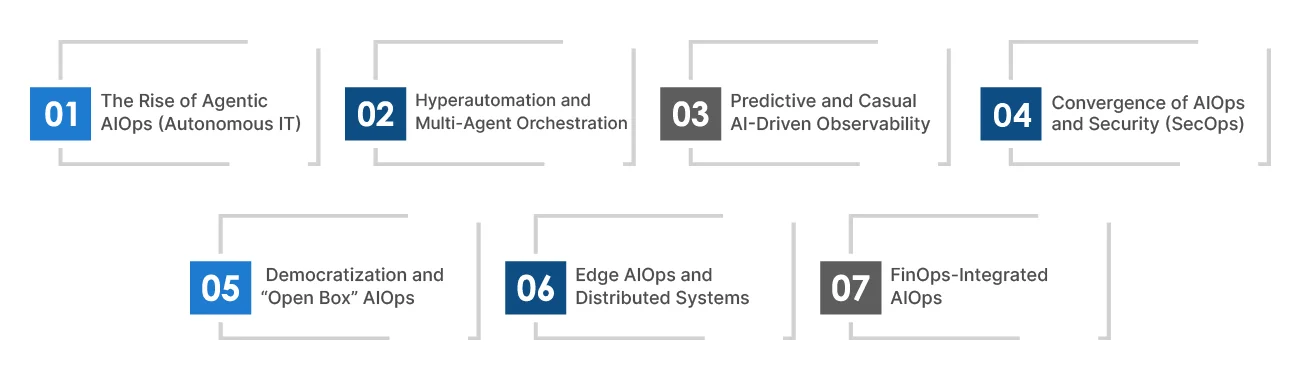
1. The Rise of Agentic AIOps (Autonomous IT)
AIOps is moving beyond detection and recommendation toward systems that can diagnose issues, trigger approved actions, verify outcomes, and improve over time based on results. The broader shift is from basic automation to more intelligent, closed-loop operations that reduce manual intervention in routine incident handling.
- Ticketless remediation: Routine incidents can be resolved before they turn into service desk queues.
- Self-healing operations: Known issues can be corrected automatically with guardrails in place.
2. Hyperautomation and Multi-Agent Orchestration
One of the biggest shifts in AIOps for IT operations is the move from isolated scripts to connected workflows across observability, incident management, and remediation. Instead of automating single tasks, enterprises are now linking multiple steps into coordinated operational processes.
- End-to-end workflow execution: From alert to triage to action.
- Multi-step coordination: Different tools handle correlation, enrichment, ticketing, and response as one process.
3. Predictive and Casual AI-Driven Observability
This is where AIOps predictive analytics becomes far more valuable. By combining event correlation, topology context, and root-cause analysis, teams can understand not just that something failed, but why it failed and what systems or services may be affected next.
- Early detection: Team can spot abnormal patterns before users feel the impact.
- Better RCA: Incidents are investigated as connected events and not separate alerts.
4. Convergence of AIOps and Security (SecOps)
Operations and security are increasingly working from the same signals. As incidents grow more complex, organizations are bringing performance, anomaly, and threat insights closer together so teams can respond with better context and fewer delays.
- Shared operational context: Performance anomalies and risky behavior can be reviewed together.
- Faster response paths: Teams can reduce handoff delays during critical incidents.
5. Democratization and “Open Box” AIOps
AIOps platforms are becoming easier for broader teams to use, but accessibility alone is not enough. Teams also need visibility into how conclusions are reached, what data supports them, and where human judgment is still necessary.
- Wider adoption: Operations, platform, and service teams can work from the same operational picture.
- More transparency: Trust improves when teams can follow the evidence behind a recommendation.
6. Edge AIOps and Distributed Systems
As IT environments expand across branch locations, edge devices, cloud platforms, and distributed applications, centralized monitoring alone is no longer enough. This is making localized intelligence and faster detection increasingly important, especially in hybrid and multi-cloud operations.
- Faster local detection: Issues can be identified closer to where they occur.
- Stronger resilience: This is increasingly important for AIOps for hybrid and multi-cloud environments.
7. FinOps-Integrated AIOps
A related direction emerging from AIOps-business intelligence convergence is closer alignment between operations and cost management. When operational telemetry is read alongside usage and capacity patterns, teams can make better decisions about scaling, performance, and spend.
- Smarter capacity planning: Teams can match performance needs with actual demand.
- Better cost visibility: Operations decisions become easier to tie to business impact.
Taken together, these seven trends show that AI-powered IT operations are moving past reactive monitoring and into a more connected, preventive operating model.
What Turns AIOps into a Predictive Operating Model
The trends above show where the market is moving. But predictive IT operations only works when the foundation is strong enough to turn raw telemetry into timely, trustworthy action.
It starts with visibility. AIOps for IT operations needs a steady flow of logs, metrics, traces, events, and alerts from across the stack, not just from one monitoring tool or one infrastructure layer. That data also must be normalized and connected, so teams can see how applications, services, networks, and cloud resources relate to one another in real time.
The second is correlation. AIOps predictive analytics becomes useful when the platform can separate noise from signal, detect abnormal behavior against changing baselines, and trace incidents across dependencies instead of treating every alert as a standalone event. That is the difference between reactive monitoring and AI-driven observability and AIOps that can surface likely causes, likely impact, and likely next steps.
The third is action with control. Predictive systems should not only flag risk early, but also support guided remediation, workflow automation, and outcome verification. That is where AI-powered IT operations begin to deliver real operational value like, less alert fatigue, faster resolution, and more confidence in day-to-day decisions.
Challenges Slowing AIOps Adoption in 2026
While the promise of predictive IT operations is compelling, results do not come from tools alone. Many organizations invest in AIOps for IT operations expecting faster resolution, cleaner observability, and stronger automation, only to find that the real barriers are operational, cultural, and structural.
- Unclear ROI and rising costs: AIOps initiatives often lose momentum when spending rises faster than visible outcomes. Without clear priorities, automation can feel expensive rather than strategic.
- Poor data quality and integration gaps: AI-driven observability and AIOps depends on clean, connected telemetry. When logs, metrics, traces, and events sit across disconnected tools, the output becomes less reliable.
- Skills and talent shortages: Many teams still lack the mix of operational knowledge and data fluency needed to turn AIOps insights into action.
- Trust and change resistance: Teams are unlikely to rely on automated recommendations if decision logic is unclear or if workflows change too quickly.
- New operational and security risks: As AI-powered IT operations expands, organizations also need stronger governance, controls, and oversight, especially in hybrid and multi-cloud environments.
To make AIOps work, businesses need more than automation. They need the right data foundation, the right operating model, and a practical way to measure results. That makes success metrics the next part of the conversation.
How to Measure AIOps Success in 2026
For most enterprises, the success of AIOps for IT operations should not be judged by how advanced the platform sounds, but by the operational outcomes it improves. If the goal is to build predictive IT operations, then measurement must focus on fewer disruptions, faster decisions, and better use of resources across the environment.
- Reduction in alert noise: Track how many low-value or duplicate alerts are eliminated after correlation and prioritization.
- Faster incident detection and resolution: Measure improvements in MTTD and MTTR to see whether teams are identifying and resolving issues earlier.
- Higher incident prevention rate: A strong sign of AIOps predictive analytics is the ability to flag risks before they become service-impacting incidents.
- Better automation efficiency: Monitor how many repetitive tasks, remediation steps, or ticketing actions are handled without manual effort.
- Improved service performance: Look at uptime, SLA adherence, and user experience indicators to understand business impact.
- Stronger cost control: In AI-powered IT operations, success also means using infrastructure and cloud resources more efficiently.
In the end, the right metrics should connect technical improvements with business outcomes. That is where AIOps starts to move from an operational toolset to a long-term strategic capability.
How TxMinds Enables Predictive IT Operations
At TxMinds, we help businesses turn observability into action. We bring together AIOps for IT operations, log analysis, cloud-native observability, and incident management to give teams a real-time view of system health, application behavior, and operational risk across on-prem, public, private, and hybrid environments.
Our observability services are built to support predictive IT operations by helping businesses correlate signals, reduce blind spots, improve root-cause analysis, and respond faster to the issues that matter most. We also focus on the outcomes behind the technology: lower downtime, better visibility, stronger cost control, and smoother collaboration across teams.
With AI-driven observability and AIOps, plus a business-aligned engineering approach, we help enterprises move toward more reliable and AI-powered IT operations without losing sight of performance, security, or long-term operational value.


Amar Jamadhiar
VP, Delivery North America
Amar Jamadhiar is the Vice President of Delivery for TxMind's North America region, driving innovation and strategic partnerships. With over 30 years of experience, he has played a key role in forging alliances with UiPath, Tricentis, AccelQ, and others. His expertise helps Tx explore AI, ML, and data engineering advancements.
FAQs
How is AIOps accelerating the shift to predictive IT operations in 2026?
AIOps is accelerating the shift by connecting logs, metrics, traces, and events in context, helping teams detect abnormal patterns earlier, cut alert noise, and act before issues affect service performance.
How does AIOps move IT from reactive to predictive operations?
AIOps moves IT from reactive to predictive operations through three core layers: end-to-end visibility, signal correlation, and guided action, so incidents are understood as connected events instead of isolated alerts.
What are the benefits of predictive AIOps for downtime reduction?
Predictive AIOps helps reduce downtime by identifying risks earlier, improving root-cause analysis, lowering alert fatigue, and enabling faster remediation before users feel the impact.
Which AIOps capabilities improve MTTR, proactive incident prevention, and service resilience in 2026?
The most important capabilities include event correlation, topology context, root-cause analysis, workflow automation, self-healing actions, and stronger support for hybrid, multi-cloud, and edge environments to improve MTTR, incident prevention, and overall resilience.
Discover more