

Recommended Blogs

Blog
Application Rationalization: How Enterprises Assess the Portfolio and Modernize What Matters

 Last Updated: February 18th, 2026
 Read Time: 4 minutes
Table of Content
- Application Rationalization for Business Agility, Cost Control, and Risk Reduction
- Outcomes that Define a Successful Rationalization Program
- Portfolio Assessment that Connects Business Value, Technical Health, and Spend
- Decision Frameworks to Retain, Modernize, Consolidate, Replace, or Retire Applications
- Roadmap Governance and KPIs to Sustain Continuous Rationalization
- How TxMinds Enables Application Rationalization and Modernization at Scale
Share On


The enterprise application landscape has grown faster than governance models can keep up. What began as a digital transformation initiative has now evolved into sprawling portfolios of overlapping systems, shadow IT tools, and aging legacy platforms.
The result is rising costs, fragmented data, increased security exposure, and slower decision-making.
Research indicates that 15–20% of enterprise applications are either redundant or little used, quietly draining resources that could be redirected toward strategic initiatives. In an environment where every technology investment is expected to deliver measurable value, this level of inefficiency is no longer sustainable.
Application rationalization addresses this challenge head-on. It is not a cost-cutting exercise, but a structured discipline that aligns application portfolios with business priorities, strengthens governance, and creates room for innovation. When approached strategically, it becomes a foundation for agility, resilience, and long-term digital competitiveness.
In this blog, we break down a practical, step-by-step approach to rationalization from assessing your portfolio to making clear disposition decisions and building a roadmap that delivers outcomes.
Key Takeaways
- Application rationalization aligns the portfolio to business priorities and agility.
- Research cited says 15 to 20% of apps are redundant or little used.
- Assess business value technical health cost usage and risk deciding objectively.
- Use clear disposition choices and ongoing governance with a simple KPI set.
Application Rationalization for Business Agility, Cost Control, and Risk Reduction
At its core, application rationalization is a structured discipline for evaluating and optimizing an enterprise’s software landscape to ensure every application delivers measurable business value. It is about making deliberate portfolio decisions that directly support growth, operational efficiency, compliance, and innovation.
Most enterprises accumulate applications over years of mergers, rapid scaling, cloud adoption, and departmental autonomy. New tools are added to solve immediate problems, while older systems remain in place to avoid disruption. Over time, this leads to overlapping capabilities, inconsistent data flows, rising licensing costs, and mounting technical debt. Without a clear application rationalization framework, these inefficiencies compound.
A well-executed application rationalization initiative creates three immediate advantages.
- Improved Business Agility: When redundant systems are consolidated and legacy platforms are modernized or retired, IT teams can respond faster to new requirements. Fewer systems mean simplified integrations, cleaner data architecture, and shorter implementation cycles.
- Cost Transparency and Optimization: Application rationalization surfaces the total cost of ownership across licensing, infrastructure, support, and maintenance. Enterprises often discover that a significant portion of their spend is tied to underused or duplicative systems. Redirecting this budget toward strategic transformation initiatives becomes easier when portfolio decisions are evidence-based.
- Risk Reduction and Governance Strength: Every unmanaged application introduces security exposure, compliance risk, and operational fragility. Application rationalization and modernization together ensure that mission-critical systems are secure, supported, and aligned with regulatory requirements.
Application rationalization is not a one-time cleanup exercise, but a continuous capability embedded within enterprise architecture and IT governance. When treated as an ongoing discipline, it enables sustained portfolio health, strategic alignment, and long-term digital resilience.
Outcomes that Define a Successful Rationalization Program
A strong application rationalization framework is only worth doing if it produces outcomes that the business can feel. For application rationalization for enterprises, success usually shows up in a few clear ways.
1. Clear Cost Visibility and Lower Total Cost of Ownership
Rationalization makes portfolio spending visible across licensing, infrastructure, support, and integration. With the right application portfolio rationalization tools, teams can compare cost against usage and value, then reduce spend without cutting capability.
2. Fewer Duplicate Apps and Simpler User Experience
Most enterprises have overlapping tools doing the same job in different departments. Application rationalization helps consolidate these, reducing complexity, improving adoption, and cutting training and support efforts.
3. Stronger Security Posture and Lower Operational Risk
Unsupported or outdated applications create real exposure. Rationalization flags high-risk systems early so they can be retired, replaced, or prioritized for application rationalization and modernization.
4. Better Alignment with Business Priorities
A good application rationalization guide keeps decisions anchored to outcomes like faster time to market, better customer experience, or regulatory readiness. The portfolio starts reflecting strategy instead of history.
5. More Capacity for Modernization and Innovation
When teams spend less time keeping redundant systems alive, they regain bandwidth for modernization. This is where application rationalization and modernization become a growth lever, not just a cleanup effort.
The best programs do not treat rationalization as a one-time project but build lightweight governance, review cycles, and measures that embed application rationalization best practices.
Portfolio Assessment that Connects Business Value, Technical Health, and Spend
Effective application rationalization for enterprises always starts with a rigorous assessment of the existing portfolio. Without a reliable inventory and a consistent way to evaluate each application, decisions are subjective, contested, and hard to justify. An assessment grounded in data and a repeatable application rationalization framework ensures that decision makers have a common understanding of what they own, what it costs, and what it delivers.
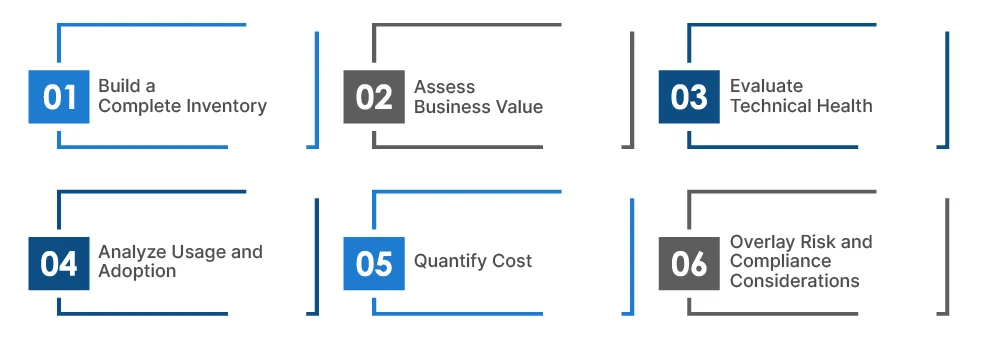
1. Build a Complete Inventory
Before any evaluation can begin, you need an accurate and up-to-date list of all applications in use across the organization. It includes SaaS, on-premises, legacy systems, and any department-specific tools.
Many enterprises rely on application portfolio rationalization tools that automatically discover and track usage, integrate with identity/access systems, and highlight shadow IT. Manual inventories often miss critical details and quickly go out of date.
2. Assess Business Value
For each application, ask how important it is to core business functions. Criteria might include strategic alignment, revenue impact, customer experience, and critical process support. Applications that directly enable key business outcomes score higher, while those with limited usage or unclear business ownership score lower.
A consistent scoring approach prevents decisions from being made on hearsay or convenience.
3. Evaluate Technical Health
Technical fit includes architecture quality, support status, version currency, scalability, and integration complexity. Systems with outdated technology, brittle interfaces, or unsupported versions often impose hidden costs and risks.
Technical assessment helps separate applications worth keeping from those that slow innovation.
4. Analyze Usage and Adoption
Usage data tells you how applications are actually used. Low adoption combined with high cost often signals candidates for Consolidation or retirement. In contrast, high usage with low business value might reveal training or process issues needing attention rather than portfolio change.
5. Quantify Cost
Total cost includes more than just licenses or subscriptions. Factor in infrastructure hosting, maintenance effort, integration upkeep, support desk tickets, and operational overhead. When cost is quantified alongside business value and technical health, it becomes possible to compare apples to apples across very different parts of the portfolio.
6. Overlay Risk and Compliance Considerations
Some applications carry regulatory or security risk due to data sensitivity, location, or control gaps. These risk dimensions should be part of every assessment, not an afterthought. High-risk systems that cannot be mitigated through configuration or controls often land higher on the replacement or retirement list, even if they have utility.
By systematically evaluating each application against these dimensions, enterprises can establish a data-driven foundation for the next stage of rationalization. This assessment phase is where an application rationalization guide becomes practical, turning a chaotic inventory into a structured dataset.
Decision Frameworks to Retain, Modernize, Consolidate, Replace, or Retire Applications
After the assessment, application rationalization comes down to making clear calls and sticking to them. A simple, consistent application rationalization framework keeps decisions fair, repeatable, and easier to defend.
Retain
Keep applications that are actively used, clearly support business priorities, and remain technically stable. These should be the systems that justify their cost and do not introduce avoidable risk. Even retained apps need regular review through an application rationalization framework, so they stay aligned with strategy and don’t quietly become future sprawl.
Retire
Remove applications that are redundant, rarely used, or expensive to maintain for the value they provide. For application rationalization for enterprises, retirement is often the simplest way to reduce portfolio size, support effort, and security exposure. It should still include basic dependency and data retention checks so nothing critical is lost.
Rehost
Move an application to the cloud with minimal change when the main issue is infrastructure cost or operational overhead, not the application itself. This option supports application rationalization and modernization by creating quick progress, especially during data center exits or when teams need to reduce hosting complexity without delaying outcomes.
Replatform
Shift the application and make targeted platform improvements to get better reliability, performance, or cost without rewriting the system. This can include moving to managed services or improving deployment and runtime setup. It is a practical modernization path that fits well when an application is worth keeping but needs a healthier foundation.
Refactor
Redesign parts of the application when it is important to the business but held back by technical debt, brittle integrations, or an architecture that slows delivery. This is the deeper modernization route that improves agility and long-term maintainability. In an application rationalization guide, refactoring is best reserved for high-value systems where the business impact is clear.
Replace
Move to a better-fit application when the current one cannot meet security, compliance, scale, or functionality needs, even with upgrades. Replacement decisions should be tied to business outcomes and total cost, not just feature comparisons. This is where application portfolio rationalization tools help by grounding the choice in usage, risk, and spend.
The goal is not to label apps. The goal is to build a portfolio that is easier to run, safer to govern, and ready for what the business wants next.
Roadmap Governance and KPIs to Sustain Continuous Rationalization
If application rationalization is treated as a one-time cleanup, sprawl returns. The fix is straightforward. You need a clear roadmap, shared ownership, and a small set of KPIs that stay visible.

Build a phased roadmap
Begin with low-risk moves such as retiring applications with minimal usage and consolidating obvious overlaps. Use these early wins to release budget and reduce clutter. Then plan the larger work, such as replacement and application rationalization, and modernization, around business timelines, funding cycles, and key dependencies.
Put governance in the right place
Rationalization cannot sit with IT alone. Bring business owners, enterprise architecture, security, and finance into a lightweight portfolio forum. The goal is consistent decisions using the same application rationalization framework and fewer exceptions that dilute progress.
Track a small set of KPIs
Keep the measures simple and meaningful. Track portfolio size, total cost of ownership, end-of-life exposure, consolidation progress, and adoption of standard platforms. Application portfolio rationalization tools can make this tracking easier and more reliable.
Make it part of the application lifecycle
A strong application rationalization guide prevents the next wave of sprawl. Build checks into procurement, renewals, and architecture reviews. New requests should prove they deliver unique value. If they cannot, the default should be to reuse, consolidate, or modernize what already exists.
How TxMinds Enables Application Rationalization and Modernization at Scale
When application rationalization highlights systems that are too important to retire but too outdated to keep as they are, we step in with a modernization path that protects business continuity. Our application modernization services start with a cloud readiness assessment and then chooses the right route for each application, whether that is rehosting, replatforming, refactoring, or rearchitecting, so the application becomes cloud-ready and future-proof.
At TxMinds, we connect application rationalization and modernization, so every change improves the portfolio, not just the codebase. For application rationalization for enterprises, that means reducing risk and operational drag while moving toward containers and serverless models, cleaner integrations, and a platform that is easier to scale and evolve.

VP, Delivery, Digital Engineering
Vivek Gupta is the Vice President of Delivery at Tx with over 25 years of experience driving digital transformation. At Tx, he has built the foundation for DevOps, Digital, and Cloud practices, shaping strategies that empower businesses. Before joining Tx, Vivek held leadership roles at Infosys and Tech Mahindra. His leadership fuels innovation, strengthens delivery excellence, and enhances Tx's global impact. Vivek's commitment to driving change ensures our clients stay ahead in an evolving digital landscape.
FAQs
What is application rationalization?
Application rationalization is the structured process of evaluating an enterprise’s application portfolio to identify redundant underused or high-cost systems. It aligns technology investments with business priorities.
What is the application rationalization process?
The application rationalization process typically includes building a complete inventory assessing business value and technical health analyzing cost and usage identifying risk. It helps make clear decisions to retain retire replace or modernize applications.
Why is application rationalization important for enterprises?
Application rationalization for enterprises improves cost transparency reduces operational risk simplifies the technology landscape and creates capacity for modernization and innovation.
How does application rationalization support modernization initiatives?
Application rationalization and modernization work together by identifying which applications should be modernized replatformed or replaced so enterprises can improve agility security and long-term digital resilience.
Discover more