Recommended Blogs

Blog
From Manual Audits to Continuous Compliance in the Cloud: What Businesses Need for Scalable Governance
Table of Content
- Why Continuous Compliance Is the New Baseline
- What Is Cloud Compliance in a Dynamic Environment?
- Continuous Cloud Compliance: From Checks to Always-On Control
- Continuous Compliance Automation with Policy-as-Code
- A Practical Continuous Compliance Framework for the Cloud
- How TxMinds Helps Achieve Continuous Compliance in the Cloud
Share On


Cloud moves fast and sometimes too fast for governance to keep up. Teams spin up services from templates, ship changes through CI/CD, and retire workloads before an auditor would even know they existed.
Real-world data confirms the scale of the issue. According to the 2025 State of Cloud Security Report, 78% of organizations now use two or more cloud providers, a trend that dramatically increases operational and governance complexity across environments. As enterprises embrace hybrid and multi-cloud models for performance, resilience, and regulatory reasons, maintaining consistent policies, security controls, and compliance posture becomes a strategic challenge.
With sensitive data, workloads, and services distributed across platforms, even small configuration drift can introduce misconfigurations, privilege gaps, and non-compliance exposures. This has accelerated the shift toward continuous compliance, a model that treats compliance as an always-on, operational discipline rather than a periodic checklist.
This blog explores what cloud compliance means today, why continuous compliance matters, and how to achieve continuous compliance in the cloud through automation and a practical framework.
Key Takeaways
- Cloud environments change too fast for periodic audits, so compliance must operate continuously within provisioning and delivery workflows.
- Multi-cloud increases governance complexity and drift risk, with 78% of organizations using two or more cloud providers.
- Continuous compliance means validating controls in real time rather than relying on point-in-time assessments.
- Policy-as-code embeds enforceable, testable controls into IaC and CI/CD, enabling automated checks, drift detection, and continuous evidence collection.
Why Continuous Compliance Is the New Baseline
Cloud infrastructure doesn’t sit still. Resources are provisioned through code, configurations change through automated pipelines, and workloads scale on demand. In that reality, a quarterly or annual audit is just a snapshot; it cannot tell you what changed the next day, or whether controls stayed effective. That’s why the Cloud Security Alliance’s Compliance Automation Revolution (CAR) is pushing the industry toward continuous, automated, evidence-driven assurance: governance must run at the same speed as the cloud.
What’s forcing this shift to continuous compliance:
- Constant change (drift): Cloud configs evolve daily, so “point-in-time compliant” becomes “unknown” fast.
- Multi-cloud complexity: Most enterprises run across multiple providers, making consistent controls harder to enforce manually.
- Manual evidence doesn’t scale: Collecting screenshots, tickets, and reports for audits burns time and misses gaps.
- Higher blast radius: One misconfiguration or overly permissive identity policy can create instant exposure.
- Regulatory pressure: Requirements keep expanding, and auditors increasingly expect better traceability and proof.
Continuous compliance turns governance into an always-on discipline where controls are embedded into provisioning, monitored continuously, and deviations are flagged and fixed quickly.
What Is Cloud Compliance in a Dynamic Environment?
Before moving further, it helps to clarify what is cloud compliance in today’s context. At its core, cloud compliance is the process of ensuring that cloud-based systems, data, and operations adhere to regulatory requirements, industry standards, and internal governance policies. That includes frameworks such as ISO 27001, SOC 2, HIPAA, PCI DSS, and region-specific data protection laws.
But cloud compliance is fundamentally different from traditional IT compliance. In on-prem environments, infrastructure changes were relatively slow and centralized. In the cloud, infrastructure is programmable, distributed, and often short-lived. Developers can provision resources in minutes using infrastructure-as-code, and workloads may scale automatically without human intervention.
This is where continuous cloud compliance becomes critical. Compliance can no longer rely on periodic validation. It must account for:
- Shared responsibility between the cloud provider and the customer
- Dynamic resource provisioning
- API-driven configuration changes
- Multi-cloud governance challenges
In a dynamic environment, compliance isn’t just about meeting a standard but about maintaining control visibility, enforcing policies consistently, and ensuring that compliance posture remains intact despite constant change.
Continuous Cloud Compliance: From Checks to Always-On Control
Once cloud compliance is defined, the next step is operationalizing it. Traditional compliance models rely on scheduled reviews where teams validate configurations, generate reports, and prepare evidence for auditors. In cloud environments, that cadence is too slow. Controls must be verified continuously, not periodically.
Continuous cloud compliance shifts the model from reactive validation to always-on control monitoring. Instead of asking, “Were we compliant last quarter?” organizations ask, “Are we compliant right now?”
This shift is supported by capabilities such as:
- Continuous control monitoring (CCM): automated checks that validate configurations against defined policies.
- Cloud Security Posture Management (CSPM): tools that detect misconfigurations and configuration drift across multi-cloud environments.
- Automated remediation workflows: predefined actions that correct non-compliant resources.
- Centralized visibility dashboards: unified views of compliance posture across accounts and regions.
The Cloud Security Alliance emphasizes automation and machine-readable evidence as essential to modern assurance. The idea is not just to detect issues, but to maintain an ongoing, verifiable compliance state.
Continuous cloud compliance reduces exposure windows, improves audit readiness, and allows governance to function as a real-time control system rather than a retrospective reporting exercise.
Continuous Compliance Automation with Policy-as-Code
Monitoring helps, but it doesn’t stop bad changes from landing. If you want continuous compliance, you need continuous compliance automation. That means controls run every time, for every change, without someone having to remember to check a box.
The simplest way to get there is policy as code. You take compliance requirements and write them as rules that tools can test automatically. Instead of controls living in documents and audit folders, they live alongside your infrastructure as code and your CI/CD workflows. That’s how teams catch problems early, while the change is still cheap to fix.
What that looks like in real life:
- If a storage bucket is public, the pipeline fails, or the deploy gets blocked.
- If encryption or logging is missing, provisioning stops until it’s corrected.
- If an IAM role is too permissive, it gets flagged and routed into a fix workflow.
A solid automation loop usually includes IaC scanning before provisioning, CI/CD gates for must-have controls, post-deploy checks to validate what is running, drift detection for changes made outside code, and auto-remediation for repeat issues.
A Practical Continuous Compliance Framework for the Cloud
A useful continuous compliance framework ties regulations to day-to-day cloud work. Think of it as a loop that keeps you compliant even when the environment is changing every hour.
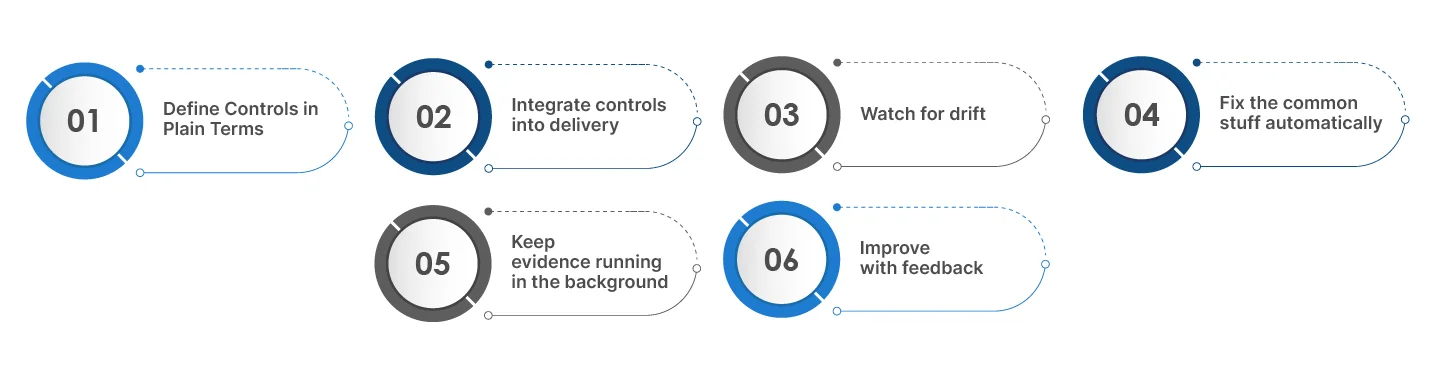
1. Define Controls in Plain Terms
Start by converting broad requirements into specific, testable rules. “Protect customer data” becomes “encryption must be on,” “public access must be blocked,” and “admin privileges must be limited.” If a control can’t be tested, it can’t be enforced.
2. Integrate controls into delivery
Put those rules where changes happen: IaC templates and CI/CD. That way, a risky change gets stopped at review time—before it becomes a production problem. This is where continuous compliance automation pays off.
3. Watch for drift
Even good pipelines don’t catch everything. People make console changes, vendors update defaults, and configurations drift. Continuous checks confirm that what’s running still matches what’s approved.
4. Fix the common stuff automatically
For repeat offenders (open storage, missing logs, overly broad IAM), use playbooks to remediate fast. The goal is shorter exposure windows, not perfect dashboards.
5. Keep evidence running in the background
Instead of scrambling during audits, collect proof as you go policy evaluations, config history, access logs, change records.
6. Improve with feedback
Track what breaks most, how long fixes take, and where policies create friction. Then tune the controls so they are strict and workable.
How TxMinds Helps Achieve Continuous Compliance in the Cloud
At TxMinds, we treat continuous compliance as a core part of cloud engineering, not an afterthought. Through our cloud consulting services, we help organizations design secure architectures, define enforceable cloud standards, and align governance with delivery velocity. Our focus is on building the right foundations so continuous cloud compliance becomes part of how systems are designed, deployed, and operated.
When organizations ask how to achieve continuous compliance in the cloud, we implement continuous compliance automation directly within engineering workflows. We embed guardrails into infrastructure-as-code, integrate automated checks into CI/CD pipelines, and establish monitoring practices aligned with a practical continuous compliance framework. The result is measurable control visibility, faster remediation, and audit readiness that is sustained year-round rather than assembled manually.


Amar Jamadhiar
VP, Delivery North America
Amar Jamadhiar is the Vice President of Delivery for TxMind's North America region, driving innovation and strategic partnerships. With over 30 years of experience, he has played a key role in forging alliances with UiPath, Tricentis, AccelQ, and others. His expertise helps Tx explore AI, ML, and data engineering advancements.
FAQs
What is cloud compliance?
-
Cloud compliance is the process of ensuring that cloud-based systems, data, and operations adhere to regulatory requirements, industry standards, and internal governance policies through continuous monitoring and enforceable controls.
Why is continuous compliance important in cloud environments?
-
Because cloud infrastructure changes rapidly through automation and scaling, continuous compliance ensures controls remain effective in real time rather than only at periodic audit checkpoints.
How to achieve continuous compliance in the cloud?
-
Organizations achieve continuous compliance in the cloud by embedding policy-as-code into IaC and CI/CD pipelines, enabling automated control checks, drift detection, centralized visibility, and automated remediation workflows.
What tools support continuous cloud compliance?
-
Continuous control monitoring (CCM), Cloud Security Posture Management (CSPM), policy-as-code frameworks, and automated remediation tools help maintain ongoing compliance across multi-cloud environments.
Discover more