

Recommended Blogs

Blog
Observability Trends 2026: The Strategic Priorities Every Leader Should Act On

 Last Updated: February 11th, 2026
 Read Time: 4 minutes
Table of Content
- What is Driving Observability in 2026
- Observability Trends 2026 That Will Shape Enterprise Operations
- Strategic Priorities Every Leader Should Act On
- Building an Execution Blueprint for KPIs and Governance
- Turn Observability into Business Outcomes with TxMinds
Share On


Enterprise observability in 2026 is being reshaped by two forces: AI is adding a new layer of system complexity, and leaders are demanding faster decisions with tighter cost control. Observability is becoming the foundation for AI-assisted operations and increasingly autonomous actions in controlled scenarios.
At the same time, most enterprises are still climbing the maturity curve. Only 11% of organizations classify themselves as observability experts with comprehensive data collection and modern AI tech.
This is why the conversation in 2026 is shifting from tools to strategy. The most important thing is not about which platform to use but how businesses operationalize observability to reduce MTTR cost and deliver outcomes leaders care about.
In this blog, we break down what is driving observability in 2026, the key observability trends shaping enterprise operations, and the strategic priorities leaders should act on.
Key Takeaways
- Observability in 2026 is a strategic outcomes program focused on reducing MTTR and improving decision-making, not a tooling debate.
- AI and hybrid multi-cloud complexity demand deeper context plus AI-assisted triage with clear guardrails.
- Telemetry spend is under leadership scrutiny, so teams must control ingestion, retention, and data volume while proving ROI.
- Enterprises will win by standardizing with OpenTelemetry, consolidating tool sprawl, and tying signals to SLOs and business impact with strong governance.
What is Driving Observability in 2026
Observability in 2026 is being driven by a convergence of technical, economic, and organizational forces. These are reshaping how enterprises run and govern their digital systems. What was once a tooling decision has now become a strategic capability that affects cost control, security, and business performance.
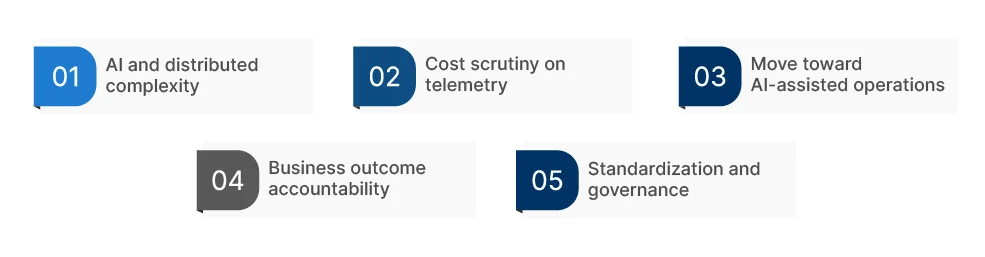
- AI and distributed complexity: Hybrid multi-cloud microservices and AI workloads create more failure modes and require deeper context than traditional monitoring can provide.
- Cost scrutiny on telemetry: Leaders are treating observability spend like any other major line item, pushing teams to control ingestion retention, and data volume while proving ROI.
- Move toward AI-assisted operations: Observability is expected to correlate signals, highlight likely root causes, and guide next actions with guardrails for safe automation.
- Business outcome accountability: Enterprises want observability to show customer and revenue impact, not just CPU and latency, driving adoption of SLOs and impact reporting.
- Standardization and governance: Tool sprawl and inconsistent instrumentation are pushing organizations toward OpenTelemetry service ownership models and clearer cross-team governance.
Together, these forces explain why observability in 2026 is about control, trust, and decision-making at scale, setting the stage for the trends and strategic priorities that enterprises must act on next.
Observability Trends 2026 That Will Shape Enterprise Operations
The enterprise observability landscape continues to evolve rapidly in 2026. It has moved from basic visibility toward intelligent insight automation and strategic value delivery. Below are the top observability trends in 2026 that enterprises must pay attention to:
1. AI-Powered Observability Moves from Dashboards to Decision Support
In 2026, observability platforms are becoming more intelligent by design, using AI to summarize telemetry, correlate signals across tools, and accelerate triage. The enterprise expectation is shifting from “show me the data” to “tell me what changed, why it matters, and what to do next” with growing focus on guardrails and human in the loop as automation increases.
2. Cost-Aware Observability Becomes a Leadership Mandate
Telemetry spend is no longer a hidden cost. Leaders are asking for justification, and teams are being pushed to treat observability like a cost optimization program without creating blind spots. In fact, 70% of organizations that effectively use observability report reduced decision-making latency by 2026.
The public sector landscape report shows strong pressure for cost justification and widespread action, such as consolidation, sampling, pipelines, and routing low-value logs to cheaper storage.
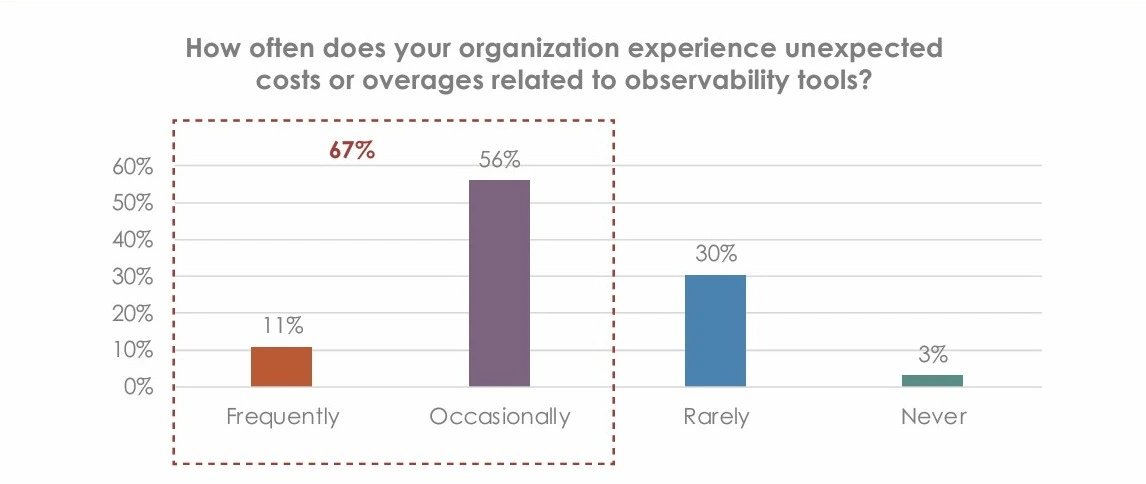
Unexpected observability cost overruns are common across enterprises, driving the shift toward cost-aware observability.
3. Platform Consolidation Accelerates to Reduce Tool Sprawl and Improve RCA
Enterprises are consolidating observability platforms to reduce fragmented views across clouds and teams. This is not just procurement hygiene; it directly improves root cause analysis by reducing context switching and improving correlation. TechTarget also highlights consolidation as one of the top cost reduction steps organizations are taking.
4. OpenTelemetry becomes the default standard for enterprise telemetry
OpenTelemetry is moving from “good to have” to “must have” as enterprises standardize collection across metrics, logs, and traces to reduce vendor lock-in and enable unified telemetry across environments. IBM also flags open standards as a core 2026 trend, especially as GenAI and agentic systems expand across the stack.
5. Observability Shifts from System Health to Business Impact
Executives increasingly expect observability to answer business questions, not just technical ones. TechTarget cites that a large majority of teams use observability data to report on business impact rather than focusing only on system performance.
This pushes organizations toward SLOs, experience signals, and impact narratives that product and business leaders can act on.
6. Observability Maturity Expands Beyond IT
As observability becomes mission-critical, enterprises are formalizing maturity with cross-functional operating models and centers of excellence and widening access beyond traditional ops teams. Elastic’s maturity breakdown shows many organizations classifying themselves as mature or in process and explicitly ties maturity to AIOps and cross-functional CoEs.
At the same time, vendors and buyers are making security and compliance requirements first-class selection criteria, especially as GenAI becomes embedded in workflows.
Strategic Priorities Every Leader Should Act On
The observability trends in 2026 clearly show that enterprise success is not just determined by how much telemetry you collect or which tool you deploy. It is measured by how deliberately observability is governed, aligned, and operationalized.
- Run observability as an outcomes program: Define 3 to 5 outcomes (MTTR reduction, SLO adherence, customer experience, change risk) and fund against measurable improvement, not more dashboards.
- Put telemetry economics under control: Set policies for ingestion, retention, sampling, and high cardinality data so cost is predictable and tied to value delivered.
- Standardize instrumentation and data pipelines using open standards: Make consistent instrumentation mandatory across teams to improve correlation, portability, and governance across hybrid environments.
- Rationalize the tool landscape to reduce fragmentation: Consolidate overlapping tools to cut noise, speed investigations, and reduce operational overhead and licensing sprawl.
- Build trust through governance and controlled automation: Establish ownership (service catalog), access controls, auditability, and guardrails so recommendations and automated actions are reliable and defensible.
In 2026, the most effective observability strategies are intentional, governed, and aligned to enterprise priorities. Leaders who act now will position observability as a long-term competitive advantage rather than a growing operational cost.
Building an Execution Blueprint for KPIs and Governance
Enterprises that get value from observability in 2026 are the ones that pair tooling with clear measurement and control. The blueprint below keeps execution practical and leader-ready.
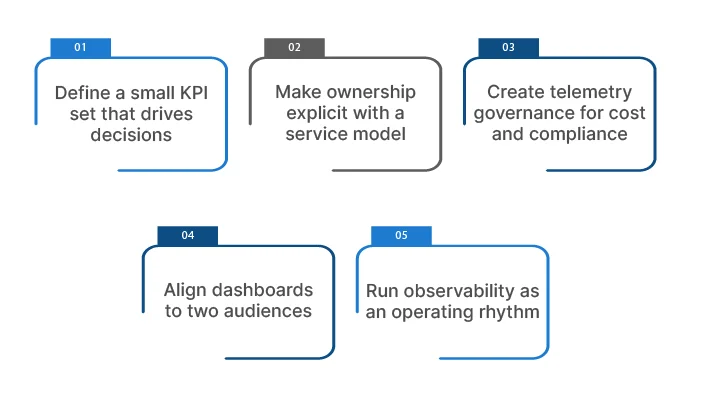
1. Define a small KPI set that drives decisions
Track a focused mix of reliability (SLO attainment, MTTR), change health (release-related incidents), cost efficiency (telemetry cost trend), and business impact (customer experience or revenue exposure). Keep it consistent and reviewed monthly.
2. Make ownership explicit with a service model
Every critical service and pipeline needs an accountable owner, on-call path, and runbook. This is what turns signals into action and enables consistent reporting across teams.
3. Create telemetry governance for cost and compliance
Set standards for what is collected by default, where sampling is required, retention tiers, and access controls. This keeps observability scalable and cost-controlled as adoption grows.
4. Align dashboards to two audiences
Engineering dashboards focus on diagnosis and remediation. Executive dashboards roll up service risk, cost trends, and business impact. Same source of truth, different views.
5. Run observability as an operating rhythm
Establish a monthly KPI review, quarterly governance updates, and post-incident learning loops. This is how observability matures instead of becoming tool sprawl.
Turn Observability into Business Outcomes with TxMinds
TxMinds helps enterprises turn observability into measurable outcomes by improving visibility across applications, infrastructure, and cloud native environments so teams can detect, investigate, and resolve issues faster. Our observability services focus on real-time insights, centralized log analysis, and incident management that reduce downtime and support better reliability and customer experience.
We help establish the operating foundation needed to sustain results at scale, including better alert routing, controlled telemetry collection, and enterprise-grade security controls such as access management, encryption, and compliance support. This closes the gap between technical signals and leadership priorities like operational efficiency, cost control, and business-aligned engineering.
Connect with TxMinds experts to assess your observability maturity, identify improvement opportunities, and build a roadmap that delivers reliable outcomes and long-term value.

VP, Delivery, Digital Engineering
Vivek Gupta is the Vice President of Delivery at Tx with over 25 years of experience driving digital transformation. At Tx, he has built the foundation for DevOps, Digital, and Cloud practices, shaping strategies that empower businesses. Before joining Tx, Vivek held leadership roles at Infosys and Tech Mahindra. His leadership fuels innovation, strengthens delivery excellence, and enhances Tx's global impact. Vivek's commitment to driving change ensures our clients stay ahead in an evolving digital landscape.
FAQs
What is data observability?
Data observability is the practice of monitoring and understanding data health end-to-end across pipelines, transformations, and consumption, so teams can quickly detect issues, find root causes, and protect business outcomes.
What are the latest trends in data observability?
The latest trends in data observability include AI-assisted anomaly detection and triage, cost-aware telemetry and retention controls, standardization via open frameworks and consistent instrumentation, and stronger governance tied to business KPIs.
How is data observability different from traditional monitoring?
Traditional monitoring focuses on system metrics and uptime, while data observability focuses on data reliability signals like freshness, completeness, volume, schema changes, lineage, and the downstream business impact of data issues.
What should leaders prioritize to make data observability effective in 2026?
Leaders should prioritize outcome-driven KPIs (like incident reduction and data SLA/SLO adherence), clear ownership for critical datasets and pipelines, policies for cost and compliance, and tooling consolidation to reduce noise and speed root cause analysis.
Discover more