


Assess Data for Trust, Reuse, and AI-Readiness
We do the comprehensive data evaluation to uncover hidden risks, standardize quality, and validate compliance at the first stage only.
Talk To Our Data ExpertsEnterprise Results - Backed by Assessment
40%
Fewer Data Integration Issues
40%
Fewer Misaligned Data Initiatives
50%
Better Alignment Across Teams
90%
Less Time Spent on Data Validation
What We Do
Turning Data Uncertainty Into an Executable Enterprise Roadmap
We understand that fragmented platforms, unclear ownership, inconsistent metrics, and rising operating costs make it impossible to scale analytics or AI with confidence.
TxMinds delivers enterprise-grade data assessments and replaces assumptions with facts. We evaluate your data estate across platforms, pipelines, governance, and operations to establish a clear baseline of readiness, risk, and cost.

Trusted by Global Clients


 From Al Pilots to Al at Scale:
Engineering the Transition to Operational Al in the Enterprise
Download White Paper

From Al Pilots to Al at Scale:
Engineering the Transition to Operational Al in the Enterprise
Engineering the Transition to Operational Al in the Enterprise
The Challenge
When Data Can’t Be Trusted, Execution Slows and Value Leaks
Low-trust data erodes decision-making, leading to a high degree of dissatisfied customers, and revenue loss for organizations.
Without a clear assessment baseline, enterprises continue investing in analytics and AI initiatives that stall in delivery.
Why Your Data Roadmap Keeps Slipping
-

Conflicting dashboards and metrics stall decisions instead of enabling them
-
Zero observability across legacy pipelines is causing late incident detection
-
Rising cost of cloud modernization while value delivery stalls
-
Governance gaps leave data ownership, controls, and accountability unclear
-
AI initiatives are repeatedly failing due to gaps in data readiness
-
No trusted data source across multiple systems


How TxMinds Makes Data Readiness Measurable
-
Customized data architecture assessment plan based on enterprise-fit
-
Comprehensive data architecture review to assess enterprise fit and identify optimization opportunities for current systems
-
Evaluation of existing data governance policies to determine readiness for scaling AI models and supporting future analytics
-
Assessment of data ownership and semantic structures to ensure alignment between technical teams and business objectives
-
Identifies reliability gaps driving rework, incidents, and delayed adoption
-
Align your data engineering plan with business objectives for measurable outcomes

What We Assess
Delivering Full-Scope Data Assessment Services at Enterprise-Level

Data Inventory
IoT, Sensor Data, Cloud Data platforms, Finance Systems, Data Lakes/Warehouses, and more.
Quality Profiling
Data Completeness, Consistency, Timeliness, Duplication, and Validity.
Architecture Review
Data Pipelines, ELT/ETL, APIs, Dependencies, and Batch vs Real-Time.
Governance & Ownership
RACI, Data Quality Standards, Stewardship Model, and Decision Rights.
Data Security & Privacy
PII Locations, Access Controls (RBAC/ABAC), Encryption, Audits, and logging.
KPIs
Semantic Layer Assessment, KPI Tree, and BI Tools Assessment.
AI Readiness
Training Data Authenticity, Responsible AI Controls, and Data Lineage.
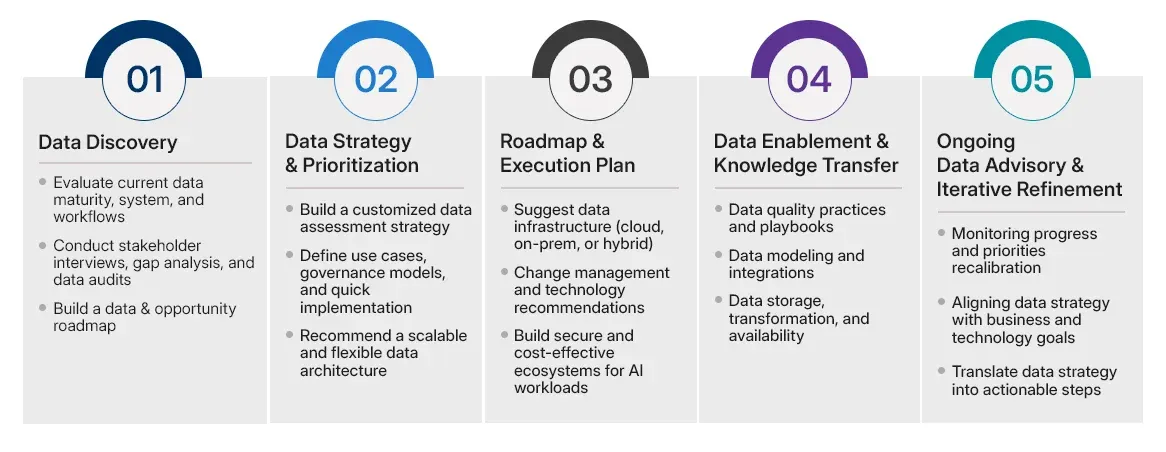
How TxMinds Builds Path from Data Maturity
Let's Engineer What's Next
Review trust gaps across data quality, governance, and KPI alignment
Identify high-risk platforms, pipelines, and reporting dependencies
Receive clear priorities and a structured assessment approach
How Do We Assist
Assessing Data Foundation That Scales AI and Revenue
Data Maturity Assessment
TxMinds delivers a gap-to-roadmap plan and quantitative maturity scoring across capability dimensions by:
- Measuring maturity level
- Identifying ROI gaps
- Uplifting data roadmap
Cloud & Data Platform Strategy
Implement reference architecture, workload placement plan, and performance model for data lakehouse/warehouse to:
- Generate TCO model
- Reduce data latency while modernizing
- Validate migration impact
BI & Analytics Strategy
Our experts deliver semantic layer designs, KPI governance models, and a reporting modernization blueprint to:
- Define the metrics layer
- Standardize data marts
- Enable metric lineage traceability
Data Assessment for AI
We offer an AI readiness assessment and a governed data foundation plan for RAI controls to:
- Enable production-grade RAG
- Implement data access controls and audit logging
- Hallucination checks, bias testing, and acceptance tests
Data Governance Framework
TxMinds’ governance operation model and control mechanism allow you to:
- Set data ownership by domain and implement RACI
- Define retention policy enforcement
- Introduce data contracts (SLA, schema, etc.)
Data Modeling
With domain data models, canonical entities, data contracts, and interoperability standards, we help:
- Improves downstream stability
- Reduce data integration complexities
- Align reusable domain models with BI
What We Deliver
De-Risk AI. Accelerate Delivery. Improve Decisions.

Safer GenAI Adoption
Governed datasets with pre-defined access controls, data lineage, and evaluation readiness.
Optimized Data Reusability
Domain-aligned data products with detailed contracts and ownership.
Faster Time-to-Value
Faster solution delivery with target-state architecture and execution plan.
Data-Driven Decision Making
Eliminate metric conflicts with proper KPI governance and semantic layer.
Governed Foundations
Enforce data consistency with governed operating models, policies, and stewardship.
Risk Management
Embedded data privacy, auditability, security, and compliance measures.
Core Technologies We Use


Insights
FAQs
What does a data assessment include?
TxMinds’ customized data assessment approach includes:
- Data Inventory and Ownership Mapping
- Data Quality Profiling
- Architecture Review
- Governance and Security Assessment
- KPI/Metrics Consistency Check
- AI Readiness Review
- Cost and Performance Analysis
- Prioritized Roadmap with Target-state Architecture and Execution Plan
How to choose a data assessment consulting firm?
Selecting the right data assessment consulting firm involves checking various factors such as:
- Clear Deliverables
- Proven Assessment methods
- Strong Data Governance and Security Expertise
- Experience in your Industry/Domain
- Ability to Convert Strategy into an Execution Backlog
- Measurable Outcomes Proof
What industries can benefit from data assessment consulting?
Any sector with complex data and high decision risk benefits from our data assessment consulting, including
- Banking/FinTech
- Retail/eCommerce
- Healthcare/Life Sciences
- Insurance
- Telecom
- Manufacturing
- Logistics
- SaaS/ISVs
- Energy
How does the TxMinds Data Assessment Service help my business?
We at TxMinds leverage AI-enabled data assessment practices to help you:
- Identify Data gaps, Risks, and Cost Drivers
- Standardize KPI Definitions
- Improve Governance and Security Controls
- Define Target Architecture
- Deliver a Prioritized Roadmap and Execution Plan
×
White Paper